
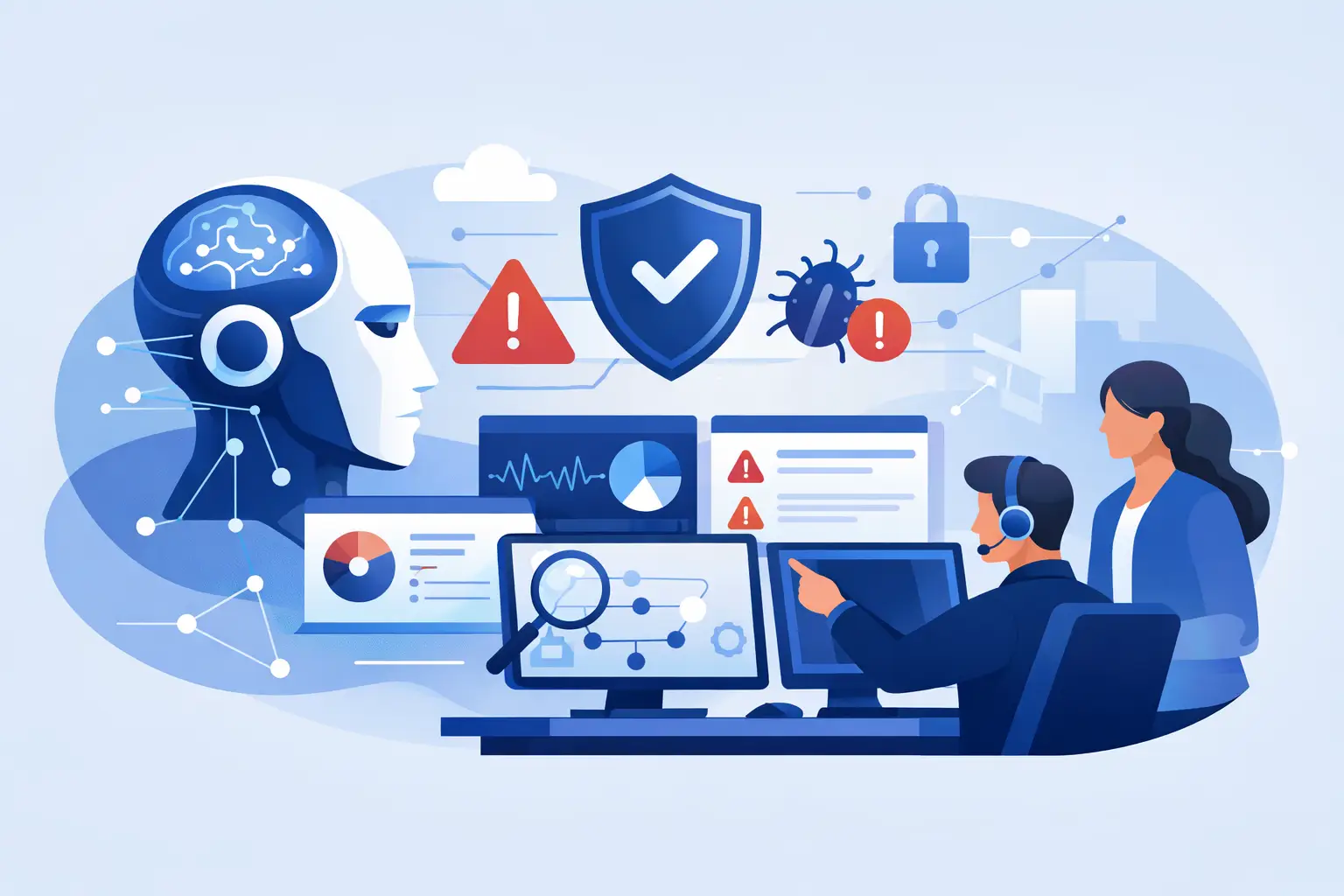
A finance administrator signs in from an unfamiliar location. Minutes later, an endpoint generates a suspicious PowerShell alert, and the firewall records outbound traffic to a newly seen destination. In a fragmented SOC, those events may sit in separate consoles until an analyst has time to connect them. AI for incident triage changes that sequence by assembling the evidence early, identifying what matters, and putting the analyst in a position to act.
The goal is not to replace security judgment with a model score. The goal is to remove the manual collection, sorting, and repetitive enrichment work that turns a potentially serious incident into a long queue of disconnected alerts. For SOC leaders under pressure to improve response without continuously adding headcount, that distinction matters.
Why traditional triage breaks under alert volume
Most security teams do not have a detection problem. They have a context problem. Endpoint, firewall, identity, cloud, email, and network tools all produce useful signals, but each signal arrives with its own severity rating, data format, and investigation path. Analysts spend too much time moving between tools to answer basic questions: Who is affected? Is this behavior expected? What happened before and after the alert? Has the activity spread?
Rule-based correlation can help, but it is often narrow and brittle. It catches known sequences when rules are tuned well, yet it requires ongoing maintenance and can miss attack paths that do not match a predefined pattern. Meanwhile, severity labels from individual tools are not business priorities. A medium endpoint alert involving a privileged account and a critical server may deserve more attention than a high-severity alert on an isolated test device.
This creates the operational failure many teams recognize immediately: the queue is full, analysts are busy, and the highest-risk work is not always first. Delayed triage also creates inconsistent investigations. Two analysts can review similar alerts and reach different conclusions because they started with different data or lacked the same context.
What AI for incident triage should actually do
Effective AI triage works at the incident level, not simply the alert level. It should ingest and correlate telemetry across the environment, group related signals into a coherent case, and present a defensible explanation for why that case deserves attention.
At a practical level, the system should reduce duplicate alerts, identify related entities, enrich events with relevant context, and prioritize cases based on likely impact and confidence. That means connecting an identity event to endpoint activity, cloud access behavior, email delivery data, and network communications when those records point to the same sequence.
The result should be an investigation-ready incident that gives analysts a usable starting point: a timeline, affected users and assets, associated indicators, relevant detections, and a clear priority rationale. AI can also summarize large volumes of event data into plain operational language, helping an analyst orient quickly before validating the evidence.
That last step is critical. A good triage system does not ask analysts to trust a black-box verdict. It shows the signals behind the recommendation. If an incident is elevated because it involves unusual sign-in behavior, credential access activity, and suspicious egress from a high-value asset, the analyst should see that chain immediately.
Prioritization needs asset and identity context
A model cannot prioritize well if it only sees detection metadata. Triage quality improves when the platform understands the business context around an event, including asset criticality, user privileges, known administrative behavior, vulnerability exposure, geographic patterns, and previous related activity.
Consider two alerts for the same command-line behavior. One occurs on a developer workstation during a scheduled software deployment. The other appears on a domain controller after an anomalous identity login. The raw detection may be similar, but the response priority should not be. Context turns technical noise into an operational decision.
This is why organizations should be cautious about adopting AI that sits apart from their core security data. A separate chatbot can help explain an alert, but it cannot reliably triage an incident without a connected view of the telemetry, entity relationships, and analyst workflow.
Where AI delivers the most value in the workflow
The strongest use cases are repetitive, evidence-heavy tasks that slow down skilled analysts. Phishing investigations are a clear example. Instead of manually checking message delivery, sender reputation, user clicks, mailbox rules, endpoint activity, and identity logins, AI can correlate the relevant records into one incident and surface the users or systems at highest risk.
Ransomware triage is another high-value scenario. Early signals may appear unrelated: a suspicious attachment, credential misuse, remote execution, unusual file activity, and lateral movement. Correlation helps identify the pattern before the incident becomes a full-scale outage. It also gives responders a faster path to containment by showing which identities, endpoints, and network connections are involved.
AI is equally useful for cloud and identity-led incidents, where the evidence is often distributed across audit logs, access events, endpoint telemetry, and SaaS activity. A single impossible-travel alert may be benign. The same alert paired with MFA changes, mailbox forwarding rules, data downloads, or privileged role activity is a different operational problem.
For analysts, the benefit is not just fewer alerts. It is fewer empty investigations. When low-value duplicates and clearly benign patterns are reduced, the team can apply its expertise to validating real threats, selecting containment actions, and improving detections.
Keep the analyst in control of response
Automation should become more assertive as confidence and potential impact increase, but fully autonomous response is not right for every environment. Disabling a user account, isolating an endpoint, blocking an IP address, or revoking cloud access can prevent damage. It can also interrupt a critical business process when applied incorrectly.
The right operating model depends on the action and the organization’s tolerance for disruption. Low-risk actions, such as enriching an incident, opening a ticket, collecting endpoint evidence, or suppressing known duplicates, can often run automatically. Higher-impact actions should use approval gates, predefined playbooks, or rules based on asset class and incident confidence.
This approach maintains speed without sacrificing control. It also produces a cleaner audit trail: what the system observed, why it assigned priority, what action was recommended, who approved it, and what occurred next. That record matters to SOC managers measuring performance and to CISOs explaining response decisions to leadership.
How to evaluate an AI triage platform
Do not evaluate AI triage based on a polished interface or generic claims about automation. Test it against your actual alert volume, data sources, and investigation patterns. The question is whether it can reduce time spent assembling context while preserving enough evidence for analysts to make sound decisions.
A useful evaluation should examine four areas:
- Data coverage: Can the platform correlate the tools that matter in your environment, including endpoint, firewall, cloud, identity, and email telemetry?
- Incident quality: Does it group related signals accurately, reduce duplicates, and explain why a case is prioritized?
- Workflow control: Can analysts investigate, document, assign, escalate, and trigger response actions from one workspace?
- Measurable outcomes: Can the team demonstrate lower alert volume, faster time to triage, shorter investigation cycles, and improved containment speed?
It also helps to test difficult cases, not only obvious malware alerts. Use scenarios involving compromised credentials, living-off-the-land behavior, business email compromise, lateral movement, and data exfiltration. These are the incidents where disconnected tooling creates the most analyst friction and where correlation delivers the clearest operational value.
Deployment model matters as well. A mature internal SOC may want direct control over triage policies and playbooks. A lean team may need 24/7 analyst coverage alongside the technology. A unified platform such as Helxon VORXOC can support either model by bringing telemetry, incident context, analyst workflow, and response coordination into the same operating layer.
Build for better decisions, not bigger queues
AI triage does not eliminate the need for experienced security analysts. It makes their experience available where it has the greatest impact. Analysts should spend less time searching across consoles and more time validating attack paths, containing threats, and improving the controls that prevent recurrence.
The practical measure of success is simple: when a serious signal appears, can the SOC quickly understand what happened, who and what is affected, how far the activity has spread, and what response should occur next? Teams that can answer those questions from one coherent incident workflow will move faster than teams still trying to reconstruct the story alert by alert.