
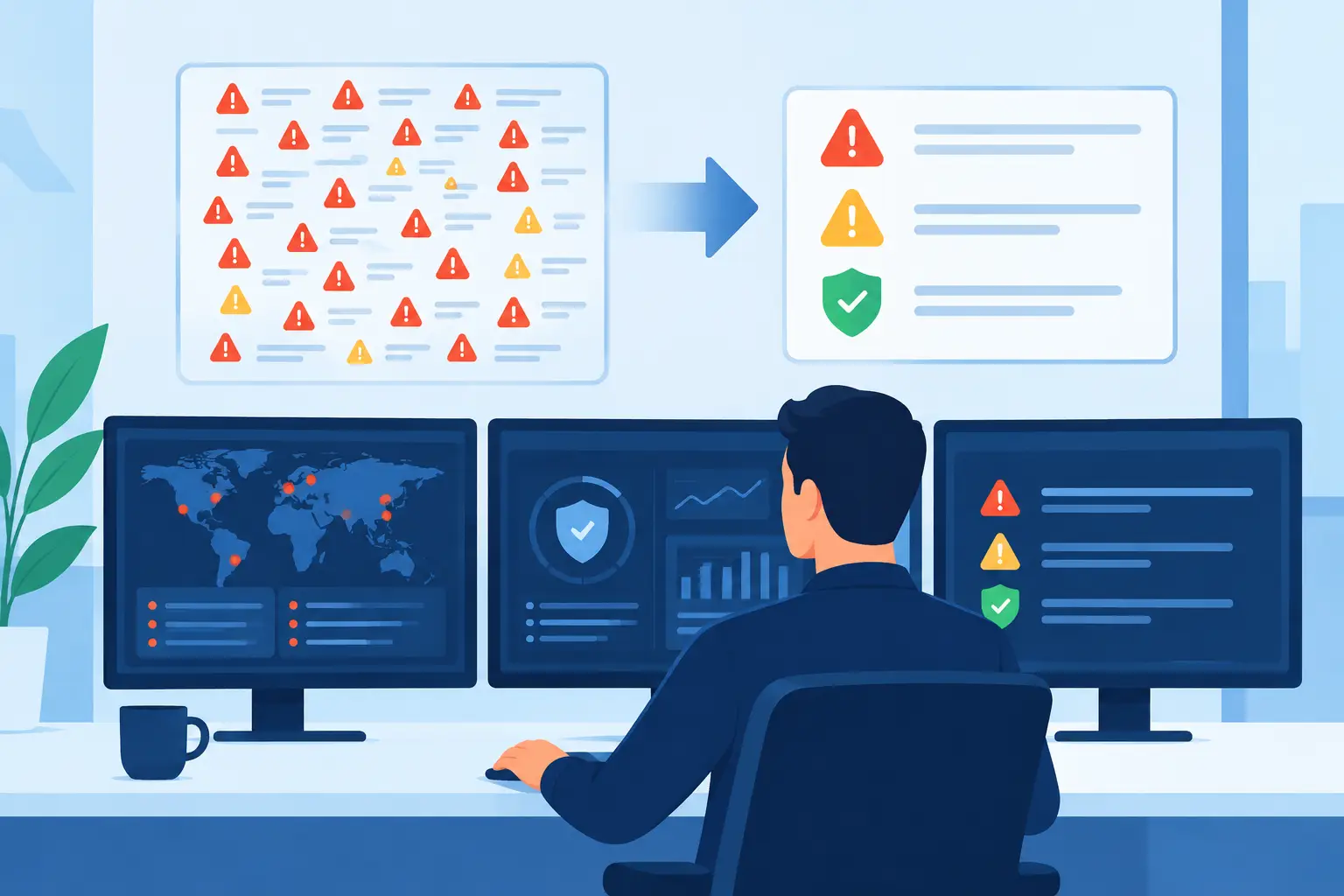
At 2:13 a.m., an analyst should not have to pivot between an endpoint console, firewall logs, identity events, and email telemetry to decide whether one alert matters. Yet that is the daily reality in many SOCs. The most effective alert fatigue reduction examples do not simply suppress more notifications. They give analysts enough context to make faster, defensible decisions while preserving the detections that expose real threats.
Alert fatigue is an operational failure, not an analyst performance problem. When high-volume, low-context alerts fill the queue, analysts spend their shift validating isolated signals, repeating the same enrichment steps, and escalating incidents without a complete story. Detection quality drops, response times rise, and experienced staff burn out. The fix is to redesign how alerts are correlated, prioritized, investigated, and closed.
8 Alert Fatigue Reduction Examples That Work
1. Correlate related alerts into one incident
A single compromised account can generate impossible-travel alerts, failed MFA events, mailbox-rule changes, unusual endpoint activity, and cloud access anomalies. If each signal arrives as a separate ticket, the SOC may treat one intrusion as five unrelated investigations.
Correlating events by user, device, IP address, process, time window, and technique changes that workflow. The analyst receives one incident with a timeline, affected assets, and supporting evidence. This reduces duplicate casework and improves judgment because the full attack path is visible from the start.
Correlation must be tuned carefully. Rules that join events too broadly can hide separate incidents inside one case. Start with high-confidence relationships, such as a login from a new country followed by a suspicious OAuth consent grant from the same user, then expand based on analyst feedback.
2. Prioritize by risk, not vendor severity
A firewall may label an event high severity because it matches a known exploit attempt. That does not automatically make it the SOC's most urgent work. The destination may be a patched, isolated test system, while a medium-severity identity alert could involve a privileged administrator accessing sensitive cloud data from an unmanaged device.
Risk-based prioritization combines alert confidence with business context. Useful inputs include asset criticality, user privilege, exposure to the internet, vulnerability status, known threat activity, and the presence of related events. This lets the queue reflect likely impact rather than the severity label produced by an individual tool.
The operational benefit is clear: analysts work the incidents with the greatest potential consequence first. CISOs also gain a more credible explanation of why the team focused on one event over another.
3. Suppress known-good activity with expiration dates
Routine administrative actions often resemble suspicious behavior. Scheduled vulnerability scans trigger port-scan detections. Backup accounts generate unusual service logins. IT teams perform bulk changes that look like privilege escalation or mass file activity.
A mature SOC suppresses these patterns only when there is documented evidence that they are expected. Each suppression should identify the owner, systems, detection logic affected, business reason, approval date, and expiration date. Expiration matters because environments change, accounts are repurposed, and a formerly safe pattern can become dangerous.
Avoid broad exclusions such as ignoring all activity from an internal subnet or suppressing every alert from a service account. Attackers frequently abuse trusted infrastructure and nonhuman identities. Narrow suppressions reduce noise without creating blind spots.
4. Enrich alerts before they enter the analyst queue
Analysts lose time when basic facts are missing. An alert that says a PowerShell command ran is not enough. The analyst needs the command line, parent process, signed status, user, host role, recent network connections, prevalence across the environment, and any related detections.
Automatic enrichment turns an alert into an investigation-ready record. It can add identity details, asset ownership, vulnerability data, geolocation, domain reputation, process lineage, and relevant historical activity. The goal is not to attach every available data point. It is to surface the evidence that changes a decision.
For example, a suspicious login becomes much easier to assess when the queue shows that the user is an executive, the device is unmanaged, MFA was bypassed through a legacy protocol, and a mailbox forwarding rule appeared six minutes later. Context raises signal quality without requiring analysts to manually hunt through disconnected consoles.
5. Automate repeatable triage, not high-impact judgment
Some investigations follow a stable, low-risk pattern. A known phishing attachment can be detonated, hashed, searched across endpoints, and checked against email recipients automatically. A newly observed domain can be enriched with reputation, DNS history, and proxy activity before an analyst sees it.
These are strong automation candidates because they remove repetitive clicks and deliver a consistent evidence package. Automation should not automatically disable an executive account, isolate a production server, or delete cloud resources without safeguards. The right action depends on business criticality, confidence level, and the potential cost of disruption.
Use human approval for consequential containment actions, particularly during early deployment. As confidence grows, allow preapproved actions for specific conditions, such as quarantining a clearly malicious email or blocking a confirmed command-and-control domain. Automation should compress investigation time, not create uncontrolled response risk.
6. Tune detections using closure reasons
Closed alerts are a source of operational intelligence. If analysts repeatedly close a rule as expected administrative activity, duplicate telemetry, benign software behavior, or insufficient evidence, that pattern should drive tuning work.
Require meaningful closure reasons rather than a generic “false positive” label. Then review them on a regular cadence with detection engineers and SOC leadership. A rule producing many benign closures may need a threshold change, an additional condition, better enrichment, or retirement. A rule closed as “insufficient context” may indicate an integration gap rather than a bad detection.
This creates a feedback loop between the people receiving alerts and the people building detections. Without it, the SOC treats noise as a permanent condition and asks analysts to absorb the cost indefinitely.
7. Deduplicate across overlapping security tools
Hybrid environments commonly have overlapping coverage. Endpoint protection, identity monitoring, email security, cloud platforms, and network tools can all flag the same phishing-led credential theft sequence. Tool-by-tool queues turn that overlap into alert volume.
Deduplication identifies when multiple products are reporting the same underlying behavior and preserves the strongest evidence in a single incident. The source events should remain accessible for audit and investigation, but analysts should not have to close five tickets to resolve one attack.
This approach also exposes stack sprawl. If several products repeatedly generate the same low-value alert, security leaders can assess whether the coverage is genuinely complementary or simply adding operational overhead.
8. Measure queue health alongside detection volume
Alert counts alone are misleading. A reduction in alerts may reflect better correlation and tuning, or it may mean valuable detections were turned off. Track outcomes that show whether the SOC is becoming more effective: mean time to acknowledge, mean time to investigate, escalation rate, reopened cases, analyst touches per incident, time spent on benign alerts, and the percentage of incidents with complete context.
Review these measures by detection source and use case. A ransomware workflow may deserve aggressive sensitivity and rapid escalation, even if it creates more review work. A low-confidence reconnaissance detection may need stronger filtering. There is no universal target for alert volume. The right target is a queue where analysts can investigate meaningful activity within the response commitments the business expects.
Put the Examples Into an Operating Model
The fastest path is rarely a large, one-time tuning project. Begin with one high-volume use case, such as phishing, impossible travel, or endpoint malware. Map the current workflow from alert creation to closure. Identify where analysts repeat work, where context is missing, and where separate tools create duplicate cases. Then apply correlation, enrichment, and automation in that sequence.
Give the effort a clear owner and review the impact weekly. If a change lowers queue volume but raises reopened cases or misses confirmed threats, reverse it. If it reduces analyst touches while maintaining detection coverage, extend the pattern to the next use case.
A unified analyst workspace makes this model easier to sustain because telemetry, case management, enrichment, and response actions operate from the same incident record. Platforms such as Helxon's VORXOC are designed around that practical outcome: fewer disconnected investigations and faster decisions backed by context.
The best SOCs do not aim for silence. They build a queue that speaks clearly enough for analysts to act with speed, control, and confidence when the next real incident arrives.