
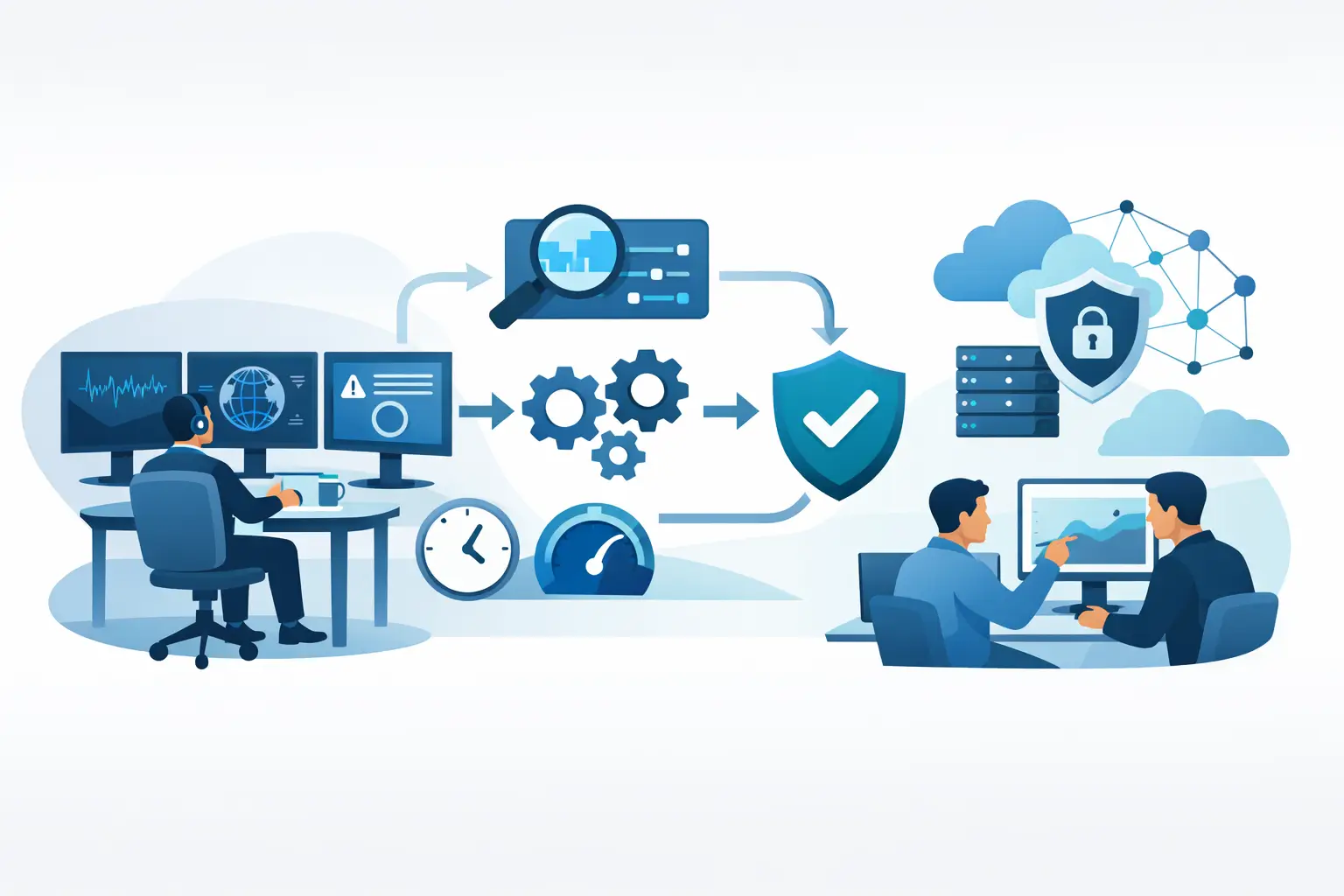
A ransomware alert should not force an analyst to open six consoles, reconstruct a user’s identity history by hand, and ask three teams for context before deciding whether to contain a device. Yet that is still the daily reality in many security operations centers. This analyst workflow optimization guide focuses on fixing the operational friction that slows detection and response: disconnected telemetry, noisy queues, incomplete context, and processes that depend too heavily on individual analyst memory.
The goal is not to automate every security decision. The goal is to ensure analysts spend their time making the decisions that require judgment, while the platform handles correlation, enrichment, prioritization, and repeatable response actions. Done well, workflow optimization reduces alert fatigue, shortens time to investigate, and gives security leaders clearer evidence of what their SOC is actually accomplishing.
Start With the Work, Not the Tools
Most SOC modernization projects begin with a technology inventory. That is useful, but it can hide the more urgent question: where does work stall? An analyst may have endpoint detection, firewall logs, cloud telemetry, identity data, email security, a SIEM, a SOAR tool, and ticketing software. The issue is rarely a total absence of data. It is the time required to turn that data into a defensible decision.
Map a typical incident from initial alert to closure. Measure how long it takes to validate the alert, identify the affected user and assets, determine scope, obtain containment approval, execute response, and document the outcome. The longest delays often occur at handoffs and pivots between tools, not during the initial detection itself.
A useful workflow map exposes repeated analyst behavior. If every suspicious sign-in investigation requires a manual identity lookup, endpoint review, mailbox check, and IP reputation search, those steps should appear together in one incident view. If an analyst repeatedly copies the same evidence into a ticket, the reporting process needs to change. Optimization begins when recurring work becomes visible enough to redesign.
Build a Unified Incident Record
Alert queues are not incident workflows. A queue tells analysts that something happened. An incident record should explain why it matters, what is affected, what related activity occurred, and which action is appropriate.
A unified record correlates telemetry across the environments where attacks actually unfold: endpoint, firewall, cloud, identity, email, and network activity. Consider a phishing case. An email gateway event alone may look routine. Add a successful click, an impossible-travel sign-in, new inbox rules, and unusual cloud downloads, and the priority changes immediately. Analysts should not need to discover those connections one console at a time.
Context must be both broad and usable. Giving an analyst every raw log line can create a new form of noise. The incident workspace should surface the evidence that supports the detection, show a clear event timeline, identify affected entities, and retain a path to deeper telemetry when needed. The right level of detail depends on the use case. A high-confidence ransomware sequence may justify immediate containment, while an anomalous login may require more identity and device context before action.
This approach also improves shift handoffs. A well-structured incident makes the current state visible: what was observed, what was validated, what actions were taken, and what remains open. The next analyst should continue the investigation, not restart it.
Use Risk-Based Prioritization to Reduce Alert Fatigue
Severity labels alone do not create priorities. Many tools mark alerts as high because the detection rule is inherently sensitive, even when the affected asset is low value or the behavior has an obvious benign explanation. The result is a high-priority queue that cannot be treated as high priority.
Prioritization should combine detection confidence with business and environmental context. A suspicious PowerShell execution on a privileged administrator’s workstation carries a different operational risk than the same command on a test device. A cloud login from an unfamiliar location becomes more urgent if it is followed by privilege changes, access to sensitive data, or a new OAuth application consent.
Effective prioritization considers factors such as asset criticality, user privilege, known vulnerabilities, attack progression, behavioral anomalies, and corroborating signals from multiple sources. It should also account for suppression rules and approved business activity. A SOC that cannot distinguish between expected administrative automation and lateral movement will either miss threats or exhaust its analysts.
Treat tuning as a continuous operational function, not a one-time deployment task. Review alerts that repeatedly close as benign, identify the missing context that would have improved the decision, and adjust logic carefully. Aggressive suppression can lower the queue quickly but create blind spots. The better outcome is fewer alerts with stronger evidence and clearer reasons for escalation.
Analyst Workflow Optimization Guide: Automate the Repeatable Steps
Automation is most valuable when it removes predictable effort from frequent investigations. It is less valuable when it attempts to replace human judgment in ambiguous, high-impact cases.
Start with enrichment. When an incident opens, the system can gather endpoint ownership, user role, recent authentication activity, asset exposure, threat intelligence, related alerts, and similar historical cases. This does not close the incident automatically. It gives the analyst a usable starting point in seconds rather than minutes.
Next, automate response actions with defined guardrails. Disabling a user account, isolating an endpoint, blocking a malicious domain, revoking active sessions, or removing a suspicious inbox rule can be appropriate when detection confidence and impact thresholds are met. For more disruptive actions, require analyst approval. A mature workflow supports both models instead of forcing a choice between entirely manual response and uncontrolled automation.
Response playbooks should reflect specific attack paths. A phishing playbook needs different evidence and actions than a suspected data exfiltration case. Ransomware workflows should prioritize containment and lateral-movement scoping. Identity compromise workflows should focus on session revocation, credential reset, privilege review, and persistence checks. Generic playbooks often look complete on paper but fail to guide fast decisions under pressure.
Design for Exceptions and Escalations
No workflow will cover every event. The test is whether it handles exceptions without creating confusion. Analysts need clear escalation criteria, especially when an investigation crosses team boundaries.
Define when an incident moves to endpoint engineering, cloud operations, legal, human resources, or executive leadership. The trigger should be based on evidence and impact, not simply the alert source. For example, suspected employee data access may require a different escalation path from external credential stuffing, even if both begin as identity alerts.
Each escalation should preserve the incident narrative. Include the affected entities, observed behavior, confidence level, business impact, actions already taken, and the decision needed from the receiving team. This is not administrative overhead. It prevents delays caused by incomplete requests and ensures containment actions are defensible later.
Managed coverage can also be part of the design. Lean teams may retain ownership of policy and final business decisions while using 24/7 SOC analysts for monitoring, validation, and initial response. More mature internal teams may prefer direct operational control with support for after-hours coverage. The right model depends on staffing, regulatory obligations, incident volume, and the organization’s tolerance for response delays.
Measure the Friction That Still Exists
A SOC cannot optimize what it only measures at a high level. Mean time to detect and mean time to respond matter, but they do not explain why work takes longer than it should. Add operational measures that reveal the underlying friction.
Track the average number of tool pivots per incident, time spent waiting for context, percentage of alerts closed without analyst escalation, repeat false-positive patterns, and the time from containment decision to action completion. Review the portion of incidents that arrive with complete asset and identity context. If analysts still need to hunt for basic facts, the workflow is not yet unified.
Leadership reporting should connect these measures to risk and capacity. Reducing the alert queue is meaningful only if detection coverage remains strong. Increasing automatic containment is meaningful only if false containment remains acceptably low. The most credible program shows how workflow changes improve both analyst capacity and the organization’s ability to limit attack impact.
Make Optimization an Operating Discipline
Workflow improvement is not a platform switch or a quarterly tuning project. It is a regular review of where analysts lose time, where detections lack context, and where response requires too many manual handoffs. A unified SOC platform such as Helxon VORXOC can consolidate the telemetry and incident workflow needed to make those improvements practical, but operating discipline determines whether the gains last.
Choose one high-volume investigation type this month, such as suspicious sign-ins or phishing. Trace the analyst’s actual path, remove one unnecessary pivot, add the missing context, and define a safe response action. Small, evidence-based improvements compound quickly. The SOC becomes faster not because analysts work harder, but because the workflow finally works with them.