
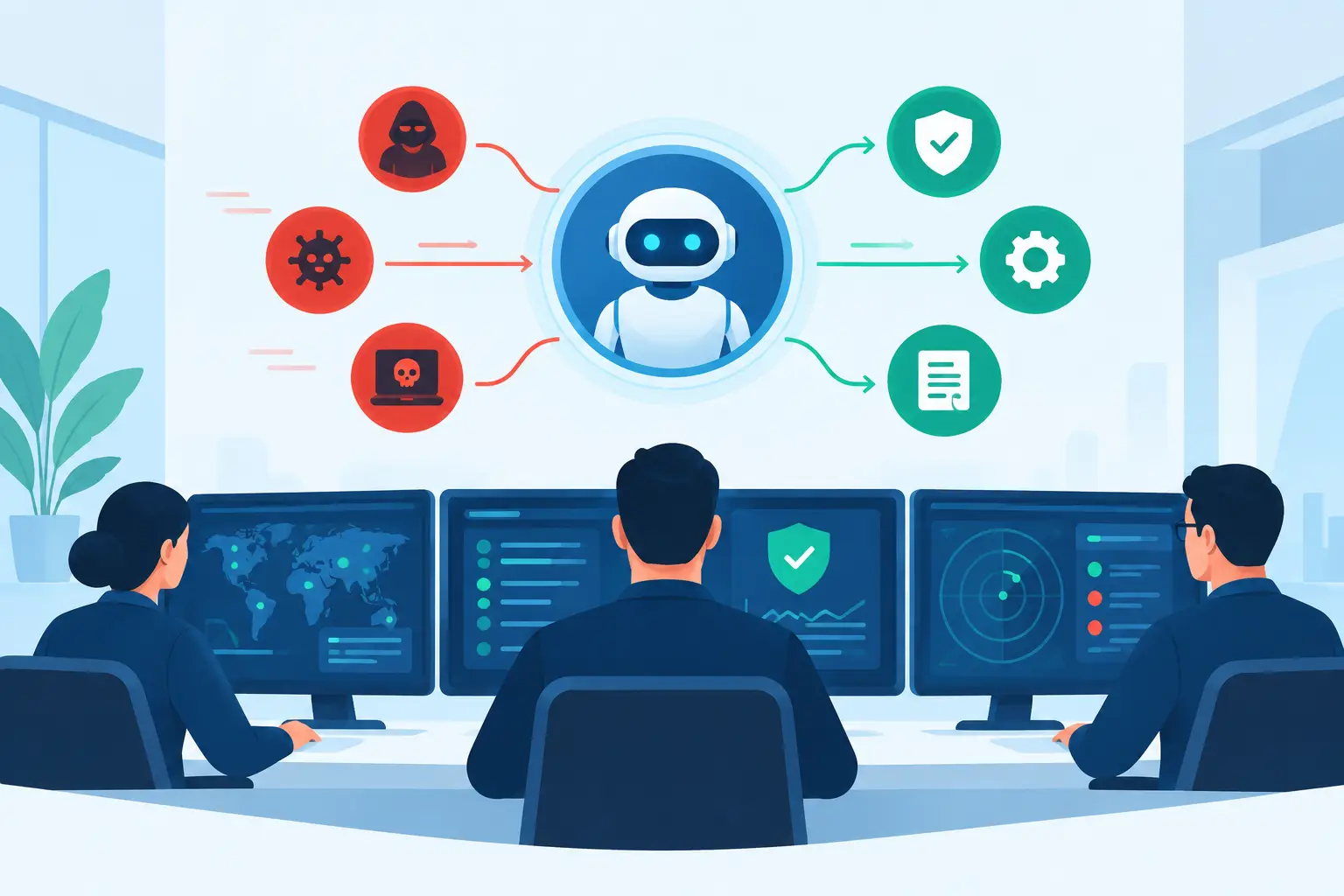
A ransomware alert should not force an analyst to open six consoles, reconstruct a timeline by hand, and guess whether an affected user still has active sessions. An autonomous SOC changes that operating model. It brings telemetry, investigation context, and response actions into a connected workflow so security teams can move from a signal to a defensible decision without losing hours to tool switching.
The objective is not to remove analysts from security operations. It is to remove the repetitive work that prevents them from applying judgment where it matters. For organizations dealing with high alert volume, hybrid infrastructure, and limited staffing, that distinction determines whether automation improves security or simply accelerates confusion.
What an Autonomous SOC Actually Means
An autonomous SOC is a security operations model in which AI and automation continuously collect, correlate, prioritize, investigate, and, within defined guardrails, respond to security events. It connects signals from endpoint tools, firewalls, cloud services, identity systems, email platforms, and other sources into a single incident workflow.
Traditional SOC stacks often divide those tasks across a SIEM, a SOAR platform, endpoint consoles, ticketing systems, and spreadsheets. Each tool may perform well on its own, but the analyst remains responsible for carrying context between them. That fragmentation creates slow investigations, inconsistent decisions, and alert fatigue.
Autonomy addresses the operational gaps between detection and action. A capable platform can identify that an impossible-travel identity event, a suspicious mailbox rule, and a new endpoint process belong to the same incident. It can enrich the case with asset criticality, user history, threat intelligence, and related activity before an analyst begins review.
That is materially different from basic automation. A rule that sends an alert to a queue is automation. A system that builds a cross-domain incident narrative, determines likely scope, recommends containment, and executes approved actions is moving toward autonomous operations.
Autonomy Must Be Designed Around Control
The term autonomous can create the wrong expectation: a SOC that acts without oversight. That is neither realistic nor desirable for many environments. Security response carries business consequences. Disabling an executive account, isolating a production server, or blocking a cloud workload can interrupt critical operations.
The right model uses graduated autonomy. Low-risk, high-confidence actions can run automatically. For example, a platform may enrich an alert, suppress a known benign pattern, quarantine a clearly malicious email, or revoke a suspicious session based on approved policy. Higher-impact actions should require analyst approval, escalation, or a predefined playbook tied to system criticality.
This approach gives teams speed without giving up accountability. It also creates an auditable record of what the platform observed, why it assigned severity, which actions it recommended, and what response was taken. CISOs need that record for governance. Analysts need it to validate outcomes and improve detection logic over time.
Confidence Is Not a Substitute for Context
AI can score events, summarize evidence, and recognize behavior patterns at a scale that manual triage cannot match. But confidence scores alone do not make a decision safe. A high-confidence detection against a test tenant should not receive the same treatment as an equivalent event against a production identity provider.
A practical autonomous SOC incorporates business context: asset ownership, environment classification, privileged access, known maintenance windows, prior incident history, and established response policy. The more accurately the platform understands the environment, the more reliably it can distinguish an urgent incident from operational noise.
The Workflow That Makes Autonomy Useful
Security teams do not benefit from an AI layer that generates more summaries while leaving the workflow unchanged. The value comes from compressing the path from raw telemetry to containment.
A productive workflow starts with normalized data collection. The platform ingests relevant security telemetry across endpoint, network, cloud, identity, and email environments. It does not require every data source to be perfect on day one, but the highest-value integrations should be prioritized based on likely attack paths and response needs.
Next, correlation turns separate alerts into an incident. Instead of creating five tickets for a phishing campaign, suspicious sign-in, endpoint execution, lateral movement attempt, and data access event, the system should connect evidence by user, device, IP address, process, time window, and behavior. The analyst receives one case with a timeline and an explanation of what happened.
Then comes autonomous investigation. The platform gathers missing context, checks reputation and prior activity, identifies related entities, and evaluates blast radius. It should answer operational questions quickly: Which accounts are affected? Did the process execute elsewhere? Is the host communicating with known malicious infrastructure? Has data left the environment?
Finally, response must be available from the same workspace. If investigation happens in one product and containment requires three others, response time remains constrained by manual handoffs. A unified platform should allow analysts to isolate an endpoint, disable a user, revoke sessions, block an indicator, or trigger a managed escalation with clear approval controls.
High-Value Use Cases for an Autonomous SOC
The best use cases are not necessarily the most exotic. They are the recurring incidents where teams already know the right first steps but cannot execute them consistently at speed.
Phishing and business email compromise are strong examples. An autonomous SOC can connect a malicious email to click activity, identity anomalies, inbox rules, and endpoint behavior. It can remove matching messages, flag exposed recipients, revoke active sessions, and present analysts with the evidence needed to determine whether credential theft progressed.
Ransomware defense benefits from cross-domain correlation. A single endpoint alert may be ambiguous. The risk changes when the same device shows unusual privilege use, remote execution, suspicious file encryption behavior, and rapid connections to shared resources. Fast correlation enables containment before the event becomes an enterprise-wide recovery effort.
Lateral movement requires the same connected view. Attackers often exploit valid credentials and normal administration tools, making individual signals easy to dismiss. By correlating identity activity, remote access patterns, endpoint processes, and network behavior, the SOC can identify movement that appears legitimate in isolation but dangerous as a sequence.
Data exfiltration is another practical target. A platform can compare unusual cloud downloads, external sharing, large outbound transfers, and risky authentication events against expected behavior. The response may require caution, especially when sensitive business workflows are involved, but the investigation should not begin from a blank page.
Measuring Whether the Operating Model Is Working
Autonomy should be evaluated as an operations improvement, not as a feature checklist. Start with time to acknowledge, time to investigate, time to contain, alert-to-incident conversion rates, and the percentage of alerts closed as benign. These metrics expose where analyst capacity is being consumed.
Also measure workflow quality. How often does an incident arrive with complete entity context? How many tools does an analyst need to open before taking action? How many response actions can be completed from the incident workspace? A lower alert count is useful only if the remaining alerts are better prioritized and easier to resolve.
For leadership, the clearest outcome is controlled efficiency. A mature autonomous SOC enables the same team to handle more relevant incidents, improve 24/7 coverage, and produce stronger evidence of response performance without treating headcount growth as the only answer to risk.
Choosing the Right Deployment Model
Some organizations want their internal SOC to operate the platform directly. Others need managed analyst coverage because they do not have the staffing or round-the-clock capacity to investigate incidents quickly. Both models can benefit from the same unified workflow, provided responsibilities are explicit.
A self-managed team should retain control over policies, response thresholds, and business-specific escalation paths. A managed service should define who owns triage, who can authorize containment, how communications occur, and what response actions are preapproved. Ambiguity during an incident is a preventable failure.
Helxon approaches this choice through a unified VORXOC platform that supports both internal security operations and SOC as a Service. The key benefit is consistency: the workflow, incident context, and reporting do not have to change simply because an organization adjusts its operating model.
Start With the Work That Slows Your SOC Down
An autonomous SOC should not begin as a wholesale replacement project driven by a broad promise of AI. Begin with the incidents that create the most repetitive analyst work, the telemetry sources that are hardest to connect, and the response actions that are well understood but too slow.
Once those workflows are centralized, measured, and governed, teams can expand autonomy with confidence. The goal is straightforward: give analysts fewer disconnected alerts, more complete incident context, and a faster path to the actions that protect the business.