
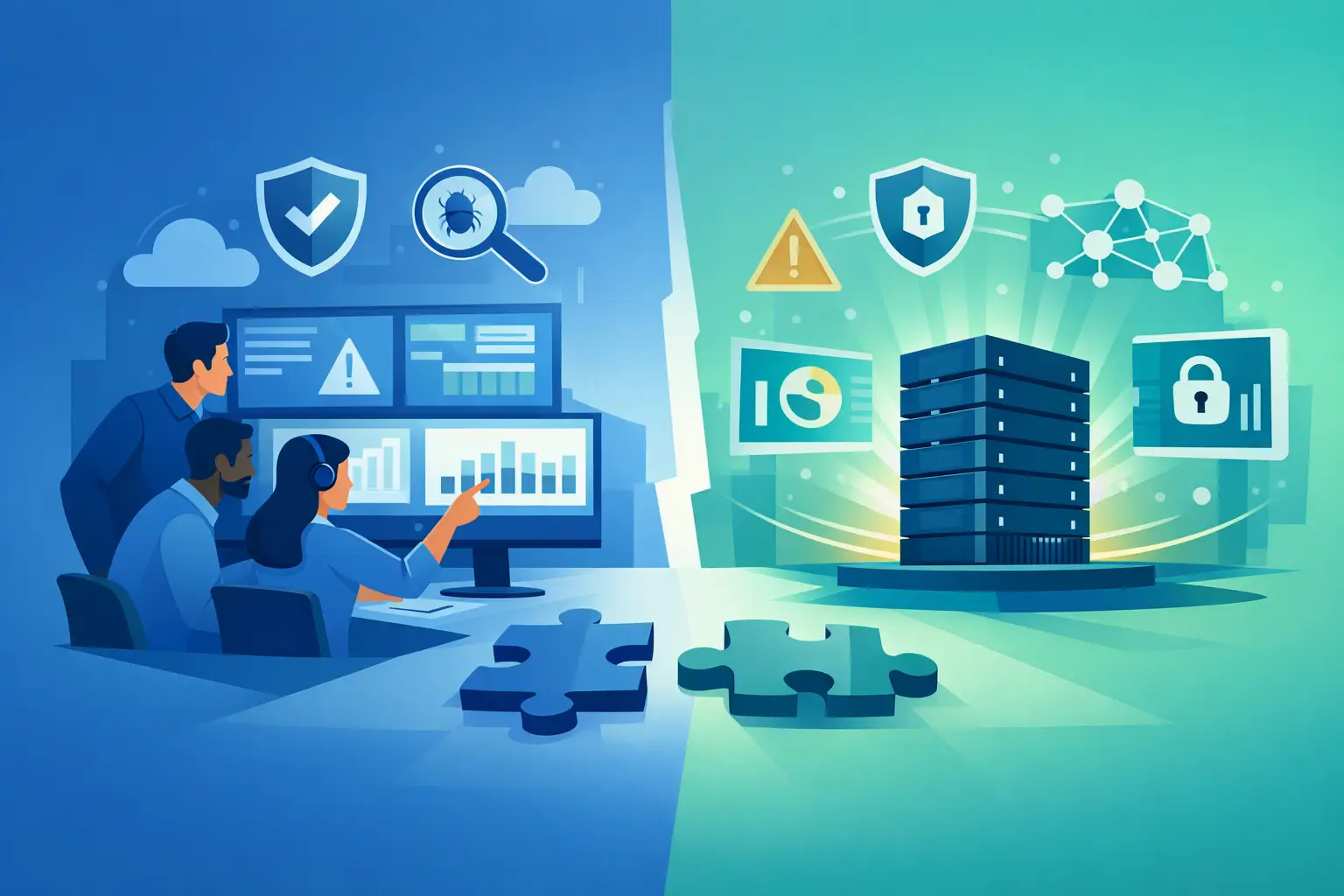
A security team can investigate alerts, contain threats, and improve detection coverage. It cannot, by itself, replace the data collection, correlation, search, retention, and evidence capabilities historically associated with a SIEM. That distinction matters when leaders ask, "can SOC teams replace SIEM?" What they usually mean is whether a modern SOC operating model can eliminate the cost and friction of a traditional SIEM stack.
For many organizations, the answer is yes - but only when they replace the SIEM's necessary functions with a better operational system. Removing a SIEM without preserving visibility, investigative context, and audit-ready records does not modernize the SOC. It creates blind spots.
The real issue is not people versus platforms
Traditional SIEM programs were built around a simple premise: collect as much log data as possible, normalize it, retain it, and search it when something goes wrong. Over time, that model became expensive and difficult to operate. Teams paid to ingest massive volumes of low-value telemetry, wrote detections across disconnected data sources, and then pushed alerts into separate case management and automation tools.
The result is familiar to most SOC managers: noisy queues, shallow investigations, escalating storage bills, and analysts moving between consoles to establish what happened. Adding more analysts may help clear the queue temporarily, but it does not resolve the architecture that creates the queue.
A capable SOC team should not be treated as a substitute for security telemetry. Analysts need evidence. They need endpoint activity, identity events, firewall records, cloud signals, email telemetry, and relevant business context. The better question is whether the organization still needs a conventional SIEM as the central system for handling that information.
When a modern SOC can replace a traditional SIEM
A modern SOC platform can take the place of a traditional SIEM when it provides the operational capabilities the SIEM was supposed to support, without forcing teams into an ingestion-first model. That means correlating meaningful telemetry across the security environment, prioritizing activity into incidents, preserving the underlying evidence, and giving analysts one workflow for investigation and response.
This model works especially well for organizations with hybrid environments and several security products already in place. The goal is not to centralize every possible log line. It is to centralize the signals required to detect, investigate, contain, and report on real threats.
Consider a ransomware investigation. A SIEM may show suspicious authentication events, endpoint alerts, and network anomalies as separate records. An analyst still has to connect them manually, decide whether they are related, check the affected user and assets, and initiate containment through other tools.
A modern SOC workflow should do more. It should correlate the impossible-travel sign-in, endpoint execution behavior, privilege changes, lateral movement indicators, and firewall connections into a single incident. The analyst should see the timeline, impacted entities, severity, recommended actions, and response status in one place. That is not merely better visualization. It changes the amount of analyst time required to reach a defensible decision.
Capabilities that cannot disappear
Replacing a traditional SIEM does not mean abandoning its core security outcomes. Before retiring or reducing SIEM use, security leaders should confirm that the replacement model covers four practical areas:
- Relevant telemetry collection: The SOC needs reliable access to the security data that supports detection and investigation across endpoint, identity, cloud, email, network, and firewall controls.
- Cross-domain correlation: Signals must be connected across tools and assets. A high-confidence incident is more valuable than a large collection of isolated alerts.
- Search, evidence, and retention: Analysts, auditors, and incident responders need access to historical evidence for investigations, compliance obligations, and post-incident review.
- Response orchestration and case ownership: The team needs a clear method to assign, document, escalate, contain, and close incidents without relying on spreadsheets and disconnected ticket queues.
If any of these capabilities is missing, the organization has not replaced the SIEM. It has shifted responsibility back to analysts.
Why alert fatigue is the decision point
Most SIEM replacement conversations begin with cost. Cost matters, particularly when ingestion pricing encourages teams to limit the data they collect or retain. But alert fatigue is often the more urgent operational problem.
When an analyst receives dozens of alerts related to the same event, response time stretches. Context gets lost between tools. Lower-priority incidents receive less scrutiny because the team is focused on clearing volume. That is where missed threats happen.
The right platform reduces alert fatigue by grouping related telemetry into incidents and suppressing duplicative or low-value noise. It should enrich the incident with asset criticality, user context, threat intelligence, prior activity, and an understandable event sequence. This lets analysts spend their time validating risk and taking action, rather than performing manual data assembly.
For leadership, the payoff is measurable. Fewer fragmented alerts can mean lower mean time to investigate, faster containment, more consistent escalation, and less pressure to add headcount simply to maintain coverage. The operating model becomes easier to explain in board reporting because metrics reflect incidents handled and outcomes achieved, not raw log volume.
The cases where keeping a SIEM still makes sense
Not every organization should fully retire its SIEM. Some environments have long-term regulatory retention requirements, highly specialized forensic needs, or large internal detection engineering teams that depend on broad raw-log access. Others have invested heavily in custom rules, integrations, and data pipelines that cannot be moved quickly without operational risk.
In these cases, a phased model is often the smarter choice. Keep the SIEM as a targeted log repository or specialist analytics layer while moving frontline triage, correlation, case management, and response into a unified SOC platform. This immediately reduces console switching and improves analyst efficiency without demanding a disruptive migration.
A SIEM can also remain useful when teams need to support unusual data sources that are not yet available through their primary security controls. The key is to prevent it from becoming the default workspace for every analyst and every event. Use it where its deep search and retention functions are genuinely required, not because the SOC has no better workflow.
What to evaluate before replacing SIEM functions
A replacement decision should begin with the incidents the SOC handles most often, not a feature checklist. Map how your team detects and responds to phishing, ransomware, compromised identities, lateral movement, and data exfiltration. Then identify every console, handoff, and manual lookup required to close those incidents.
If the current process requires an analyst to pivot from a SIEM to an endpoint console, then to an identity provider, then to a ticketing tool, the problem is not a lack of data. It is a lack of operational integration.
Ask whether the new operating model can correlate those signals automatically, preserve the source evidence, and trigger or guide containment actions. Also validate how it handles role-based access, investigation notes, reporting, retention, and integrations with the controls your team already trusts. A platform that only improves the alert screen is not enough.
Deployment model matters as well. A mature internal SOC may want direct ownership of detections and response workflows. A lean team may need 24/7 analyst coverage with clear escalation paths and shared visibility into every decision. Both models require the same foundation: one coherent workspace where telemetry becomes actionable incidents.
Platforms such as Helxon's VORXOC are designed around this operating reality, connecting security telemetry and response work into a single analyst workflow rather than treating correlation, automation, and case handling as separate products.
Replace the operating gap, not just the tool
The strongest SIEM replacement projects do not begin with a mandate to remove a product. They begin with a decision to eliminate wasted analyst effort. That means reducing duplicate alerts, connecting evidence automatically, making response actions easier to execute, and retaining the visibility required for accountability.
SOC teams are the decision-makers and responders. They should not be forced to serve as the integration layer between disconnected security tools. Give them a platform that creates clear incidents from the telemetry that matters, and the traditional SIEM can become optional rather than operationally central.
The practical next step is to examine one high-volume incident type and measure how many tools, alerts, and manual pivots it requires today. That workflow will show exactly where consolidation can shrink response time without sacrificing control.