
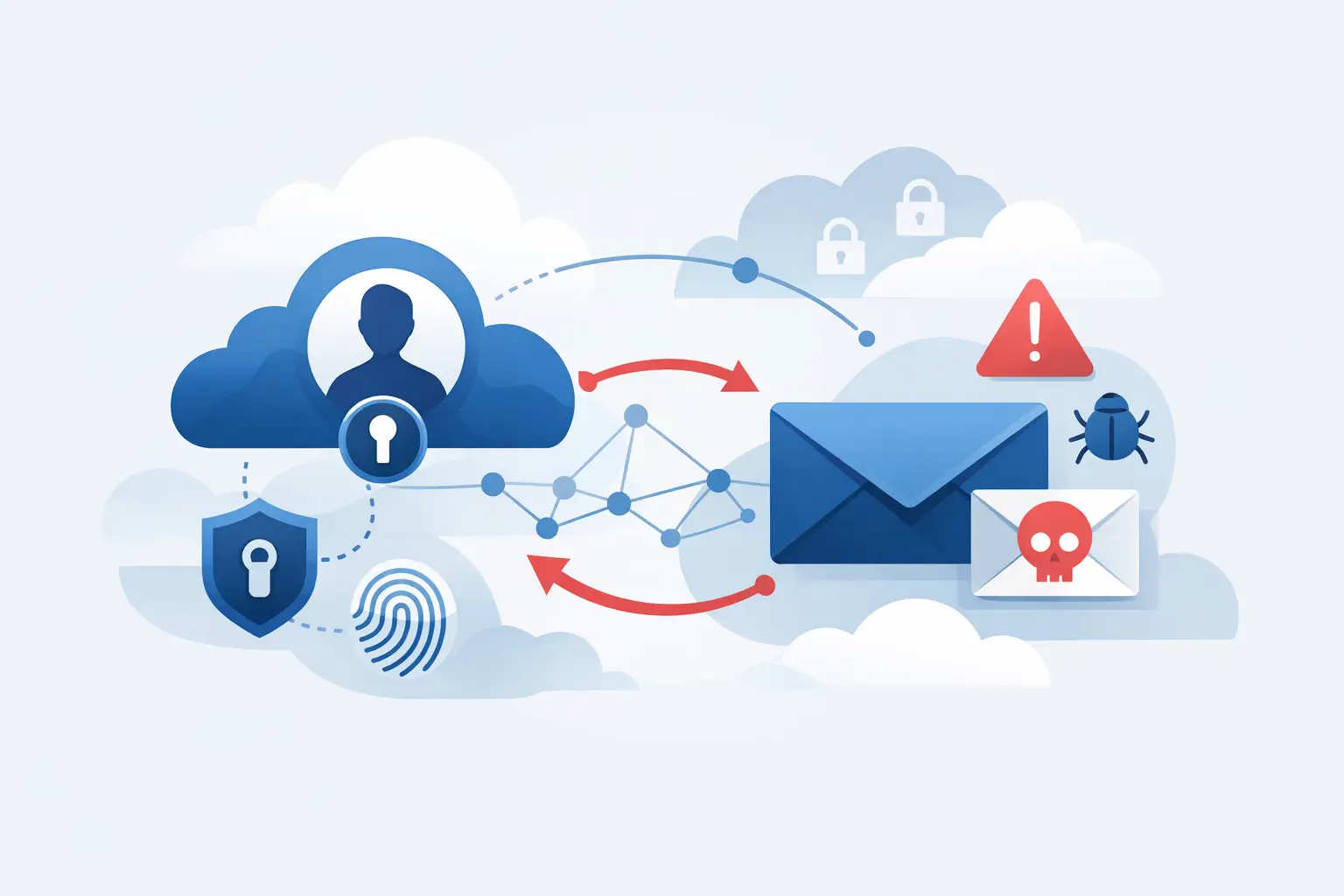
A user signs in from a new cloud location at 2:13 a.m. Four minutes later, that same account starts sending unusual email traffic and creates an inbox rule that hides replies. In many security stacks, those events land in different tools, with different severity scores, and often with no shared case context. That is exactly where cloud identity email threat correlation matters. It turns scattered telemetry into a single attack story your SOC can act on.
For security teams under pressure to reduce response time without adding headcount, this is not a nice-to-have analytic. It is a practical way to detect account compromise earlier, cut false positives, and stop phishing-led intrusion chains before they expand into broader cloud abuse or data loss.
What cloud identity email threat correlation actually does
At a technical level, cloud identity email threat correlation connects signals from identity providers, cloud apps, and email security systems to determine whether separate alerts are part of the same incident. That sounds straightforward, but the value is in the context layer. A suspicious login by itself may be noise. A mailbox forwarding rule by itself may be low priority. A burst of failed MFA attempts may look annoying but not urgent. When those events are tied to the same user, device, IP, session, or time window, the risk picture changes fast.
This kind of correlation is especially effective against modern account takeover activity because attackers rarely operate in just one control plane. They phish through email, establish access through identity, persist in cloud services, and then use the compromised account for internal targeting, external fraud, or data collection. Treating those as separate monitoring domains creates blind spots the attacker benefits from.
A mature correlation model usually maps relationships across login behavior, MFA status, token anomalies, mailbox changes, suspicious send patterns, privilege shifts, device posture, and cloud workload access. The goal is not to create more detections. The goal is to create fewer, higher-confidence incidents.
Why cloud identity email threat correlation changes SOC performance
Most SOC teams do not have a detection problem. They have a workflow problem. Alerts arrive from too many places, analysts spend too much time pivoting between consoles, and real incidents hide inside repetitive low-context events. Cloud identity email threat correlation improves operations because it reduces the number of manual joins analysts have to perform during triage.
Instead of asking whether an email alert is related to an identity alert, the platform should already know. Instead of opening separate dashboards for mailbox activity, sign-in logs, and conditional access events, analysts should be working from one incident view with a timeline, impacted assets, and recommended actions.
That has measurable consequences. First, mean time to investigate drops because analysts start with assembled evidence instead of hunting for it. Second, alert fatigue falls because low-value standalone alerts can be suppressed or deprioritized when they lack supporting context. Third, containment gets faster because the response action is clearer. If the issue is likely account takeover, you can disable the session, reset credentials, revoke tokens, and inspect mailbox artifacts immediately rather than spending thirty minutes proving what already happened.
There is a trade-off, though. Correlation is only as good as the telemetry quality and normalization behind it. If identity logs are incomplete, mailbox telemetry is delayed, or enrichment is inconsistent across vendors, correlation logic can miss important links or overstate weak ones. That is why operational design matters as much as detection logic.
The attack patterns this correlation catches best
The most obvious use case is business email compromise, but the real value goes beyond classic invoice fraud or executive impersonation. Cloud identity email threat correlation is strong wherever email is the entry point and identity is the control plane.
One common pattern starts with a phishing message that steals credentials or session tokens. The attacker logs in from an unusual geography or impossible travel sequence, registers a new MFA method, and then modifies mailbox rules to hide warnings and reroute communication. If those events sit in separate systems, none may rise above a moderate severity threshold. Correlated together, they point to active compromise with clear intent.
Another pattern involves password spraying or MFA fatigue followed by successful access to cloud collaboration tools. Email may then be used to spread internal phishing, send malicious file links, or exfiltrate conversation data. Correlating identity, email, and cloud app activity helps distinguish a noisy authentication attack from one that actually led to business impact.
This approach also helps with insider risk and abused legitimate access. If a valid employee account suddenly accesses sensitive cloud data, forwards email externally, and signs in through an unmanaged device, the risk is not just about identity hygiene. It is about the combined behavior across systems.
What good correlation looks like in practice
A useful detection pipeline does more than match timestamps. It builds confidence through entity relationships and behavioral baselines. The strongest implementations correlate by user identity, mailbox, source IP, device ID, session token, application, and sequence of activity. They also factor in what is normal for that user or peer group.
For example, a login from a new location may be expected for a traveling executive. A new mailbox forwarding rule may be legitimate during a leave-of-absence handoff. But if that same user has concurrent impossible travel, unusual admin consent activity, and a spike in outbound email volume, the case is different. Correlation should raise risk based on accumulation and sequence, not isolated events.
This is also where automation needs discipline. Too little automation leaves analysts buried in enrichment tasks. Too much automation can close the loop on weak evidence and trigger disruptive actions unnecessarily. In most enterprise environments, the right model is tiered. High-confidence patterns get automated containment. Medium-confidence patterns get analyst review with assembled context. Low-confidence patterns stay as searchable telemetry instead of becoming incidents.
Architecture matters more than another point tool
Many organizations already own separate products for email security, identity protection, cloud monitoring, SIEM, and response orchestration. The issue is rarely a complete lack of data. The issue is fragmented execution. Correlation breaks down when every tool has its own alert model, schema, case queue, and automation engine.
That is why platform design matters. If your SOC has to move between five consoles to validate one account takeover, the stack is slowing down the outcome it was supposed to improve. A unified incident workflow gives analysts one place to see related alerts, evidence, user risk, asset impact, and response options. That is materially different from forwarding alerts into a central bucket and calling it correlation.
For teams operating hybrid or multi-vendor environments, normalization is the hard part. Different identity providers log differently. Email systems expose different telemetry depth. Cloud applications vary in event fidelity. The right architecture handles those differences upstream so the analyst sees a coherent incident downstream.
This is where a platform approach has an edge over stitched-together tooling. Helxon’s model, for example, is built around correlating firewall, endpoint, cloud, identity, and email telemetry into one analyst workflow rather than forcing the SOC to assemble that context manually across disconnected systems.
How to evaluate cloud identity email threat correlation
If you are assessing this capability, focus less on feature checklists and more on operational proof. Ask how the system correlates identity and email events into a single incident, how it scores confidence, how quickly data becomes searchable, and what automated actions can be taken safely. You should also test investigation flow. Can an analyst see the sign-in anomaly, mailbox manipulation, user history, device context, and response options in one screen? Or are they still pivoting across tools?
It also helps to examine how the platform handles edge cases. Shared mailboxes, service accounts, delegated access, and contractors often generate activity that looks suspicious but is expected. Strong correlation design accounts for those realities instead of creating endless exceptions.
Finally, look at reporting. CISOs and SOC managers need defensible metrics, not just technical detail. A good implementation should show reduced alert volume, faster triage, containment time, and incident quality improvements tied to correlated detections.
Where this goes next
As identity becomes the primary security boundary and email remains the most common intrusion path, the gap between those domains becomes more expensive. SOC teams that still investigate them separately will keep paying in longer triage cycles, noisier queues, and missed attack progression.
Cloud identity email threat correlation is not about adding more analytics for the sake of it. It is about giving analysts enough joined-up context to act with speed and confidence. If your team is trying to do more with the same people, that is the kind of improvement that changes daily operations, not just architecture slides.
The most useful next step is simple: look at your last few account compromise investigations and count how many manual pivots it took to get the full picture. That number will tell you how much room there is to improve.