
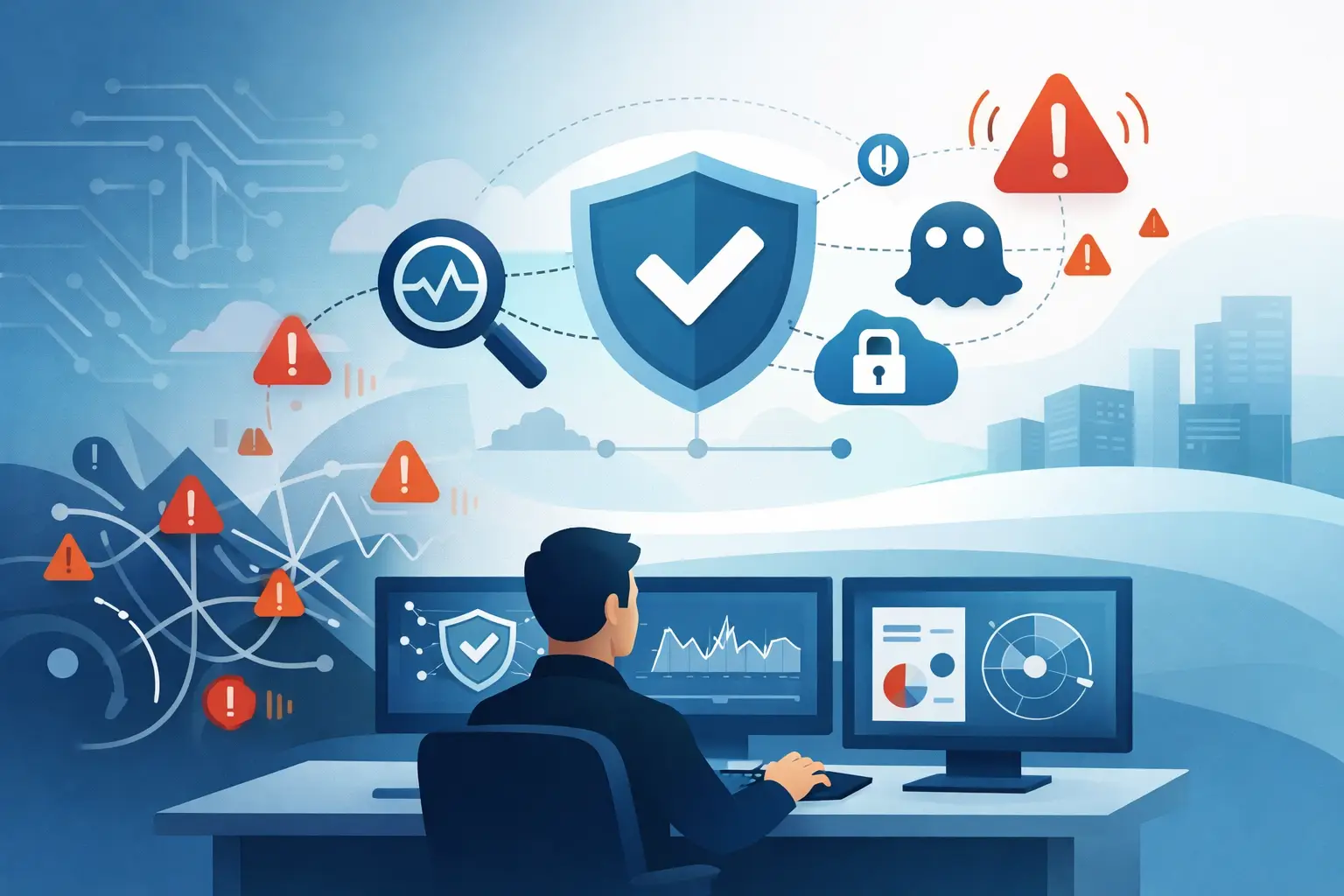
A queue full of alerts is not proof that your SOC is working. In many environments, it is proof that analysts are buried under disconnected data, duplicate detections, and too many tools that do not share context. That is where cybersecurity monitoring becomes operationally decisive. Done well, it gives teams a clear view of what matters, what changed, and what requires action before a low-signal event turns into a business incident.
For mid-market and enterprise teams, the issue is rarely whether monitoring exists. It is whether the monitoring model can keep up with hybrid infrastructure, cloud adoption, identity-based attacks, and a threat landscape built to exploit handoff delays. The difference between a manageable SOC and a constantly overloaded one often comes down to how monitoring is designed.
What cybersecurity monitoring should actually do
Cybersecurity monitoring is often treated as a log collection exercise. That is too narrow and too expensive a way to think about it. Collecting telemetry is only the starting point. The real job is to turn raw activity across endpoint, firewall, cloud, identity, and email into prioritized incidents that analysts can investigate quickly.
That means effective monitoring should answer a few immediate questions. What happened? Where did it happen? Is it isolated or part of a broader attack path? Has this user, host, mailbox, or IP shown related behavior elsewhere in the environment? And most importantly, what should the team do next?
If your monitoring stack cannot answer those questions without pivoting between multiple consoles, the bottleneck is not your analysts. It is your operating model.
Why traditional monitoring breaks under pressure
Most SOCs did not become fragmented by accident. They added tools to solve specific problems - email security here, endpoint detection there, cloud posture somewhere else, identity monitoring on top. Each purchase made sense in isolation. Over time, the result became a workflow problem.
Analysts now spend too much time moving between products, stitching together timelines, and validating whether alerts are related or redundant. The more telemetry sources you add, the worse that problem gets unless there is strong correlation and incident-level context. More data does not automatically improve detection. In many cases, it increases triage time and alert fatigue.
This is why many teams struggle even after investing heavily in SIEM, SOAR, and adjacent tools. The architecture may be technically capable, but operationally slow. Rule tuning becomes a constant maintenance burden. Automation is hard to scale when the underlying data is inconsistent. Investigations drag because context lives in different systems owned by different teams.
Cybersecurity monitoring fails when it creates visibility without clarity.
The core capabilities that matter most
A modern monitoring program needs breadth, but breadth alone is not enough. The critical requirement is correlation across the control points attackers actually move through.
Cross-domain telemetry correlation
Most serious incidents leave traces in more than one system. A phishing email leads to a risky sign-in. That sign-in triggers suspicious endpoint activity. Then you see cloud access anomalies or outbound traffic patterns that suggest staging or exfiltration. Monitoring should connect those dots automatically instead of asking analysts to reconstruct the chain by hand.
This is where many legacy setups underperform. They can ingest events, but they do not consistently turn related signals into one coherent incident. When that happens, analysts work the same threat multiple times under different alert names.
Incident-driven workflow
Alert lists are not a workflow. Analysts need monitoring that organizes related detections into incidents with timelines, affected assets, user context, and recommended response actions. That shift sounds simple, but it changes the operating tempo of the SOC.
Instead of burning time on isolated notifications, teams can focus on attack progression, scope, and containment. That reduces mean time to investigate and improves confidence in escalation decisions.
Prioritization that reflects business reality
Not every alert deserves the same response. Monitoring should factor in asset criticality, user privilege, attack technique, and detection confidence. A suspicious sign-in tied to a privileged account on a critical system is not the same as a single low-confidence anomaly on a test device.
Teams that ignore this end up treating volume as urgency. That is one of the fastest ways to exhaust analysts and still miss the events that matter.
Cybersecurity monitoring in hybrid environments
Hybrid and multi-vendor environments expose the weaknesses of fragmented monitoring faster than almost anything else. Visibility gaps show up at the handoff points - on-prem to cloud, identity to endpoint, email to user behavior, firewall to workload.
Attackers benefit from those seams. Security teams should not.
A workable monitoring model in a hybrid environment needs normalized telemetry and shared incident context across sources, even when the underlying tools come from different vendors. It also needs enough flexibility to support both centralized SOC operations and distributed ownership models. Some organizations want full internal control. Others need managed coverage after hours or around the clock. The monitoring layer has to support both without creating two separate operational systems.
That is one reason unified SOC platforms are getting attention. They reduce the translation work between products and give teams one analyst workspace for detection, investigation, and response. For organizations trying to consolidate sprawl without losing visibility, that is a meaningful operational gain, not just a tooling preference.
Where efficiency gains actually come from
Security leaders often ask how to improve monitoring without simply hiring more analysts. The answer is usually not better dashboards. It is less friction in the workflow.
Efficiency comes from reducing duplicate alerts, enriching detections automatically, correlating events before they reach an analyst, and cutting the number of console switches needed to understand an incident. It also comes from having clear response paths once a threat is confirmed.
This is where automation helps, but only when it is grounded in reliable context. Automating low-quality alerts just moves noise faster. Automating enrichment, triage support, and defined containment steps can materially shrink response times.
For example, when a monitoring platform can associate a suspicious email with endpoint execution, identity activity, and lateral movement indicators in one case, the analyst no longer has to spend the first 20 minutes proving those events belong together. They can move directly to scope and response.
That is the difference between automation that looks impressive in a demo and automation that improves SOC performance.
Build versus buy is really an operating model decision
Some teams can build and run an effective monitoring operation internally. They have the analysts, engineering depth, process maturity, and leadership support to tune detections and sustain coverage. For them, the challenge is often platform consolidation and workflow speed.
Other organizations have a capable internal team during business hours but cannot justify full overnight staffing. In that case, cybersecurity monitoring should support a mixed model where internal teams maintain strategic control while managed analysts provide continuity and rapid response coverage.
Then there are teams that need outcomes more than infrastructure ownership. They want monitored, triaged, and investigated incidents without managing a sprawling backend stack themselves. For those buyers, a managed SOC model can be the more practical path, especially when it runs on the same platform available to self-managed customers.
The right answer depends on staffing, risk tolerance, compliance requirements, and how much operational control the organization wants to retain. What matters is avoiding a split between the technology platform and the service model. When those are disconnected, visibility and accountability usually suffer.
What to evaluate before changing your monitoring approach
If your current stack generates noise, slow investigations, or reporting gaps, focus less on feature volume and more on workflow outcomes. Ask whether the platform reduces analyst steps, correlates across your actual environment, and produces incidents with enough context to support fast action. Ask how it handles email, identity, cloud, endpoint, and network telemetry together, not as separate silos. Ask what deployment options exist if you need internal control today and managed coverage later.
This is also where practical proof matters. A platform should show how it handles ransomware precursors, phishing-to-compromise chains, lateral movement, and suspicious outbound activity. These are not edge cases. They are the day-to-day tests of whether monitoring is ready for real operations.
Helxon’s approach reflects that reality by focusing on one unified analyst workflow rather than another disconnected stack of alerts, playbooks, and dashboards. For teams trying to modernize the SOC without adding friction, that model lines up with how incidents actually unfold.
The strongest cybersecurity monitoring programs do not win by collecting the most data. They win by turning scattered signals into fast, confident decisions. If your team can see the full incident, act from one place, and spend less time proving what happened, you are not just monitoring better. You are operating better.