
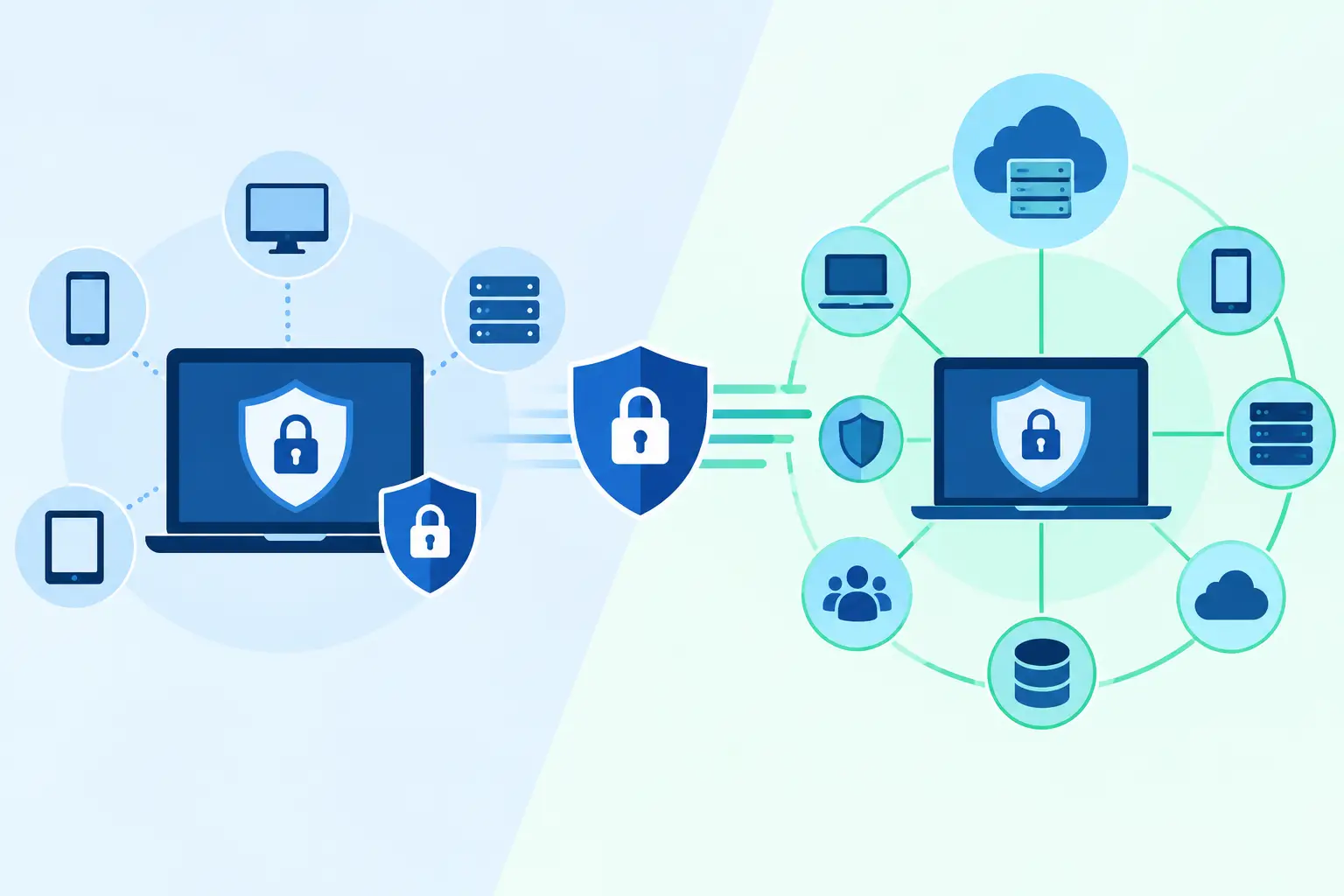
A ransomware alert on a laptop rarely starts and ends on that laptop. The initial signal may be suspicious PowerShell activity, but the evidence needed to confirm the attack could sit in identity logs, email telemetry, firewall events, and cloud audit trails. That operational gap is the real issue in the EDR versus XDR decision.
EDR and XDR both improve detection and response, but they solve different parts of the SOC problem. EDR gives security teams deep endpoint visibility and control. XDR extends the investigation across security domains, helping analysts understand whether an endpoint event is isolated, part of a phishing campaign, connected to a compromised identity, or moving laterally through the environment.
For security leaders, the question is not which acronym is more advanced. It is whether the team can investigate and contain threats quickly enough with the data, workflow, and staffing model it has today.
What EDR Does Well
Endpoint detection and response focuses on workstations, servers, and other managed endpoints. It collects detailed endpoint telemetry such as process execution, command lines, file changes, registry activity, network connections, persistence mechanisms, and user behavior. It then applies analytics and detections to identify suspicious activity.
That depth makes EDR highly effective for endpoint-centric threats. Analysts can trace a malicious process tree, identify the parent application that launched it, isolate the affected device, terminate a process, quarantine a file, or collect forensic artifacts. When malware executes on a managed endpoint, EDR is often the fastest path to high-fidelity evidence and immediate containment.
EDR is especially valuable when an organization needs to improve basic endpoint hygiene, replace legacy antivirus, or establish a repeatable incident-response process for laptops and servers. It creates a necessary control point for ransomware, credential dumping, malicious scripts, persistence, and many forms of hands-on-keyboard activity.
The limitation is scope. An endpoint alert can tell an analyst what happened on a device, but not always how the attacker got there, whether the same identity is being abused elsewhere, or whether related activity is occurring in email, cloud infrastructure, or the network. Analysts must often pivot into multiple consoles to answer those questions.
EDR Versus XDR: The Operational Difference
Extended detection and response is designed to correlate signals from multiple security layers. Depending on the platform and integrations, XDR can bring together endpoint, identity, email, firewall, network, cloud, and SaaS telemetry into an incident-level view.
The difference matters because attackers do not respect product boundaries. A phishing email can lead to a stolen session token. That token can trigger unusual cloud access. The compromised account can create mailbox forwarding rules, access sensitive files, or authenticate to a server where endpoint detections finally appear. Treating each alert as an independent event slows triage and creates opportunities for the attacker to advance.
XDR aims to connect those events before the analyst has to hunt manually. Rather than presenting five alerts from five tools, it can assemble a single incident with affected users, assets, indicators, timeline, likely attack path, and recommended response actions. The goal is not simply more telemetry. It is less analyst effort required to establish what is real, what is related, and what must happen next.
That broader context can reduce alert fatigue, but only if the platform correlates signals in a way analysts can trust. An XDR deployment that ingests every possible log without clear detection logic, prioritization, or workflow can become another noisy interface. Context must lead to a faster decision, not a larger investigation queue.
Where EDR Is the Right Choice
EDR can be the right operational choice when the organization has a narrow, immediate endpoint-security requirement. A team with limited telemetry sources, a standardized endpoint fleet, and a clear need to contain device-level threats may gain significant value without deploying a broader detection architecture.
It can also be appropriate when other security systems already provide mature correlation and case management. For example, a well-operated SIEM and SOAR environment may already combine identity, email, cloud, and network evidence. In that case, EDR serves as a critical endpoint data source rather than the center of the SOC workflow.
Cost and operational maturity also matter. XDR is not a substitute for ownership. Teams still need clear escalation paths, response authority, tuning discipline, and a plan for handling high-severity incidents. If those foundations are absent, adding another platform will not fix the underlying process.
When XDR Delivers More Value
XDR becomes more compelling when the investigation process is fragmented. Common signs include analysts copying indicators between consoles, incident responders waiting for another team to retrieve logs, duplicate tickets created from related alerts, and leadership receiving reports that cannot explain the full scope or timeline of an incident.
It is particularly useful in hybrid and multi-vendor environments where risk spans Microsoft 365, cloud workloads, firewalls, endpoints, identity providers, and email security tools. The objective is to make that distributed environment operationally manageable without requiring analysts to become experts in every vendor interface during a live incident.
Consider a business email compromise scenario. Email telemetry identifies a suspicious message. Identity events show an unfamiliar sign-in location and impossible travel pattern. Cloud audit logs reveal an inbox rule forwarding messages externally. EDR may show no malware at all. An endpoint-only view can miss the severity of the incident, while XDR can correlate the evidence, prioritize the account takeover, and guide containment across the affected systems.
The same principle applies to lateral movement. A suspicious remote execution event on one server has more meaning when it is tied to a recently compromised account, unusual VPN activity, and firewall connections to other critical assets. Cross-domain context helps analysts distinguish a single anomalous event from an active intrusion.
The Key Trade-Off: Depth, Breadth, and Workflow
EDR provides exceptional depth on the endpoint. XDR provides broader visibility and incident context. Mature security operations generally need both capabilities, whether they are delivered in one platform or assembled through integrations.
The better question is where the analyst spends time. If the team already has strong endpoint investigation but loses hours correlating email, identity, cloud, and network evidence, the priority is cross-domain workflow. If the team lacks reliable endpoint telemetry and containment, that gap should be addressed first.
Buyers should also separate native coverage from open integration. Some XDR products work best when an organization standardizes on one vendor ecosystem. Others are designed to normalize telemetry from existing controls. Neither model is universally better. A mostly standardized environment may benefit from tight native integration, while a multi-vendor enterprise needs to confirm that the platform can correlate the tools it already relies on without forcing a costly replacement project.
What to Evaluate Beyond the Label
Product categories do not guarantee outcomes. During an evaluation, security leaders should test how the platform performs during a real investigation, not just how many data sources it claims to support.
Ask whether analysts can move from an alert to an incident timeline without manual searching. Verify whether the system identifies affected users, devices, and cloud resources in one workspace. Examine the quality of prioritization and whether it explains why an alert matters. Confirm that containment actions can be executed and documented without switching among disconnected consoles.
It is also worth testing reporting. CISOs need defensible evidence of detection coverage, incident volume, response time, and unresolved risk. SOC managers need visibility into analyst workload, repeatable triage processes, and gaps that require tuning. A platform that detects threats but cannot demonstrate operational improvement will struggle to justify its cost.
For teams that cannot staff continuous monitoring internally, the operating model is equally important. A platform combined with 24/7 managed analyst coverage can provide the context and response discipline that technology alone cannot deliver. Helxon's VORXOC approach, for example, centers on a unified incident workflow across endpoint, identity, email, cloud, and firewall telemetry, with the option to run that workflow internally or through SOC as a Service.
The most effective choice is the one that gives your team a clearer path from signal to decision to containment. If analysts can see the full attack path, act on it quickly, and explain the outcome with confidence, the SOC is moving in the right direction.