
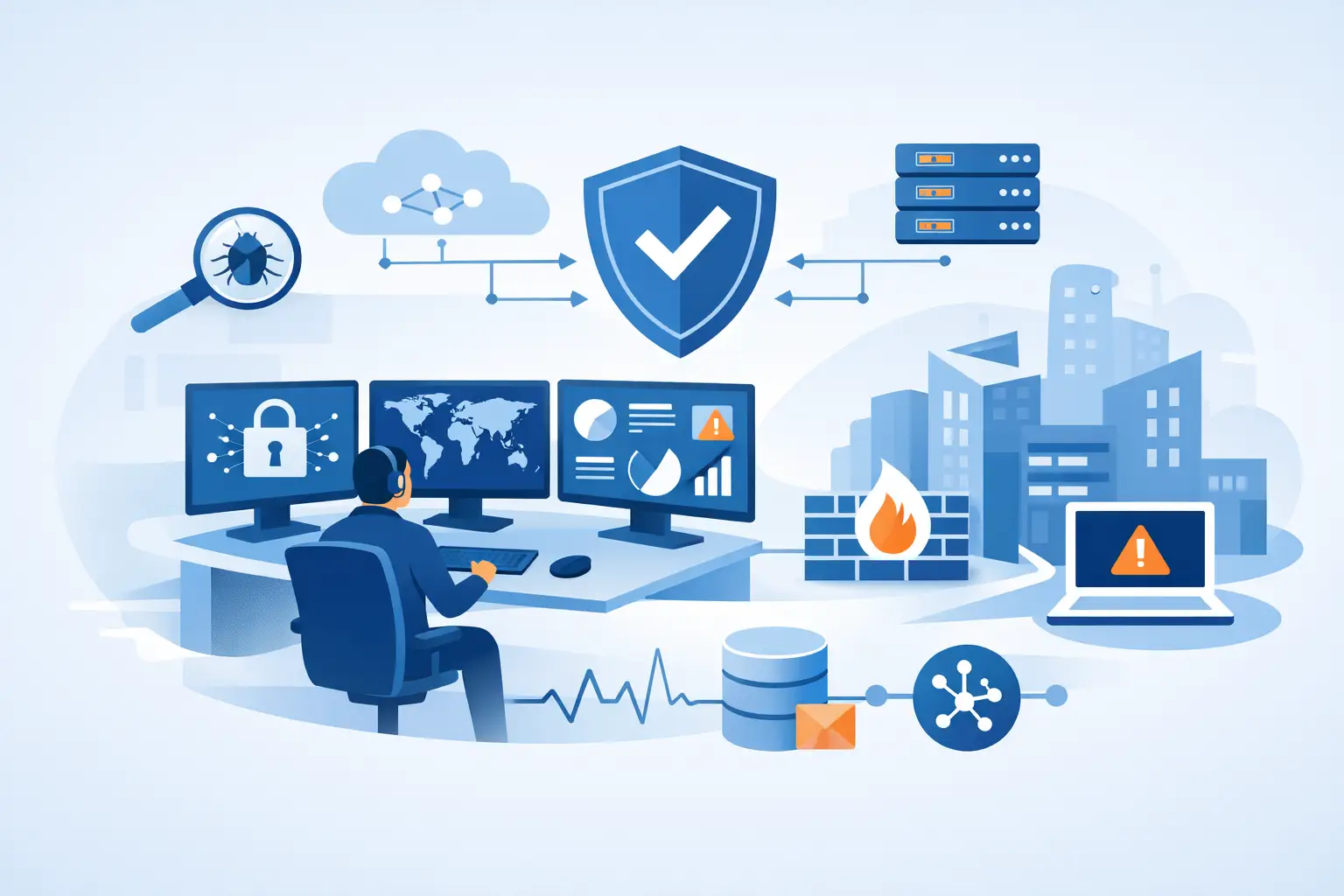
A ransomware alert should not send an analyst through six consoles to determine whether it is real. Yet that is still the daily reality for many security teams: endpoint telemetry in one system, identity events in another, cloud logs in a third, and response actions split across separate tools. This enterprise SOC architecture guide explains how to design operations around a unified workflow instead of a collection of disconnected products.
The goal is not to collect every possible log or automate every analyst decision. It is to give the team enough high-quality context to identify material threats quickly, investigate with confidence, and take controlled response actions before an incident spreads.
What an Enterprise SOC Architecture Must Deliver
An enterprise SOC is an operating system for detection and response, not a stack diagram. Its architecture should support the full path from telemetry collection through triage, investigation, containment, recovery, and reporting. If any stage is disconnected, the team pays for it in alert volume, delayed decisions, and inconsistent outcomes.
At a minimum, the architecture needs to answer four operational questions. What happened? Which users, assets, and business services are affected? How credible and urgent is the threat? What action can the team take now without creating unnecessary business disruption?
That requires more than a central log repository. The SOC needs normalized security data, correlation across environments, case management, response orchestration, and a clear record of analyst decisions. Executives need defensible metrics, while analysts need a workspace that removes repetitive pivoting and preserves context from the first alert to final resolution.
Enterprise SOC Architecture Guide: The Core Layers
A practical architecture is easiest to plan in layers. The layers are connected by workflow, not merely by APIs.
Telemetry and integration layer
Start with the systems that show how an attack moves through the organization. For most enterprises, that includes firewall and network controls, endpoint detection, identity providers, email security, cloud platforms, SaaS applications, vulnerability data, and critical business systems.
Prioritize sources based on detection value and response utility. Identity, endpoint, email, and cloud activity often provide the strongest initial coverage because they reveal common attack paths: phishing, credential misuse, privilege escalation, lateral movement, and data access. Network telemetry remains essential for validating command-and-control activity, unusual connections, and exfiltration.
Collection should be broad enough to support correlation but disciplined enough to control cost and noise. Ingesting every low-value event without a retention plan can create an expensive archive that analysts rarely use. Define which events require real-time processing, which belong in searchable historical storage, and which can be retained only for compliance.
Detection and correlation layer
Raw events are not incidents. The detection layer should convert related signals into a risk-based view of suspicious activity. A failed login alone may be routine. Repeated failures followed by a successful sign-in from an unfamiliar location, a new inbox rule, and unusual endpoint activity demand immediate attention.
Correlation works best when the platform can connect entities across data sources: a user, device, IP address, mailbox, cloud workload, file hash, or application. This context reduces the number of alerts an analyst must review and makes prioritization more accurate.
Use a mix of detection methods. Rules are effective for known patterns and policy violations. Behavioral analytics help surface deviations that do not match a fixed signature. Threat intelligence adds external context, but it should inform a decision rather than generate a flood of unverified matches. The right balance depends on the organization’s threat profile, asset criticality, and analyst capacity.
Investigation and case management layer
This is where many SOC designs fail. Teams may have strong detection tools but no coherent place to investigate and manage incidents. Analysts are left copying evidence into tickets, manually building timelines, and losing visibility when ownership changes between shifts.
A capable investigation layer presents the alert, relevant entities, correlated evidence, prior activity, severity rationale, and recommended next steps in one case. It should retain the chain of decisions: why an alert was closed, which evidence supported escalation, what containment action was approved, and when recovery was verified.
That record matters for more than audit readiness. It helps the SOC improve. When a false positive repeats, the team can tune the detection based on real evidence. When a true incident exposes a blind spot, engineers can add telemetry or refine correlation logic without guessing what failed.
Response and automation layer
Automation should remove predictable work, not replace judgment where business context matters. Enriching an alert with asset ownership, user risk, geolocation, threat intelligence, and recent activity is usually safe to automate. So are repetitive actions such as opening a case, collecting endpoint details, or notifying an on-call owner.
Containment requires more care. Disabling an account, isolating an endpoint, revoking cloud sessions, or blocking a domain can stop an attack quickly, but each action can interrupt a business process. Mature SOCs use playbooks with decision points. High-confidence incidents may trigger immediate containment. Ambiguous events should be enriched and routed to an analyst with the authority to act.
The architecture should also support response verification. Blocking an IP address is not proof that an incident is contained. Analysts need to confirm whether malicious sessions ended, persistence was removed, credentials were reset, affected systems were remediated, and related activity has stopped.
Design Around Real Attack Paths
A SOC architecture becomes useful when it is tested against the incidents the organization is most likely to face. Ransomware is a strong example because it crosses multiple control domains. The SOC may first see a phishing email, then suspicious identity activity, endpoint execution, privilege changes, remote administration tools, and file encryption behavior. A fragmented stack turns that sequence into separate alerts. A unified workflow turns it into one evolving incident.
The same approach applies to business email compromise, cloud account takeover, lateral movement, and data exfiltration. For each use case, define the telemetry required, the detections expected, the enrichment needed for triage, the response owner, and the containment actions available. Then measure whether the team can complete that path under realistic time pressure.
This exercise often reveals that the problem is not a lack of tools. It is missing context between tools. A detection may identify suspicious PowerShell execution, but without identity and asset data, the analyst cannot quickly determine whether it occurred on a privileged workstation, a production server, or a low-risk test device.
Choose a Deployment Model That Matches Operations
Architecture decisions should reflect who will run the SOC. A self-managed model gives internal teams direct control over detection engineering, investigation standards, and response approval. It works well when the organization has sufficient coverage, defined escalation paths, and the capacity to continuously tune detections.
A managed SOC model provides 24/7 monitoring and experienced analyst coverage without requiring an enterprise to staff every shift. It can be the right choice for lean teams, but only if responsibilities are clear. The provider needs access to meaningful telemetry and approved response procedures. The customer needs visibility into investigations, evidence, actions taken, and service-level performance.
A hybrid model is often the most practical. Internal teams retain control of business-critical decisions and long-term security strategy, while an external team handles overnight monitoring, initial triage, and defined escalation. Platforms such as Helxon VORXOC support this model by giving both parties a shared operational workspace rather than separate views of the same incident.
Measure the Architecture by Operational Outcomes
Do not judge the SOC solely by the number of integrated data sources or detections deployed. Measure whether the architecture improves the work that matters. Time to acknowledge, time to investigate, time to contain, alert-to-incident conversion rate, repeat false positives, and incidents resolved within target should all be visible.
Also track analyst workload. If automation is working, analysts should spend less time on enrichment and duplicate tickets and more time validating threats, improving detection logic, and handling complex investigations. A lower alert count is not automatically better if it comes from suppressing meaningful signals. The objective is a higher signal-to-noise ratio and faster, more reliable decisions.
SOC architecture is not a one-time implementation. Add integrations as the environment changes, retire noisy detections, test playbooks against real scenarios, and review response authority before the next incident forces the issue. The most effective SOC gives analysts a clear path from signal to action - and gives leadership confidence that security operations can move at the speed of the business.