
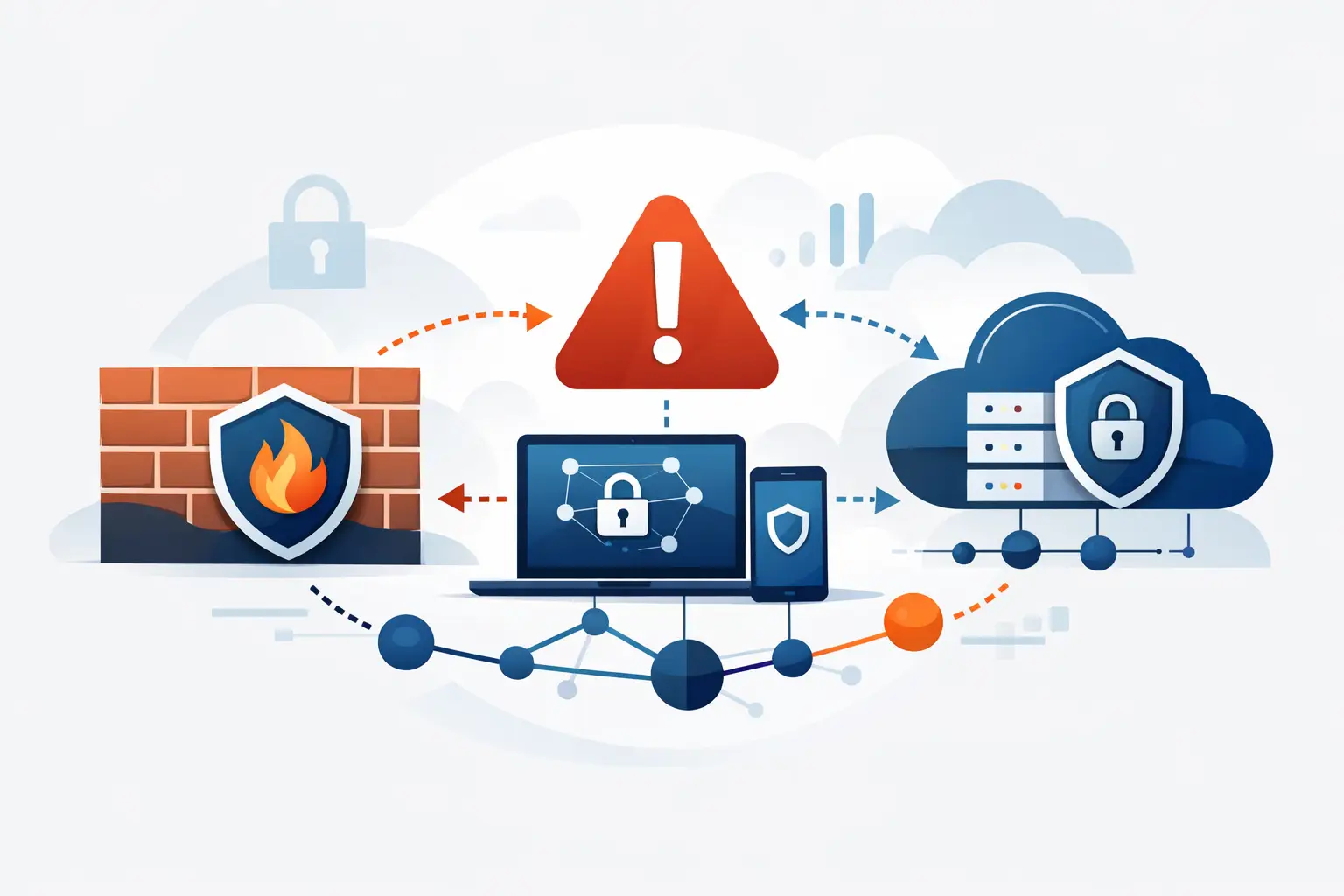
A blocked outbound connection at the firewall may look routine. A suspicious process on an endpoint may be closed as low priority. A cloud login from an unfamiliar location may be treated as a user verification issue. Viewed separately, each alert has limited meaning. Firewall endpoint cloud alert correlation changes that equation by showing whether those events are stages of the same intrusion.
For SOC teams operating across hybrid infrastructure, correlation is not simply a way to create cleaner dashboards. It is the operating model that turns fragmented telemetry into an incident analysts can investigate, validate, and contain. The difference matters when attackers move quickly and the team has limited capacity to separate signal from noise.
Why isolated alerts create slow investigations
Most security tools are designed to answer a narrow question. Firewalls show network activity and policy enforcement. Endpoint tools identify process execution, persistence, and suspicious behavior on devices. Cloud security tools track access, configuration changes, and workload events. Identity systems reveal sign-ins, privilege changes, and authentication anomalies.
Each source is valuable, but each also produces its own alerts, severity model, event format, and console. The analyst is left to assemble the story manually. That creates delays at the point where speed matters most: determining whether an event is benign, contained, or part of an active compromise.
Consider a common phishing-to-cloud-account-takeover sequence. An employee receives a convincing email, opens a malicious attachment, and launches a process that contacts an external command-and-control domain. The attacker steals a session token, signs into Microsoft 365 from a new location, creates an inbox rule, and begins searching for finance-related data.
The endpoint platform may flag the process. The firewall may log the outbound connection. The cloud platform may alert on the unfamiliar sign-in. Email telemetry may identify the original message. If those alerts remain separate, the SOC may assign them to different analysts or close one before the broader pattern is visible. Correlation links them through shared entities, timing, behavior, and threat context.
That linkage does not mean every alert with a common IP address should become a critical incident. Effective correlation must preserve evidence and apply judgment. The goal is to reduce duplicate work without creating a larger volume of false high-severity cases.
What firewall endpoint cloud alert correlation should connect
Meaningful correlation begins with normalized telemetry and a consistent entity model. The platform needs to recognize that a hostname in endpoint data, an internal IP in firewall logs, a user in identity events, and an account in cloud audit records may describe connected parts of the same activity.
Time is equally important. A cloud sign-in occurring three weeks after an endpoint alert is usually not relevant. A sign-in occurring minutes after suspicious credential-access activity on that user’s device deserves immediate scrutiny. Correlation logic should use adjustable time windows based on the behavior under investigation, rather than relying on one universal threshold.
The strongest incident narratives commonly combine four forms of context:
- Entity context: Users, devices, IP addresses, cloud accounts, applications, domains, and workloads tied to the same activity.
- Behavioral context: A sequence that matches attacker tradecraft, such as credential theft followed by unusual authentication and privilege escalation.
- Threat context: Known malicious infrastructure, file reputation, vulnerability exposure, and intelligence associated with the observed artifacts.
- Business context: Asset criticality, user role, data sensitivity, geographic norms, and whether the system belongs to a production environment.
Business context is often the difference between a useful priority score and another noisy queue. A suspicious PowerShell command on a kiosk and the same command on a domain administrator workstation should not receive identical treatment. Likewise, a cloud API call from a developer’s normal automation account is different from the same action performed by a newly created privileged identity.
Build incidents, not oversized alert groups
Correlation programs fail when they indiscriminately bundle events because they share an IP address, a device name, or a broad time range. Analysts then receive bloated cases that are harder to understand than the original alerts. The system has reduced ticket count but not investigation time.
A practical approach creates a single incident only when there is a defensible relationship among the events. That relationship might be a shared user and device, a clear execution chain, common malicious infrastructure, or a sequence consistent with a known attack path.
The incident should retain the underlying alerts while presenting a concise storyline: what happened first, what changed, which assets are affected, why the activity is suspicious, and what containment action is appropriate. Analysts should not have to reopen five tools to reconstruct the timeline.
Severity should be dynamic rather than inherited from the loudest individual alert. An endpoint alert initially rated medium may become high when it is connected to a successful privileged cloud login, suspicious mailbox rule creation, and outbound communication to a known malicious domain. Conversely, several low-quality alerts should not become high severity just because they occur near one another.
Use correlation for the attack paths that matter most
Teams should begin with a small number of high-confidence use cases tied to their real exposure. Starting with every possible alert source and detection rule often creates a lengthy tuning project with little operational benefit.
Ransomware and lateral movement
Ransomware investigations benefit from connecting endpoint process activity with internal network behavior. A suspicious executable on one device becomes materially more urgent when firewall data shows SMB, RDP, or remote administration traffic to multiple hosts, especially when identity events show new privilege use.
The correlation should identify the likely initial host, affected accounts, lateral movement targets, and evidence of encryption or defense evasion. This gives responders a containment path: isolate the device, disable or reset the identity, block external infrastructure, and assess connected systems before the event expands.
Cloud account compromise
Cloud account takeover rarely appears as one definitive alert. It often emerges through a pattern: unusual sign-in behavior, legacy authentication, multifactor changes, consent grants, privilege escalation, mailbox forwarding rules, or unusual data access.
Firewall and endpoint evidence can validate whether the suspicious sign-in followed activity on a managed device. Email telemetry may reveal the credential-harvesting message that initiated the sequence. By correlating across those sources, the SOC can distinguish a traveler using a new network from an attacker operating with stolen credentials.
Data exfiltration
Exfiltration detection requires attention to both access and movement. Cloud audit logs may show unusual downloads, while firewall telemetry shows large outbound transfers or connections to unfamiliar storage services. Endpoint activity can reveal compression tools, archive creation, browser uploads, or command-line utilities used to stage data.
Correlation should account for expected business behavior. Backup jobs, software distribution, and sanctioned data transfers can produce high volumes. The important question is whether the user, destination, method, timing, and data scope align with normal operations.
Make the analyst workflow the design center
Correlation is only valuable if it reduces the number of steps between detection and action. A SOC platform should give analysts a unified incident view with the evidence, timeline, impacted entities, related alerts, and recommended response actions in one workspace.
That does not eliminate the need for analyst judgment. Automated enrichment can identify a domain’s reputation, map an IP to prior events, or show an asset owner. It cannot always determine whether a senior engineer’s unusual cloud behavior is legitimate emergency work or account misuse. The right workflow automates repetitive collection and leaves decisions that require organizational context to the analyst.
Response actions also need guardrails. Automatically isolating an endpoint may be appropriate for confirmed ransomware behavior. Automatically disabling an executive’s account based on a single anomalous sign-in may interrupt business operations unnecessarily. Mature programs define playbooks by confidence level, asset criticality, and potential business impact.
Helxon’s VORXOC approach is built around this operational requirement: correlate firewall, endpoint, cloud, identity, and email telemetry into one incident workflow rather than sending analysts between disconnected consoles. For teams using a self-managed SOC or 24/7 managed coverage, the value is the same: faster decisions based on complete context.
Measure whether correlation is improving operations
A lower alert count alone is not proof of success. SOC leaders should measure whether correlated incidents improve triage quality and response outcomes. Useful measures include mean time to acknowledge, mean time to contain, repeat alert handling, percentage of incidents closed with sufficient evidence, and the rate of escalations that prove to be non-actionable.
It is also useful to review incidents that correlation missed. If a confirmed incident required an analyst to manually connect events across tools, that is a candidate for a new rule, enrichment source, or entity mapping improvement. Tuning should be continuous because environments, attack methods, and business processes change.
The practical test is straightforward: when the next suspicious endpoint event appears, can the analyst immediately see the associated firewall traffic, cloud activity, identity changes, and email origin? If the answer is yes, the team has a clearer path to action. If the answer is no, the alert may still be detected, but the investigation is already running behind.