
A ransomware alert arrives from the endpoint platform. Minutes later, an identity tool flags an impossible-travel login, while the firewall reports unusual outbound traffic. Each alert may look manageable on its own. Together, they may show an active intrusion moving toward data exfiltration.
The future of security operations depends on whether the SOC can see that connection fast enough to act. For too many teams, the answer is still no. Analysts pivot across consoles, reconcile timestamps manually, chase duplicate alerts, and spend valuable time assembling context that should already be available. The result is slower containment, higher analyst fatigue, and a security stack that costs more without delivering proportionate operational control.
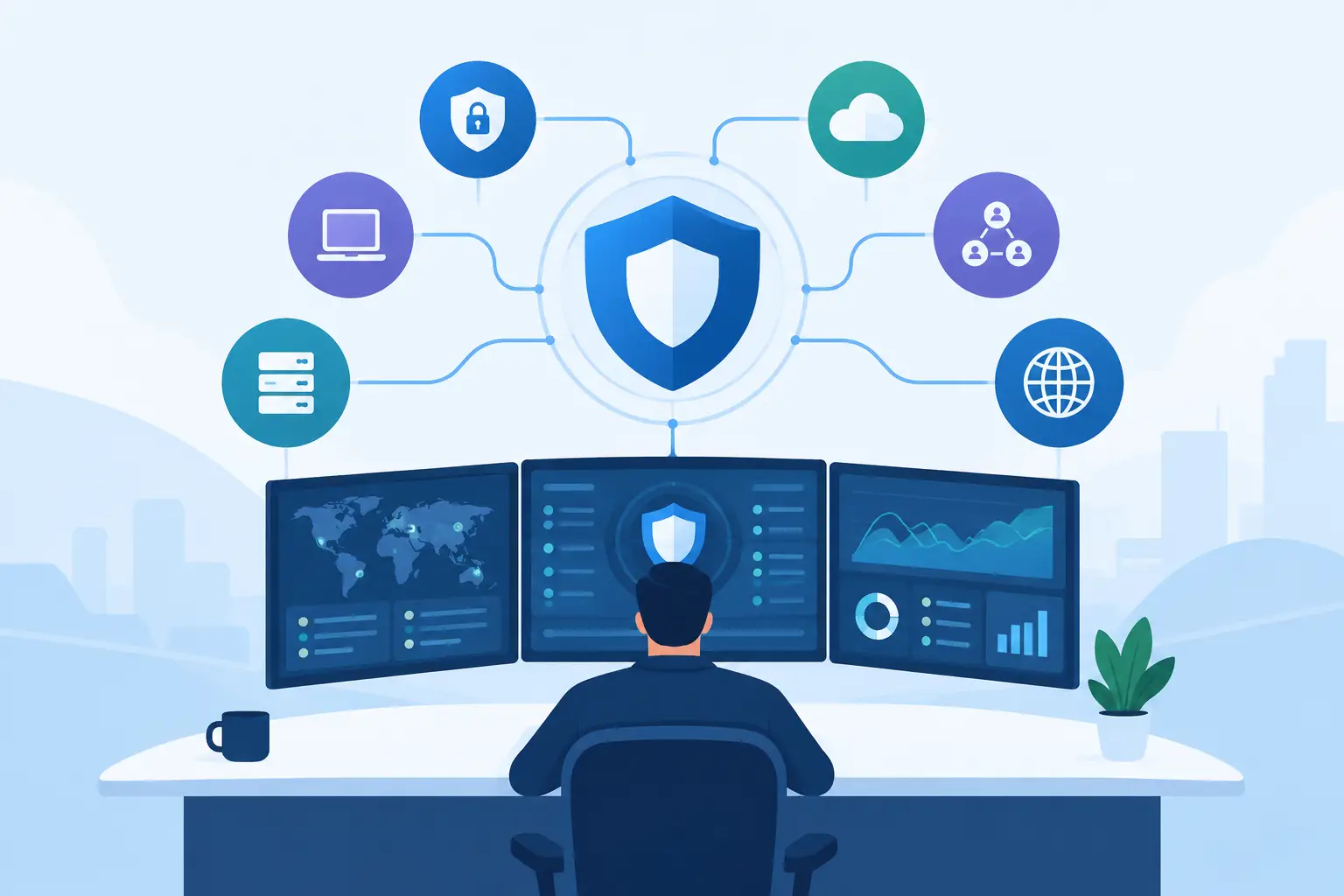
The next-generation SOC is not defined by adding another dashboard. It is defined by unifying the evidence, workflow, and response decisions that analysts need to investigate real threats.
Why the Traditional SOC Model Is Breaking Down
Traditional security operations were built around separate layers of tooling. A SIEM collected logs. Endpoint tools watched devices. Identity systems monitored access. Email security filtered messages. SOAR products attempted to automate selected response tasks. Each layer solved a legitimate problem, but the operating model became fragmented as environments expanded across cloud services, remote endpoints, SaaS applications, and multiple security vendors.
That fragmentation creates a context gap. Alerts arrive without the full story: the user involved, the asset’s risk level, the related network activity, the preceding email event, or the actions already taken by another tool. Analysts must build the incident narrative themselves, often under pressure and with incomplete data.
More alerts do not necessarily create more security. They can create more uncertainty. A SOC manager may see rising event volume while investigation quality declines because experienced analysts are occupied with triage, enrichment, and repetitive validation work. Hiring more people can help, but it is an expensive answer to a workflow problem.
The practical issue is not simply detection coverage. It is the time between signal and confident action. Attackers benefit whenever that gap is wide.
The Future of Security Operations Starts With Context
Security operations will move from alert-centric workflows to incident-centric workflows. Instead of asking analysts to review thousands of isolated notifications, the SOC should correlate telemetry across endpoint, firewall, cloud, identity, and email environments into a single investigation.
This changes the analyst’s starting point. Rather than opening an alert and asking, “Is this real?” the analyst can begin with a prioritized incident that already includes related users, hosts, assets, events, indicators, and attack-path evidence. That is a meaningful operational difference. It reduces the time spent gathering basic facts and increases the time spent making sound containment decisions.
Context also improves prioritization. A failed login attempt against a low-value account is not equivalent to suspicious authentication activity involving a privileged user, followed by access to a sensitive cloud workload and outbound network connections. Security teams need systems that recognize the difference and elevate the incidents that carry real business risk.
This does not mean every correlation is automatically correct. Detection logic, asset quality, identity hygiene, and telemetry coverage still matter. But a unified workflow gives analysts a much stronger basis for validating risk than a queue of disconnected alerts.
Unified telemetry must support action
Centralizing data alone is not enough. Many organizations already collect enormous volumes of logs, yet their analysts still work across separate consoles because the data is difficult to search, poorly normalized, or disconnected from case management.
The useful outcome is not a larger repository. It is a coherent workspace where evidence leads directly to investigation, decision-making, and response. An analyst should be able to see the incident, understand its scope, document findings, assign ownership, and take or recommend containment action without rebuilding the case in spreadsheets, chat threads, and ticketing systems.
AI Will Change the Analyst Workflow, Not Remove the Analyst
AI will be central to the future of security operations, but the strongest use case is not autonomous security theater. It is operational acceleration.
AI can help correlate weak signals across tools, summarize event timelines, identify related entities, surface unusual behavior, and guide analysts toward relevant evidence. It can reduce the manual burden of reading raw logs and compiling repetitive incident notes. For a lean SOC, those gains can significantly improve coverage without requiring a matching increase in headcount.
However, AI should not be treated as a replacement for judgment. High-impact actions such as disabling executive accounts, isolating critical production systems, or blocking business-critical traffic require policy-aware human oversight. The right level of automation depends on the organization’s risk tolerance, the reliability of the detection, and the reversibility of the response action.
A mature operating model uses AI to compress investigation time while keeping accountability clear. Analysts remain responsible for validating material risk, understanding business context, and making decisions that automation cannot safely make on its own.
Explainability is an operational requirement
If an AI-driven system prioritizes an incident, the SOC needs to know why. Analysts need visibility into the signals, relationships, and evidence behind the recommendation. CISOs need defensible reporting when leadership asks why an incident was escalated, contained, or closed.
Black-box scoring creates friction because it forces teams to either trust a recommendation blindly or repeat the analysis manually. Explainable prioritization lets analysts move faster while preserving confidence in the process.
Response Will Become More Coordinated and Measurable
Detection without response is only visibility. The future SOC must connect investigations to defined actions across security controls and business processes.
For a phishing incident, response may include removing related messages, disabling malicious rules, resetting credentials, revoking active sessions, and reviewing access to sensitive applications. For ransomware, the workflow may require endpoint isolation, credential investigation, lateral-movement analysis, backup validation, and executive escalation. These are not isolated tool actions. They are coordinated incident activities that need ownership, timing, evidence, and approval paths.
The strongest SOC platforms will make these workflows repeatable without making them rigid. A known commodity phishing pattern may justify high automation. A suspected insider threat or a complex cloud compromise requires more analyst-led investigation. The platform should support both conditions in one operating model.
Measurement will also become more useful. Mean time to detect and mean time to respond remain valuable, but they should not stand alone. Teams should track how many alerts become meaningful incidents, how long analysts spend collecting context, where investigations stall, which controls generate the most noise, and whether containment actions are executed consistently.
Those metrics expose operational bottlenecks that volume-based dashboards often hide.
SOC Delivery Will Be Flexible, Not One-Size-Fits-All
The future of security operations is not limited to a fully internal SOC. Some enterprises need direct control over every investigation and response decision. Others need 24/7 monitoring but cannot justify staffing multiple shifts with specialized analysts. Many need a hybrid model, where internal teams retain authority over business-critical decisions while external experts provide continuous monitoring and escalation.
The critical factor is continuity. Whether the SOC is self-managed, fully managed, or shared, the team should operate from the same incident record, telemetry context, playbooks, and reporting structure. Handing incidents between separate tools or separate teams introduces delay precisely when speed matters most.
A platform such as Helxon VORXOC supports this model by bringing detection, investigation, and response into one analyst workspace while allowing organizations to choose self-managed operations or managed 24/7 coverage. The value is not merely consolidation. It is a clearer path from signal to action.
What Security Leaders Should Do Now
Security leaders do not need to replace every tool immediately. A better first step is to identify where the SOC loses time today. Is it alert triage? Missing telemetry? Duplicate investigations? Manual enrichment? Slow handoffs between internal teams and service providers? The answer should shape the modernization plan.
Then assess security operations as a workflow, not as a collection of products. Determine whether analysts can trace an incident across identity, endpoint, network, cloud, and email data without excessive pivoting. Review whether response procedures are documented, measurable, and tied to the systems that can actually enforce them. Evaluate whether automation reduces work or simply adds another interface to maintain.
The future SOC will favor organizations that simplify how security work gets done. Faster response will not come from asking analysts to process more alerts. It will come from giving them complete context, focused priorities, and a unified path to containment when the threat is real.