
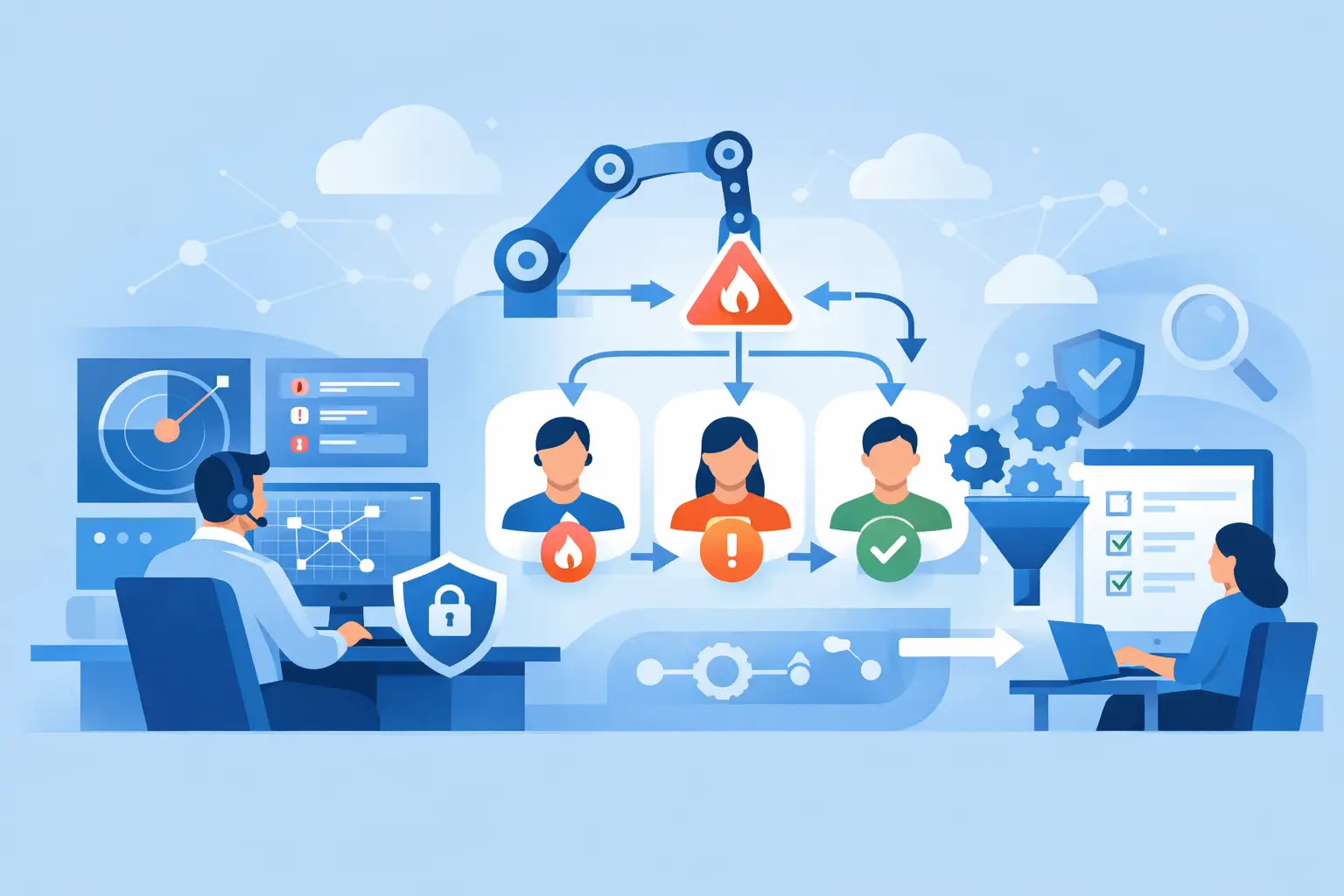
A phishing alert fires from email security. Minutes later, endpoint telemetry shows a suspicious child process. Then identity logs record an impossible travel event for the same user. In too many SOCs, those signals land in different tools, get reviewed by different people, and lose time before anyone sees the pattern. That is exactly why security teams ask how to automate incident triage. The goal is not to hand judgment over to a black box. It is to reduce noise, assemble context faster, and make sure analysts spend time on real incidents instead of sorting duplicates and dead ends.
Incident triage is where security operations either gain speed or lose it. If the first stage of review is slow, inconsistent, or fragmented, everything downstream suffers. Mean time to respond climbs. Analyst fatigue gets worse. Leadership sees more tooling, more spend, and not enough operational improvement.
Automation fixes part of that problem, but only when it is applied to the right tasks. Good triage automation does not replace analysts. It handles the repetitive work that machines are better at: collecting evidence, correlating signals, scoring risk, suppressing known benign activity, and routing incidents based on severity and ownership. The analyst still decides what matters. The difference is that the analyst starts with an incident that already has context.
What incident triage automation should actually do
Many teams approach triage automation as a playbook problem. If alert A happens, enrich it with B and send it to queue C. That helps, but it is too narrow for modern environments. Most real incidents do not begin and end in one control point. They move across identity, cloud, endpoint, firewall, and email. If your automation only works inside one tool, it speeds up a silo instead of improving the investigation.
A stronger model starts by treating triage as an incident-building process rather than an alert-handling process. That means the automation should ingest telemetry from multiple sources, normalize it, correlate related events, and present one workflow to the analyst. When a suspicious sign-in, mailbox rule change, and endpoint execution are tied to the same user or host, the system should group them into one incident instead of three unrelated tickets.
At a practical level, triage automation should do five things well. It should deduplicate alerts, enrich entities, correlate events across controls, apply risk-based prioritization, and trigger the next operational step. If one of those is missing, analysts still end up doing manual stitching.
How to automate incident triage without creating more noise
The biggest mistake is automating bad logic at scale. If your detections are noisy, your asset data is incomplete, or your escalation criteria are vague, automation will push flawed decisions faster. Before you automate, tighten the basics.
Start with detection quality. Review the alert types that generate the most analyst time and the least security value. Some should be tuned. Some should be suppressed under specific conditions. Some should be merged into broader detections that better reflect attacker behavior. Automation is most effective when it starts from signals that deserve attention.
Then define your triage decision points. A mature process usually asks the same questions every time: what asset is involved, who owns it, is the identity privileged, has this entity been seen in recent alerts, is the behavior expected, and what business risk does it create if true? Those questions should not live only in analyst memory. They should be translated into enrichment and scoring logic.
The next step is centralizing telemetry. This is where many SOCs get stuck because their SIEM, SOAR, EDR, email security, cloud tooling, and identity logs all operate on different schemas and timelines. If triage depends on analysts pivoting manually between consoles, automation will only cover a fraction of the workflow. You need a unified incident layer that can correlate related evidence before the analyst opens the case.
Once the data is centralized, build automation around context, not volume. For example, a single malware detection on a test machine may not need immediate escalation. The same detection on a domain controller tied to privilege escalation signals should move to the top of the queue. Good automation weighs identity, device criticality, exposure path, and attack progression. It does not just count alerts.
Start with high-friction use cases
Not every triage path needs automation first. The best starting points are high-volume, repetitive investigations where analysts already follow a consistent pattern. Phishing is a strong example because the workflow is usually clear: inspect sender reputation, compare message patterns, identify impacted users, check whether links were clicked, and determine whether related endpoint or identity activity followed.
Credential abuse is another good candidate. The enrichment steps are well understood, and the business impact is high. If automation can immediately pull sign-in history, MFA status, geolocation, privilege level, device posture, and linked alerts, the analyst can make a decision much faster.
Lateral movement and ransomware precursors also benefit from correlation-based triage. These are not single-alert problems. They are sequence problems. Automation should detect when multiple weak signals together represent a stronger incident than any one alert would suggest alone.
Use scoring carefully
Risk scoring helps with prioritization, but only if the score is explainable. Analysts and SOC leaders need to know why an incident ranked high. Was it the affected asset, the attack technique, the user privilege, the confidence of the detection, or a combination of all four? If the score feels opaque, teams stop trusting it and revert to manual review.
A useful scoring model combines technical severity with business context. A suspicious PowerShell execution on a kiosk is not the same as the same behavior on an executive laptop with access to finance systems. The logic should reflect that reality.
The operating model matters as much as the technology
When teams ask how to automate incident triage, they often focus on tooling and skip process ownership. That creates a predictable failure mode. The automation gets deployed, but nobody governs exceptions, tunes thresholds, or reviews missed escalations. Six months later, the SOC has more workflows but not better outcomes.
Someone must own triage policy. In some organizations that is the SOC manager. In others it is a detection engineering or security operations lead. Either way, ownership should include maintaining enrichment sources, reviewing false positives, validating risk logic, and measuring whether automation is actually reducing analyst load.
The handoff model also matters. If the SOC is fully internal, triage automation should map clearly to your queue structure, escalation paths, and on-call coverage. If you rely on a managed service, the platform and provider need to work from the same incident logic so customers do not get flooded with isolated alerts that should have been consolidated upstream.
This is one reason unified platforms tend to outperform stitched-together stacks in day-to-day operations. When telemetry correlation, incident creation, enrichment, and response workflow happen in one analyst workspace, the gap between detection and action gets smaller. Helxon built its platform around that operating reality because fragmented security operations create delay long before remediation begins.
How to measure whether incident triage automation is working
The first metric is not total alerts processed. That number can be misleading. What matters is whether analysts are spending less time on low-value review and more time on validated incidents.
Track mean time to triage, percentage of alerts auto-closed with acceptable confidence, incident consolidation rate, false positive reduction, and analyst touches per incident. If automation is healthy, you should see fewer duplicate investigations and faster escalation of high-risk activity.
Also watch for quality drift. If auto-closure rates rise but reopened incidents or downstream misses increase, the logic is too aggressive. If enrichment is slow or correlation is weak, the analyst experience may not improve even though the workflow is technically automated. Efficiency only counts when it preserves or improves detection quality.
Executive reporting should translate these changes into operational and business terms. Less analyst time spent on repetitive review means better coverage without immediate headcount growth. Faster triage means shorter containment windows. Better incident grouping means more defensible reporting on what the SOC is actually handling instead of a bloated alert count.
What to avoid when you automate incident triage
There are a few traps worth calling out. First, do not automate every path at once. Start where the workflow is stable and measurable. Second, do not rely on enrichment sources you do not trust. Bad CMDB data and stale asset criticality tags will produce bad prioritization. Third, avoid building triage around vendor-specific alert labels alone. Attackers do not care how your tools categorize events.
Finally, do not mistake orchestration for triage. Launching scripts and tickets is useful, but if the system still cannot tell analysts which signals belong together and why they matter, the hard part remains manual.
The best incident triage automation feels less like a flashy feature and more like operational discipline encoded into the workflow. Analysts get fewer, better incidents. Managers get cleaner queues and better metrics. Leadership gets a SOC that moves faster without adding unnecessary complexity. That is the real target - not more automation for its own sake, but a security operation that can keep pace with the environment it is defending.