
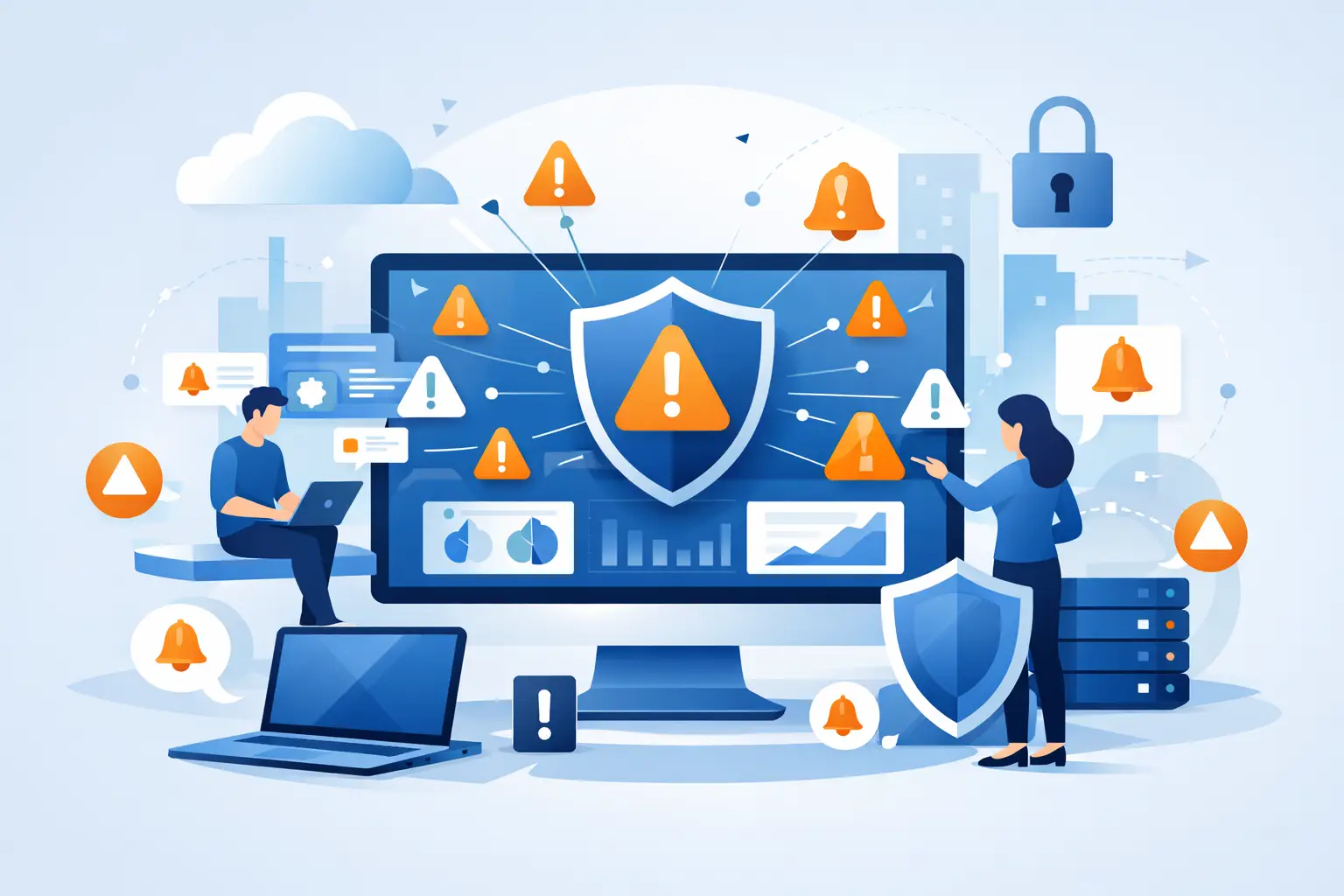
A SOC that starts the day in six consoles is already behind. When firewall events live in one queue, endpoint detections in another, cloud findings in a third, and identity risk somewhere else, analysts waste time switching tools instead of confirming threats. If you want to know how to centralize security alerts, start by treating it as an operations problem, not just a data ingestion project.
Centralization works when it gives analysts one place to see, investigate, and act on related activity. That sounds obvious, but many teams still centralize by forwarding everything into a large repository and calling it done. The result is usually the same mess in a different interface: more data, more noise, and very little improvement in response time.
What centralizing security alerts should actually fix
The real goal is not to collect every alert in one bucket. The goal is to reduce analyst effort per incident while improving detection confidence and response speed. That means a centralized model should correlate signals from multiple sources, group related alerts into incidents, preserve the surrounding context, and support action from the same workflow.
If your team still has to pivot from an email alert to an endpoint tool to an identity provider to a case system, you have not centralized operations. You have only centralized storage. That distinction matters because most SOC bottlenecks happen after the alert arrives.
A well-designed alert centralization strategy should improve three things quickly: visibility, triage quality, and handoff speed. Visibility matters because attackers move across systems. Triage quality matters because isolated alerts are easy to misread. Handoff speed matters because every extra queue, export, and copy-paste step adds delay.
How to centralize security alerts without creating a bigger queue
Start with your highest-value telemetry, not your entire environment. Most teams get the fastest return by bringing together endpoint, firewall, identity, email, and cloud telemetry first. These sources capture a large share of the activity behind ransomware, phishing-led compromise, privilege misuse, lateral movement, and data theft.
The next step is normalization. Different tools describe the same behavior in different ways. One product says suspicious sign-in, another says impossible travel, and a third logs token abuse with no risk label at all. If those signals are not normalized into a common model, analysts will still have to mentally reconcile them. Centralization fails when the platform becomes a translation problem.
Correlation comes after normalization. This is where many programs either gain efficiency or lose it. Good correlation ties related alerts to a user, device, mailbox, IP, or session and presents them as one incident with a clear timeline. Bad correlation either groups too aggressively and hides risk, or not enough and leaves the analyst with ten alerts that describe one attack.
Response capability should be built into the workflow. If an analyst confirms malicious activity but has to leave the system to isolate a host, disable an account, block a sender, or open a ticket, the workflow still has friction in the worst possible moment. Centralization should shorten the path from detection to containment.
Build around incidents, not individual alerts
Analysts do not investigate alerts in isolation. They investigate stories. A phishing alert becomes meaningful when it connects to a mailbox rule change, a risky login, a suspicious PowerShell execution, and lateral authentication attempts from the same user context.
That is why incident-centric operations are a better design model than alert-centric operations. Centralization should produce a unified case that includes affected assets, related entities, timeline, severity, recommended actions, and response history. This cuts duplicate work and makes escalation easier because the next analyst sees the full picture without rebuilding it.
For SOC managers and CISOs, this model also improves reporting. Executives do not need a count of how many disconnected alerts hit the environment last week. They need to know how many credible incidents were detected, how quickly they were triaged, and whether containment happened before business impact spread.
The common failure points in alert centralization
The first failure point is over-ingesting low-value noise. If every informational event from every source is treated as equal, analysts lose trust in the system. Centralization should sharpen signal, not flood the queue. That requires source prioritization, rule tuning, suppression logic, and entity-aware correlation.
The second failure point is keeping detection and action separated. Some organizations centralize alerts into a monitoring platform while leaving response in disconnected endpoint, email, and identity tools. That may look acceptable on an architecture slide, but it slows real investigations. Analysts need fewer jumps, not more.
The third failure point is ignoring ownership. Someone has to maintain parsers, tune detections, retire broken content, and validate that incident grouping still reflects the environment. If that operational ownership is unclear, a centralized stack degrades fast. This is one reason some teams choose a managed model while others keep direct control with a smaller, more unified platform.
How to centralize security alerts in hybrid environments
Hybrid environments are where fragmented operations become most expensive. You may have on-prem network controls, multiple endpoint tools from acquisitions, Microsoft security data, cloud-native findings, and identity events spread across providers. In that setting, centralization is less about forcing uniformity and more about creating one analyst-ready operating layer over a mixed environment.
That operating layer needs broad integrations, but breadth alone is not enough. It should preserve enough source detail for investigations while still standardizing fields that drive correlation and automation. Analysts need both the common view and the original evidence.
This is also where workflow design matters. A hybrid SOC usually has different teams touching the same incident - security operations, identity, infrastructure, cloud engineering, and sometimes legal or compliance. A centralized alert model works better when case ownership, escalation triggers, and response playbooks are already mapped into the platform. Otherwise, the technology centralizes the signal while the organization stays fragmented.
Choosing the right operating model
There is no single answer for every team. Some organizations want full internal ownership because they have mature analysts and strict workflow requirements. Others need centralized visibility but do not have enough staff for continuous monitoring, tuning, and overnight response.
If you are building internally, focus on platform consolidation and analyst efficiency first. Do not recreate the same fragmented process inside a newer interface. If you are leaning toward outsourced support, make sure the provider works from the same unified workflow you see, not a black-box service model that hides triage logic and incident history.
The strongest operating models give you one place to manage detections, incidents, response actions, and reporting whether the work is performed by your team, a managed team, or a blend of both. That flexibility matters because staffing needs change faster than security architecture.
What good looks like after centralization
You know centralization is working when analysts spend less time gathering evidence and more time making decisions. Duplicate alerts drop. Related activity shows up in a single incident. Mean time to triage improves because context is already assembled. Mean time to respond improves because containment actions are available in the same workflow.
You also see a management benefit. Instead of defending a sprawling stack with unclear overlap, security leaders can show operational metrics tied to actual outcomes: lower alert fatigue, faster investigations, cleaner escalations, and more consistent incident handling. That is easier to justify than another tool added to an already crowded architecture.
For teams replacing disconnected SIEM, SOAR, and telemetry workflows, platforms like Helxon VORXOC reflect this shift well because the value is not just aggregation. The value is one coherent incident workflow across endpoint, cloud, identity, email, and network signals with response built in.
The practical test is simple. When the next phishing-led compromise hits, can one analyst see the email event, the user risk, the endpoint execution chain, and the containment options without opening five separate products? If the answer is no, alert centralization is still unfinished work.
The best time to fix that is before your team loses another month to swivel-chair triage and another real threat inside a pile of disconnected warnings.