
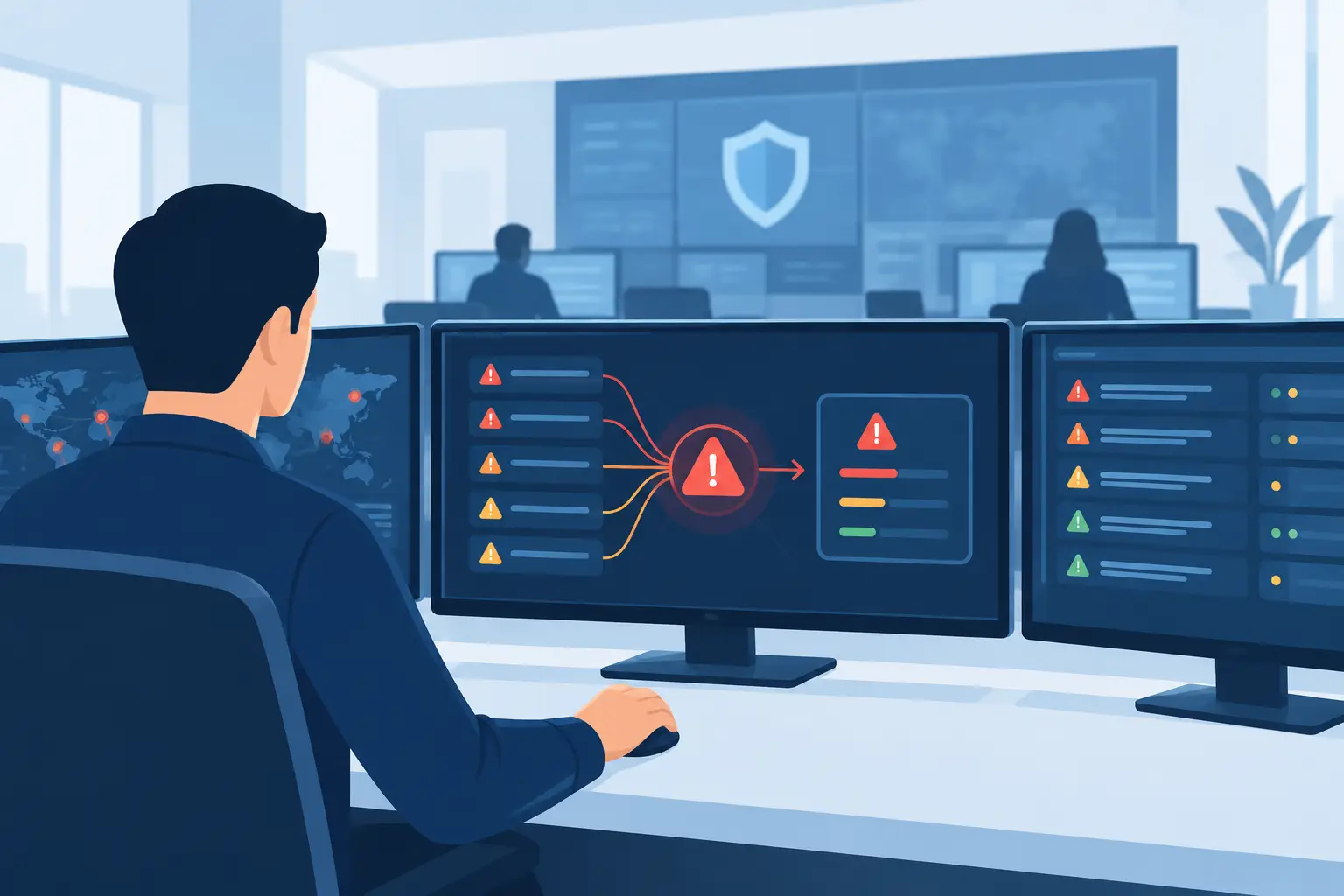
A SOC does not need more alerts. It needs a defensible way to decide which incident deserves action first. Knowing how to prioritize correlated alerts turns a stream of disconnected detections into an ordered response queue based on real business risk, attacker progress, and time to impact.
That distinction matters when one phishing email leads to an identity anomaly, an endpoint process alert, and unusual outbound traffic. Treated separately, those events create four investigations. Correlated correctly, they may represent one active intrusion that requires immediate containment. The goal is not simply to reduce alert volume. It is to make sure analysts spend their limited time on the activity most likely to damage the organization.
Why Alert Severity Alone Fails
Most security tools assign a severity score to each detection. That score is useful, but it is rarely enough to drive the SOC queue on its own. A high-severity malware alert on an isolated test machine may be less urgent than several medium-severity identity and cloud alerts tied to a privileged finance user.
Individual severity describes what a tool observed. Incident priority should describe the probable consequence of what is happening. Those are different decisions.
A reliable priority model accounts for the affected asset, the identity involved, the sequence of activity, the confidence of the detections, and whether the activity suggests an attacker is advancing. This is why correlation is operationally valuable: it adds the context that point products cannot see from one telemetry source alone.
How to Prioritize Correlated Alerts by Incident Risk
Start by grouping related alerts into a single incident rather than ranking each alert independently. Grouping should consider shared users, hosts, IP addresses, cloud workloads, email indicators, timestamps, and attack behaviors. Correlation based only on an IP address or a narrow time window can create false relationships, so the logic should also account for whether the events form a plausible attack path.
For example, a failed sign-in from an unfamiliar location may be low priority by itself. Add a successful sign-in from the same source, a mailbox forwarding rule, and a download of sensitive files, and the priority changes immediately. The correlated incident shows credential compromise and potential data exposure, not a routine authentication anomaly.
Once alerts are grouped, assess the incident across four operational dimensions:
- Business impact: Identify whether the incident affects a domain controller, production server, executive account, payment workflow, customer data store, or a low-value endpoint.
- Attack progression: Determine whether activity is reconnaissance, initial access, persistence, privilege escalation, lateral movement, collection, or exfiltration. Later-stage activity usually demands faster action.
- Detection confidence: Weigh the quality of the evidence. Multiple independent signals from identity, endpoint, firewall, cloud, and email telemetry carry more weight than repeated alerts from one source.
- Response urgency: Consider the attacker’s likely next step and how quickly damage can occur. Suspected ransomware encryption, active account takeover, or data transfer to an untrusted destination should move ahead of activity that can be safely validated.
These dimensions prevent a common failure mode: letting a noisy tool dictate the SOC’s day. A priority score should be explainable in plain language. An analyst and a CISO should both be able to understand why Incident A was handled before Incident B.
Put Asset and Identity Criticality in the Score
Asset criticality must come from the organization’s operating reality, not a generic CMDB label. A production identity provider, a payroll application, a source code repository, and a system used to manage industrial processes should carry different risk weights because compromise creates different consequences.
The same principle applies to identities. A standard user account and a privileged administrator account may generate the same suspicious sign-in alert, but the response priority should not be the same. Include role, permissions, access to sensitive systems, and recent privilege changes when calculating incident risk.
Criticality also changes over time. A server may become high priority during a migration, an executive may be traveling during a merger, or a cloud account may temporarily hold sensitive exports. SOC managers should have a process for updating context as the business changes. Static asset tiers eventually become another source of blind spots.
Score the Story, Not the Alert Count
More alerts do not automatically mean greater danger. A single confirmed command-and-control connection from a privileged server can outweigh dozens of low-confidence endpoint detections. Conversely, a burst of weak alerts may become urgent when it demonstrates coordinated password spraying across multiple accounts.
Prioritization should reward evidence that tells a coherent story. Look for cause and effect: a malicious email attachment followed by a new process, credential access, remote administration, and outbound connections. The sequence indicates attacker behavior and helps analysts decide whether to contain first and investigate second.
This approach is especially effective for ransomware. Early signals can look ordinary in isolation: a PowerShell command, disabled security controls, unusual authentication, and file access. When those signals occur across endpoint, identity, and network telemetry in a short period, the SOC should treat them as an emerging ransomware incident even before encryption begins.
Build a Queue Around Response Decisions
A useful incident queue answers a practical question: what action must happen next? That is more valuable than a dashboard filled with abstract risk scores.
For the highest-priority incidents, the next action may be to isolate an endpoint, disable a session, revoke tokens, reset credentials, block an indicator, or stop a suspicious cloud workload. These actions require confidence and clear approval boundaries. Automation can accelerate containment, but it should not blindly disable a business-critical account because of a single weak signal.
For medium-priority incidents, the next action may be targeted validation. Analysts can verify whether a login came from an approved VPN, whether a process was authorized by IT, or whether a data transfer matches a known business workflow. The key is to preserve the correlation context so the analyst does not reopen five separate consoles and reconstruct the incident manually.
Lower-priority incidents should not disappear. They should be deduplicated, monitored for escalation, and retained for threat hunting and tuning. Repeated low-confidence alerts around the same asset may expose a coverage gap or a misconfiguration. Suppression without review can hide the early stages of an attack.
Use Time to Containment as a Priority Check
A priority model is only useful if it improves response performance. Measure how long high-risk correlated incidents remain unassigned, how quickly containment actions occur, and how often analysts downgrade incidents after reviewing the evidence. These metrics expose whether the queue reflects real risk or simply reproduces tool-generated severity.
Also measure alert-to-incident compression. If 500 raw alerts become 25 meaningful incidents, the SOC has reduced investigation overhead. But compression is not a success if those 25 incidents lack the evidence analysts need to act. The incident record should preserve source events, timeline, affected entities, related indicators, analyst notes, and containment status.
This is where a unified analyst workspace changes the operating model. Platforms such as Helxon VORXOC can correlate firewall, endpoint, cloud, identity, and email telemetry into one incident workflow, helping teams evaluate the full attack path without moving between disconnected SIEM, EDR, and ticketing views.
Tune Correlation Without Hiding Risk
Correlation rules need ongoing tuning because environments, users, and attacker techniques change. Start with high-confidence use cases that combine signals from independent sources, such as impossible travel plus suspicious mailbox activity, or endpoint credential dumping plus lateral authentication attempts.
Avoid building rules that are too broad merely to reduce volume. Over-grouping can merge unrelated activity and obscure a serious event inside a large, vague case. Under-grouping creates the opposite problem: analysts receive a stack of alerts that each lack enough context to justify action. The right threshold depends on telemetry quality, asset inventory accuracy, and the organization’s tolerance for automated containment.
Review closed incidents regularly. Ask whether the priority was correct, whether the correlation logic captured the relevant events, and whether analysts had enough context to make a quick decision. Use those findings to adjust risk weights, enrich asset records, refine detection logic, and identify automation candidates.
A disciplined queue gives analysts permission to act with speed and control. When correlated alerts are prioritized by the likely impact of the full incident, the SOC stops chasing noise and starts interrupting attacks before they become business disruptions.