
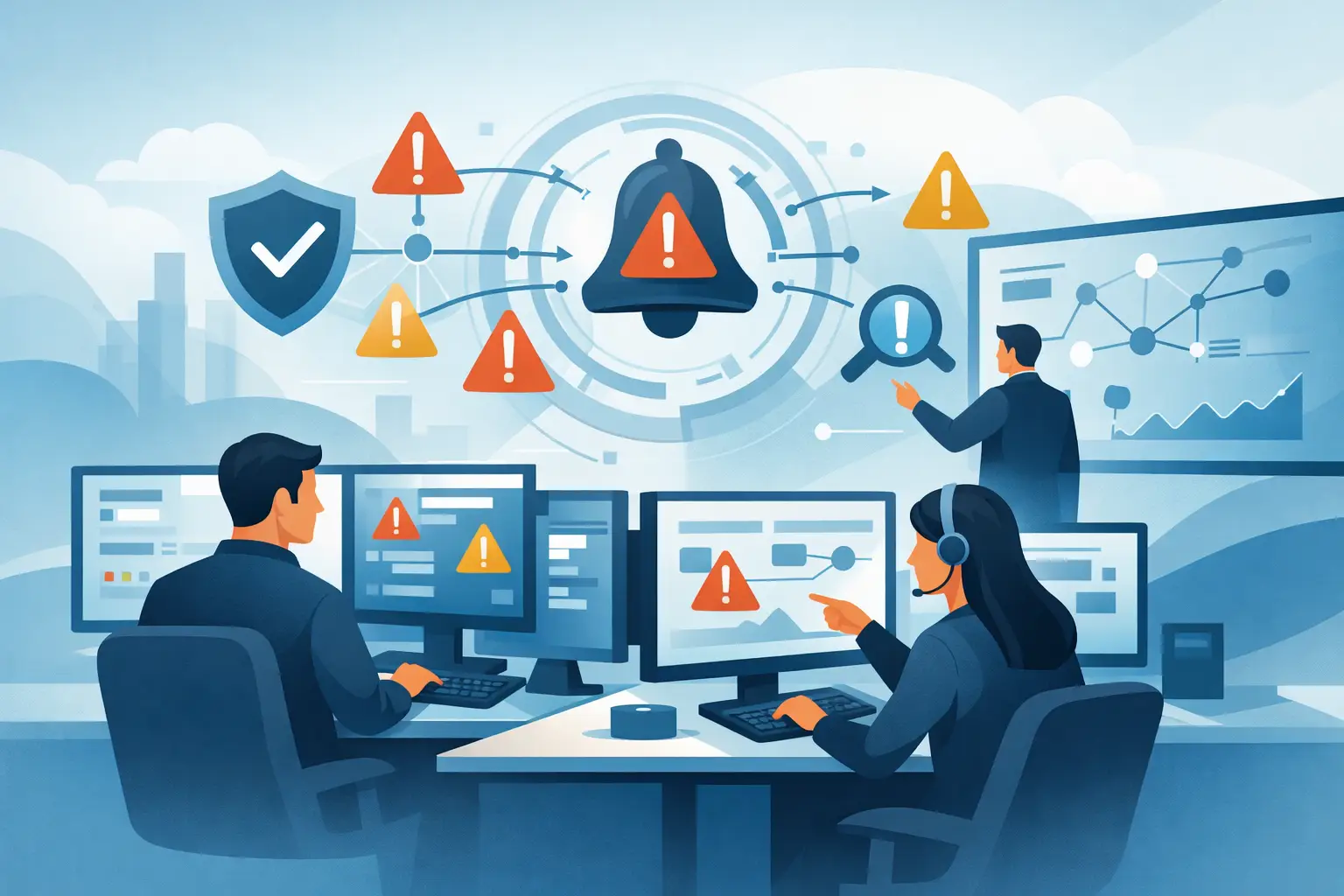
A SOC can receive thousands of alerts in a day, but only a small fraction require immediate analyst action. The challenge in how to streamline alert triage is not simply reducing volume. It is ensuring the right signals reach the right analyst with enough context to make a fast, defensible decision.
When alerts arrive from disconnected endpoint, firewall, identity, cloud, and email tools, analysts spend too much time gathering evidence before they can assess risk. That delay creates more than alert fatigue. It increases dwell time, slows containment, and makes it harder for SOC leaders to explain performance to the business.
Why Alert Triage Breaks Down
Most alert triage problems begin with fragmented visibility. A suspicious login might generate an identity alert, while the related endpoint activity appears in another console and the supporting firewall evidence is buried elsewhere. Each tool may identify a valid signal, but none delivers the full incident story.
The result is a queue built around individual detections rather than real security events. Analysts repeatedly investigate the same activity, close low-value duplicates, and manually pivot between systems to determine whether a detection is benign, suspicious, or actively malicious.
Volume makes the problem visible, but poor prioritization causes the real operational damage. A low-severity alert involving a privileged account, an unmanaged device, and an unusual country may deserve more attention than a high-severity alert from a known benign scanner. Static severity labels cannot account for that context.
How to Streamline Alert Triage With Better Context
The fastest triage process starts before an analyst opens an alert. Detection sources need to feed a shared incident workflow that correlates activity by user, host, IP address, process, email message, cloud workload, and time. Instead of presenting five alerts from five products, the workflow should assemble one incident with the relevant evidence attached.
Correlation reduces duplicate effort, but it must be transparent. Analysts need to see why events were grouped, which detections contributed to the incident, and what sequence of activity occurred. Black-box scoring may reduce queue volume, yet it can create new delays if analysts cannot validate the logic behind a priority decision.
Effective context should answer the first triage questions without requiring a manual search: Who is involved? Which asset is affected? Is the account privileged? What happened before and after the alert? Has this user, device, domain, or IP been seen in prior incidents? Is there evidence of persistence, credential access, lateral movement, or exfiltration?
A unified timeline is particularly useful for multi-stage attacks. Consider a phishing email that leads to a malicious login, endpoint execution, and unusual outbound traffic. Treated separately, those detections may look routine. Correlated into one timeline, they establish a clear escalation path and help analysts move directly to containment.
Build a Risk-Based Priority Model
A triage queue should rank work by likely business impact and attack confidence, not alert severity alone. Risk-based prioritization combines the detection's confidence with environmental context. A medium-confidence alert on a domain controller or finance executive's mailbox should rise above a higher-volume event on a low-value test system.
Use a scoring model that reflects the realities of your environment. Asset criticality, identity privilege, known vulnerabilities, external threat intelligence, unusual behavior, and the number of related detections can all influence priority. The exact model depends on the organization, but the purpose is consistent: put credible, consequential threats at the top of the queue.
Avoid turning risk scoring into an overly complex project. If the model requires constant tuning from a small team, it may become another source of operational drag. Start with a limited set of high-value factors, measure whether the queue improves, and refine based on analyst feedback and closed-case outcomes.
Tune detections with evidence, not frustration
Alert suppression is necessary, but indiscriminate suppression can create blind spots. Before muting a noisy rule, determine whether the detection is wrong, poorly scoped, missing an allowlist, or generating duplicate alerts because correlation is absent.
Track false positives by detection rule, source system, asset type, and business unit. This shows whether the issue is a detection engineering problem or a broader data-quality issue. For example, repeated impossible-travel alerts may reflect VPN routing behavior, while repeated endpoint alerts may indicate an expected administrative process that needs better baselining.
Every tuning change should have an owner, a rationale, and a review date. Threat behavior changes, infrastructure changes, and a formerly harmless pattern can become relevant again. The goal is controlled noise reduction, not permanent silence.
Standardize Decisions Without Forcing Rigid Playbooks
Analysts should not have to decide from scratch what evidence to review for common incident types. Defined triage workflows create consistency across shifts and make it easier to onboard new analysts. They also give SOC managers a way to assess whether decisions are being made with the required evidence.
For phishing, triage might confirm message delivery, recipient exposure, URL or attachment behavior, login activity, and endpoint execution. For suspected ransomware, the workflow should quickly establish the affected host, encryption indicators, backup exposure, lateral movement evidence, and containment status. The checklist changes by use case, but the operating principle is the same: collect the minimum evidence needed to make the next decision quickly.
That does not mean every incident should follow a fixed script. High-confidence commodity phishing can be handled with more automation than a potential insider threat involving a sensitive data repository. Mature triage separates repeatable actions from judgment calls, preserving analyst attention for the cases where context and experience matter most.
Automate Actions That Are Safe to Reverse
Automation delivers the most value when it removes repetitive enrichment and response work without hiding meaningful risk. A triage platform can automatically retrieve user details, device history, geolocation, reputation data, related alerts, and prior case activity. This gives analysts an evidence-rich incident instead of a raw detection.
Response automation should be graduated. Low-risk actions, such as collecting additional telemetry, tagging an incident, creating a case, or requesting a sandbox verdict, can often run automatically. Higher-impact actions, such as disabling an executive account, isolating a production server, or blocking a business-critical domain, may require approval depending on policy and confidence.
The right threshold depends on the organization's tolerance for disruption. A lean team facing active ransomware risk may prioritize rapid endpoint isolation. A regulated environment may require a human approval step and a complete audit trail. Both approaches can be efficient when the decision path is clear and built into the workflow.
Measure the Triage Process, Not Just the Queue
A smaller queue is not automatically a better SOC. Teams should measure whether triage is improving investigation quality and response speed. Mean time to acknowledge, mean time to triage, time to contain, escalation rate, duplicate-alert rate, and false-positive rate reveal different parts of the operating picture.
Also measure analyst effort. If an incident requires repeated console switching, manual copying of indicators, or duplicate case creation, the process is consuming time that could be spent investigating real threats. A useful metric is the number of analyst touches required to reach a disposition or containment decision.
Reporting should connect these operational measures to business risk. Security leaders need to show that high-risk incidents are identified faster, low-value noise is reduced, and the SOC can handle growth without matching every increase in telemetry with additional headcount.
Consolidate the Analyst Workspace
The most durable improvement comes from reducing the number of places analysts must work. A unified SOC platform can bring firewall, endpoint, cloud, identity, and email telemetry into a shared incident workflow, while supporting investigation, case management, and response from the same workspace.
This is where platforms such as Helxon's VORXOC change the operating model. Rather than forcing teams to maintain a disconnected SIEM, SOAR, and collection of point consoles, the platform correlates telemetry into an analyst-ready incident view. Teams can operate it directly or use the same workflow with managed 24/7 SOC coverage.
Tool consolidation is not always an immediate replacement exercise. Organizations with existing investments may integrate first, prove operational gains, and retire overlapping capabilities over time. What matters is establishing one clear system of work for triage decisions and incident ownership.
Alert triage becomes faster when analysts no longer spend their shift proving whether separate signals are related. Build the process around correlated evidence, business-aware prioritization, controlled automation, and a single place to act. That gives the SOC more control over its workload and more time to stop the threats that matter.