
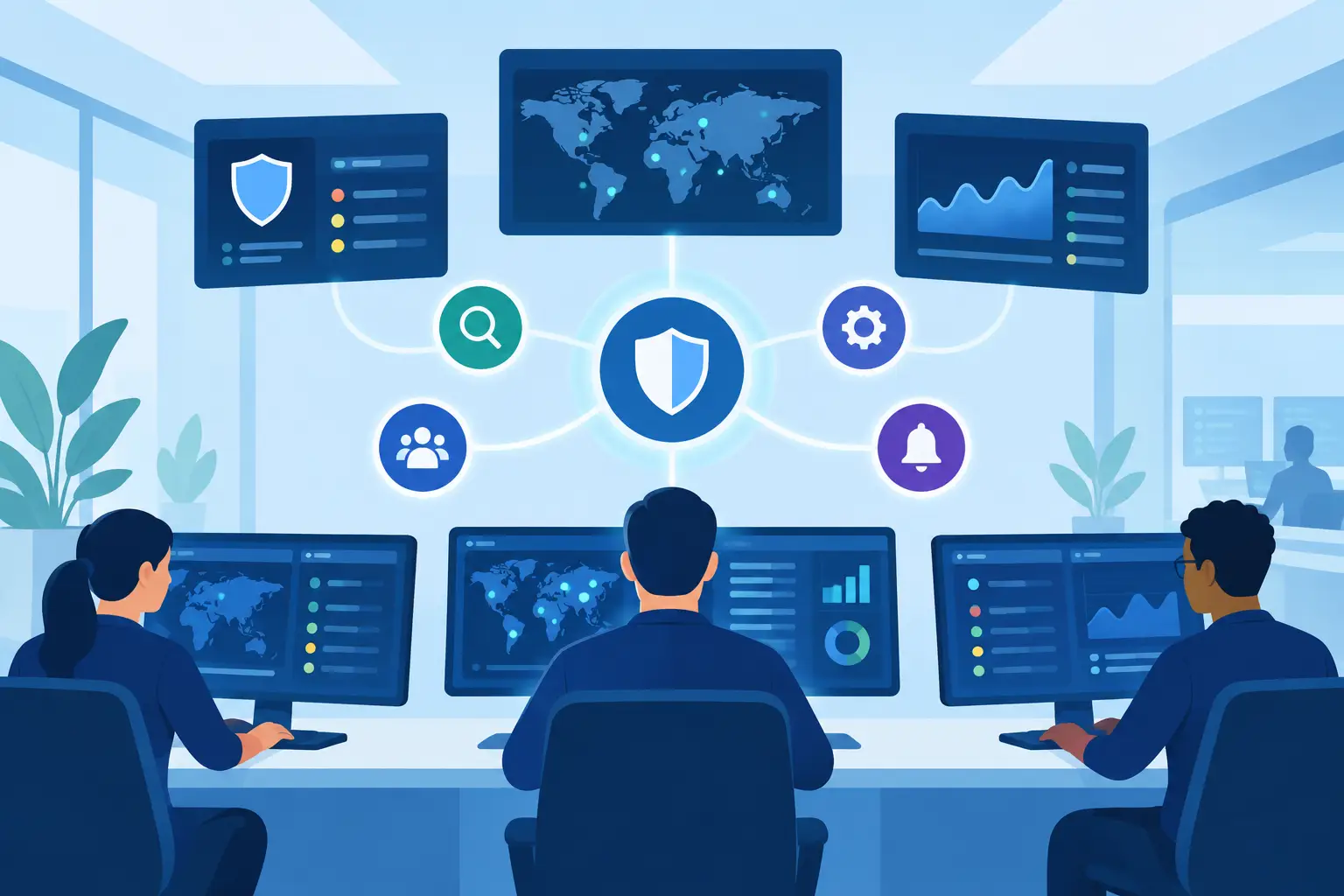
A phishing alert should not require an analyst to pivot across an email console, identity logs, endpoint telemetry, firewall records, threat intelligence, and a separate ticketing system before they can decide whether a user is at risk. Yet that is still the operating model in many SOCs. Learning how to unify analyst workflows means replacing those disconnected pivots with one incident process that carries the evidence, decision history, and response actions together.
The goal is not to force every security tool into a single vendor stack. Most enterprise environments are hybrid by design. The goal is to make the analyst experience coherent: one place to assess priority, investigate scope, coordinate action, document outcomes, and prove what happened.
Why fragmented workflows slow response
Tool sprawl is not only a procurement problem. It creates operational drag at the exact moment speed matters. Every console switch asks an analyst to re-establish context, translate data formats, and determine whether an alert is related to activity already under investigation. The result is duplicated effort, inconsistent decisions, and alerts that remain open simply because nobody has enough time to assemble the full picture.
Fragmentation also distorts risk. A low-severity authentication anomaly may appear harmless in an identity tool. Combine it with an endpoint detection, suspicious mailbox rule, and outbound connection to a known malicious destination, and it becomes a credible account takeover or data exfiltration scenario. When these signals live in separate queues, correlation depends on analyst memory and manual searching.
The business impact is straightforward. More alerts require more analyst hours, while mean time to investigate rises and reporting becomes harder to defend. Hiring more people can help, but it does not fix a workflow that makes every person repeat the same collection and triage work.
How to unify analyst workflows around incidents
A unified workflow starts with an operating decision: the incident, not the individual alert, is the unit of work. Alerts are evidence. An incident is the analyst's complete, prioritized case for action.
That distinction changes how the SOC should organize technology and process. Instead of sending every detection to a queue, collect related signals into an incident that includes affected users, devices, cloud assets, email activity, network traffic, relevant history, and recommended next steps. Analysts should enter the workflow with context already assembled, not with a blank search field and five tabs to open.
Normalize telemetry before analysts need it
Unification depends on broad data coverage, but coverage alone is not enough. Endpoint, firewall, cloud, identity, and email tools describe similar events differently. A practical platform needs to normalize key fields such as user, host, IP address, process, destination, timestamp, and severity so related activity can be compared reliably.
Do not wait for a perfect data model before starting. Prioritize the telemetry that supports your highest-risk use cases: ransomware, phishing, compromised credentials, lateral movement, and data exfiltration. The right sequence depends on the environment. A cloud-first organization may begin with identity, SaaS, and cloud audit signals; a manufacturing or campus environment may need endpoint and network visibility first.
The test is simple: when an alert arrives, can the analyst see the asset, identity, related events, and recent activity without manually stitching together records from multiple systems?
Correlate before the alert reaches the queue
Correlation should reduce noise before it reaches an analyst. Group repeated detections from the same host, tie a suspicious login to follow-on activity, and suppress known-benign patterns with documented rules. This is not about hiding alerts to make reporting look better. It is about ensuring the queue reflects work that requires judgment.
Effective correlation uses both time and entity relationships. Ten failed logins from a single IP may be one event. A successful login from that IP, followed by mailbox forwarding and endpoint credential access, should be treated as one escalating incident. The analyst needs the sequence, not ten isolated notifications.
Be careful with aggressive suppression. A rule that reduces volume but masks early signs of a real attack is not efficiency. Review suppression logic regularly, especially after environment changes, new application deployments, or shifts in attacker behavior.
Put investigation, response, and documentation in one case
A unified incident workspace should keep evidence and action together. Analysts need a timeline of correlated events, entity relationships, assigned ownership, notes, response status, and a complete audit trail. If containment happens in one tool and the decision record lives in another, handoffs become unreliable and post-incident review becomes expensive.
The workspace should also support response actions in context. Depending on access and policy, an analyst may isolate an endpoint, disable or challenge an account, revoke sessions, block a domain, quarantine an email, or open an IT service request. Not every action should be fully automated. High-impact steps often require approval, particularly where business-critical accounts or production systems are involved.
The principle is to automate the repeatable mechanics while preserving human judgment for material decisions. A platform should enrich a suspicious login automatically. It should not necessarily disable an executive account automatically without a defined approval path.
Build a workflow that fits real SOC operations
Technology can centralize data, but the workflow still needs clear decisions. Start by mapping the life of a high-priority incident from detection through closure. Identify who owns initial triage, what evidence confirms escalation, who can authorize containment, and when the incident moves to IT, legal, privacy, or leadership.
Keep triage criteria specific. Analysts should not have to interpret vague instructions such as “investigate suspicious activity.” Define the conditions that elevate priority: privileged account involvement, a known malicious indicator, multiple related telemetry sources, sensitive asset exposure, or confirmed unauthorized action. Clear criteria make decisions more consistent across shifts and reduce dependence on a small number of senior analysts.
Handoffs deserve the same discipline. A case transferred to another analyst should include the current hypothesis, evidence reviewed, actions taken, remaining questions, and next recommended step. A unified platform makes this possible, but managers must make complete handoffs an operational standard.
For organizations without round-the-clock internal coverage, the same incident workflow should extend to managed operations. SOC as a Service works best when the external team operates in the same environment, with the same evidence and escalation rules, rather than sending disconnected email notifications that internal staff must reconstruct the next morning.
Measure whether workflow unification is working
Alert counts are not enough. A lower volume can reflect better correlation, but it can also reflect missing data or overly broad suppression. Measure the quality and speed of the work instead.
Track time from detection to analyst decision, time from confirmation to containment, the number of alerts consolidated into incidents, and the percentage of cases closed with complete evidence. Also measure how often analysts must leave the primary workspace to investigate or act. That number should decline as integrations and incident views mature.
Leadership reporting should show operational outcomes, not just raw activity. Explain which incidents were prioritized, how quickly critical threats were contained, which controls produced the most useful detections, and where visibility remains incomplete. This turns SOC reporting into a defensible view of risk reduction rather than a monthly list of ticket totals.
Avoid the common consolidation mistakes
The first mistake is treating consolidation as a rip-and-replace project. Replacing every existing tool may be justified in some environments, but it can delay improvement and introduce unnecessary operational risk. Start by unifying the workflow across the tools that already produce critical telemetry, then rationalize overlapping capabilities based on evidence.
The second is building automation without ownership. Playbooks need named owners, approval rules, testing, and periodic review. Automation that silently fails or acts on stale assumptions creates a different kind of operational risk.
The third is centralizing data without improving the analyst experience. A larger data lake does not reduce response time if analysts still need complex searches to understand every alert. The workflow must present meaningful context at the moment of triage.
Platforms such as Helxon's VORXOC are designed around this operational model: correlating security telemetry into a unified incident workflow so teams can investigate and respond without rebuilding the case across disconnected consoles.
A unified analyst workflow is successful when the next critical incident arrives and the analyst can answer the essential questions quickly: What happened, what is affected, how serious is it, what has already been done, and what action should happen next? Build toward that standard, then keep refining it with the evidence your SOC produces every day.