
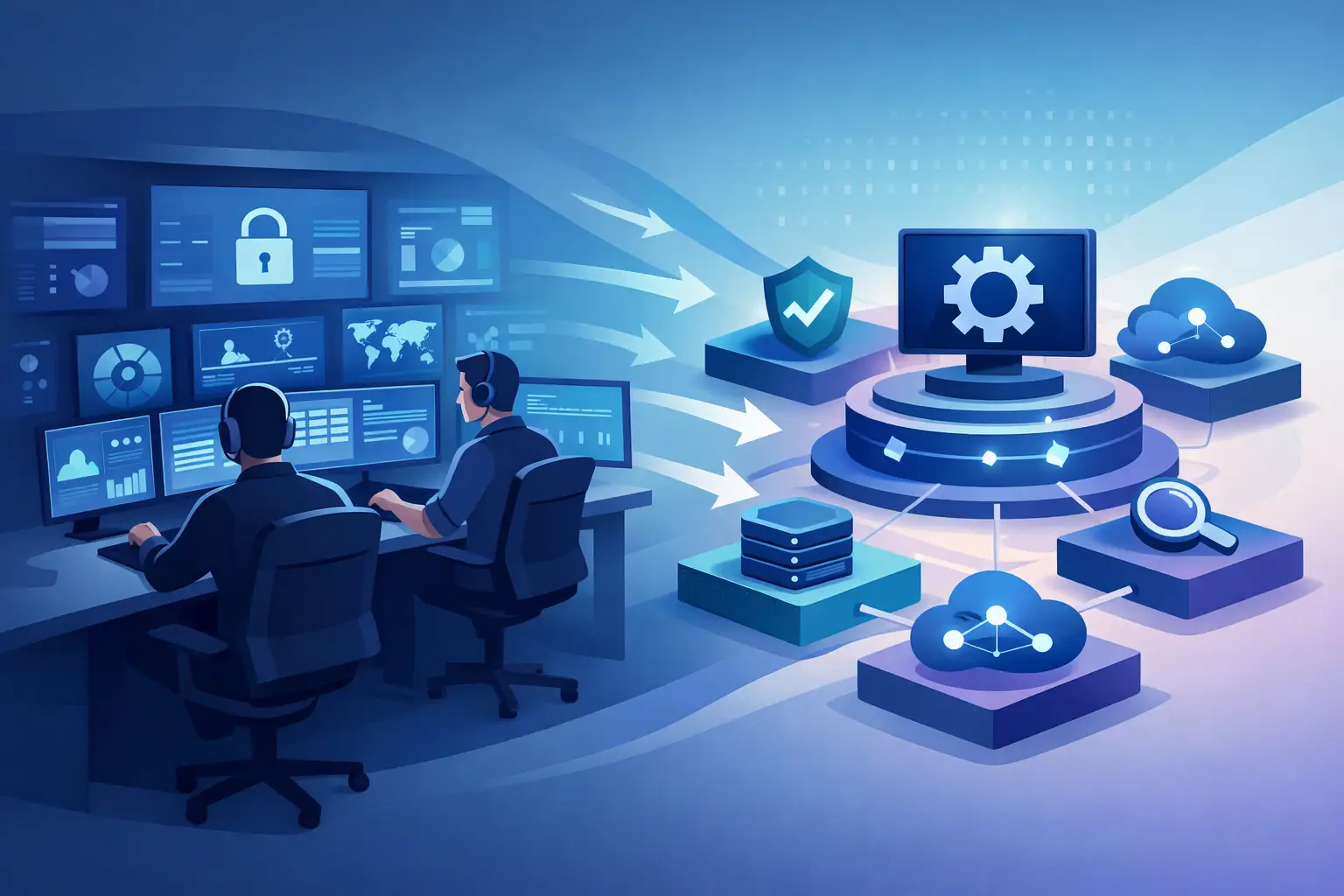
Most SOC teams do not have a detection problem. They have a workflow problem.
That distinction matters when you are deciding how to unify SOC workflows. Many teams already collect enough telemetry from endpoints, firewalls, cloud platforms, identity providers, and email security tools. What slows them down is everything that happens after the alert fires - pivoting between consoles, rebuilding context by hand, duplicating notes, and trying to coordinate response across disconnected systems. If your analysts are spending more time stitching together evidence than making decisions, the stack is working against them.
Why SOC workflows break down
SOC workflows usually fracture as the environment grows. A team adds an endpoint tool for better visibility, a cloud security product for posture and runtime risk, an email defense layer, and maybe a SOAR platform to automate repetitive actions. Each addition solves a local problem. Over time, the operating model becomes fragmented.
The result is familiar. Alerts arrive in different formats. Incidents are tracked in multiple places. Analysts investigate in one tool, enrich in another, and document findings somewhere else. Response actions depend on which console owns the control point. Managers end up measuring activity instead of outcomes because there is no single operational record.
This is why unification is not just a tooling decision. It is an operating model decision. The goal is to create one incident workflow across detection, triage, investigation, and response, even when your environment includes multiple vendors and data sources.
How to unify SOC workflows without creating more complexity
The fastest way to fail is to treat unification like a dashboard project. A common view helps, but it does not fix broken operations on its own. To unify SOC workflows, you need to standardize how incidents are formed, how context is assembled, and how actions are executed.
Start with the incident, not the alert. Alerts are noisy by nature. A unified SOC workflow should correlate related signals into a single case with enough context for an analyst to act. That means linking endpoint behavior, identity anomalies, network indicators, cloud events, and email artifacts around the same suspicious activity. If every telemetry source still generates its own separate investigation path, you have centralization, not unification.
The second step is to define a common workflow state model. Every incident should move through the same operational stages: intake, triage, validation, investigation, containment, remediation, and closure. This sounds basic, but many SOCs skip it because each tool imposes its own process. When workflow states differ by product, handoffs break down and reporting loses credibility.
The third step is to bring evidence and actions into the same workspace. Analysts should not have to switch between five tabs to answer simple questions such as what happened first, which asset is affected, which user was involved, and what containment has already been attempted. If the analyst workspace separates analysis from action, response time will stay high no matter how much automation you add.
The data sources that matter most
A unified workflow does not require ingesting every log source on day one. In fact, overloading a new operating model with too much low-value data can make the situation worse. The better approach is to prioritize the controls that define most real-world investigations.
For most enterprise teams, that means endpoint, firewall, identity, cloud, and email. Those five domains cover a large share of common attack paths, including phishing, credential misuse, lateral movement, command-and-control activity, and data exfiltration. When they are correlated inside one incident model, analysts can move from signal to scope much faster.
There is a trade-off here. Broad ingestion improves visibility, but it can also increase noise and cost if correlation is weak. Narrow ingestion reduces complexity, but blind spots remain if critical attack paths fall outside the workflow. The right balance depends on your environment, threat profile, and staffing model. A lean team often benefits more from tighter, high-confidence correlation across fewer sources than from massive ingestion with poor operational context.
Where automation helps and where it hurts
Automation is part of workflow unification, but it should follow analyst logic rather than replace it.
The highest-value automations are usually the least glamorous. Auto-enriching incidents with asset data, user context, historical activity, and related indicators saves time without hiding important details. Automatically suppressing duplicate signals and grouping related events also reduces alert fatigue in a measurable way. These are workflow improvements because they reduce manual effort at the point where analysts lose the most time.
By contrast, fully automated response can create risk if the workflow lacks reliable context. Isolating an endpoint or disabling an account may be appropriate for a confirmed ransomware pattern, but not for a weak identity anomaly tied to a privileged service account. The more disruptive the action, the stronger the correlation and validation requirements should be.
A practical rule is simple: automate enrichment and orchestration broadly, automate containment selectively, and keep analyst approval where business impact is high.
How to measure whether your SOC is actually unified
If leadership asks whether the SOC is more efficient, tool counts alone are not a good answer. The better measure is whether analysts can move through incidents faster and with fewer handoffs.
Look at mean time to triage, mean time to investigate, and mean time to respond. Track how many alerts are consolidated into a single incident and how often analysts leave the primary workspace during an investigation. Measure duplicate case creation, manual enrichment steps, and the percentage of incidents with complete audit trails. These are operational indicators of whether workflows are improving or still fragmented.
A mature unified SOC also produces clearer reporting. Executives should be able to see incident volume, response times, control coverage, and analyst workload without reconciling multiple systems. That visibility matters because SOC modernization is not just about analyst experience. It is about giving security leadership defensible operational metrics tied to business risk.
Choosing the right deployment model
Not every organization should unify SOC workflows the same way. Some teams want direct control over detection logic, triage, and response. Others need 24/7 coverage without adding headcount. The workflow design should support both realities.
For internally run SOCs, the priority is usually analyst efficiency and platform consolidation. These teams want one place to correlate telemetry, investigate incidents, and execute response. They often care about replacing fragmented SIEM and SOAR processes with a cleaner analyst workflow that is easier to maintain.
For outsourced or co-managed models, consistency matters even more. A managed service only works well when analysts, customer stakeholders, and reporting all operate from the same incident workflow. Otherwise the provider works in one system while the customer reviews another, and operational clarity disappears.
This is where a unified platform approach tends to outperform layered point products. Helxon, for example, positions unified incident operations as the practical fix for noisy alerts, slow investigations, and scattered response actions across hybrid environments. That approach fits organizations that need one workflow whether the SOC is self-managed or delivered as a service.
Common mistakes teams make when trying to unify SOC workflows
The first mistake is assuming integration equals unification. Connecting tools through APIs is useful, but if analysts still think and work in separate systems, the workflow is still fragmented.
The second mistake is over-customizing process logic around legacy tools. If every workflow exception is preserved, the new model inherits the same inefficiencies as the old one.
The third mistake is focusing only on detection fidelity. Better detections help, but they do not solve case management, context assembly, or coordinated response. A SOC can have excellent analytics and still suffer from poor operations.
The last mistake is ignoring adoption. Even a well-designed platform will underperform if analysts are not trained on a consistent investigation model. Unification works when the team trusts the incident record, uses the same workflow states, and knows where actions belong.
What good looks like
A unified SOC workflow feels simpler, but it is not simplistic. An analyst sees one incident, not twenty loosely related alerts. The relevant endpoint, identity, network, cloud, and email evidence is already attached. Triage decisions are faster because context is not scattered. Response actions happen in the same operational flow, with a clear audit trail and measurable outcomes.
That is the real standard for how to unify SOC workflows. Not more screens in one portal. Not more integrations for their own sake. One coherent process that reduces analyst drag, improves decision quality, and shortens the path from detection to action.
If your SOC still depends on analysts to manually connect the dots, the problem is no longer visibility. It is workflow design - and fixing that is where meaningful speed starts.