
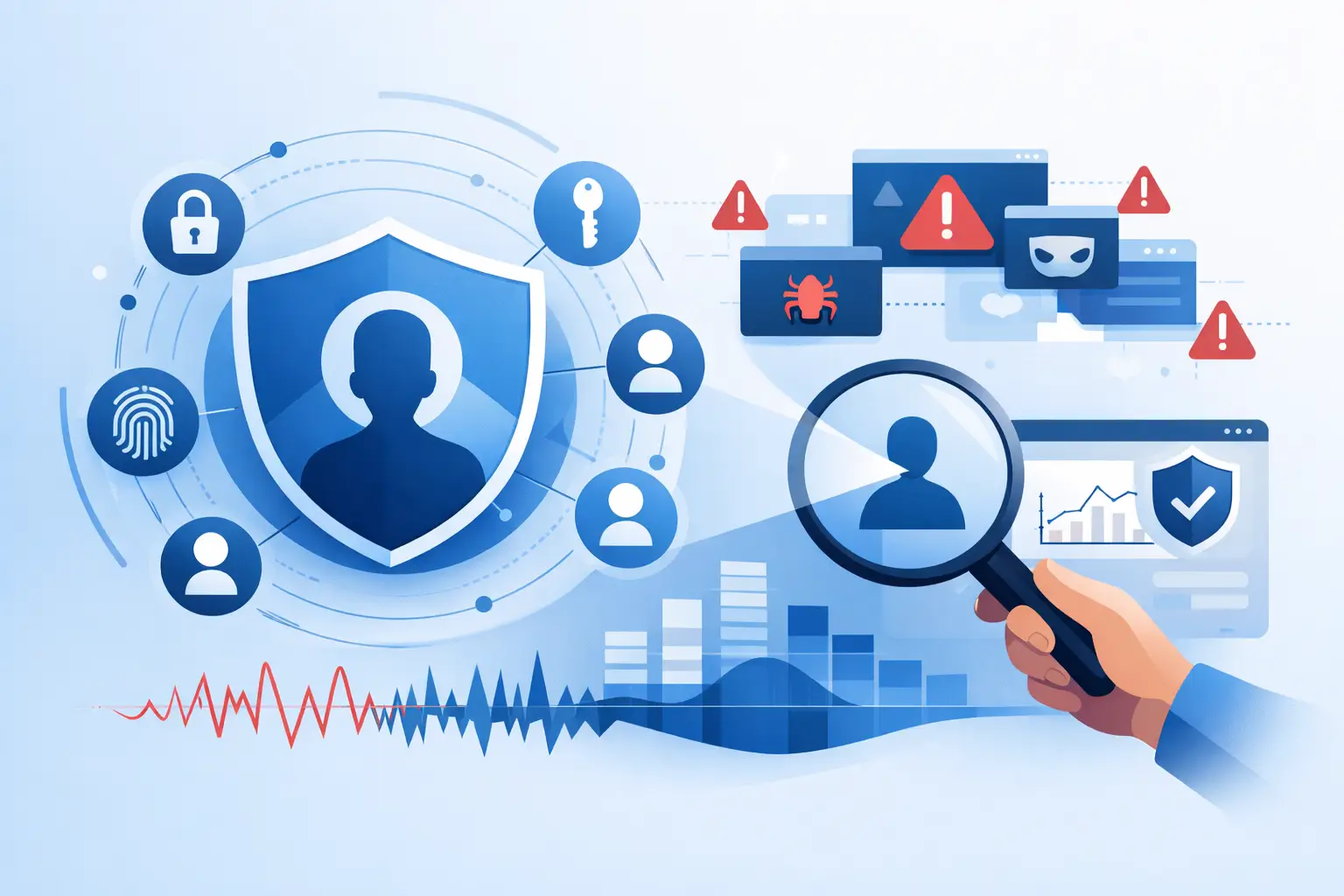
A user signs in from a new location, accepts a suspicious MFA prompt, creates a mailbox rule, and accesses a file share they have never touched before. Treated as separate alerts, those events may never reach an analyst. Identity based threat detection turns them into one investigation with a clear question: is this person, account, or workload identity behaving in a way that creates material risk?
That distinction matters because identities now sit at the center of most enterprise attack paths. Attackers do not always need to deploy malware or exploit a perimeter weakness. A stolen credential, hijacked session token, overprivileged service account, or abused OAuth application can provide a quieter route into cloud services, email, endpoints, and sensitive data. For a SOC already managing high alert volumes, detecting identity abuse requires context, not another disconnected feed of sign-in logs.
Why identity signals change the detection model
Traditional detection programs often organize telemetry by control. Firewall alerts go to one queue, endpoint activity to another, cloud logs to a third, and identity events to a separate identity team or console. That structure reflects how tools were purchased, not how attacks unfold.
A compromised identity crosses those boundaries quickly. An attacker may use a valid VPN session, enumerate cloud resources, add a forwarding rule in Microsoft 365, authenticate to an endpoint remotely, and elevate privileges through a misconfigured role. No single event is necessarily definitive. The risk emerges from the sequence, the timing, the account's normal behavior, and the assets involved.
Identity-based detection changes the unit of analysis. Instead of asking whether one alert meets a severity threshold, the SOC asks what an identity did across the environment, what access it held, and whether the activity aligns with expected behavior. This reduces noise because low-confidence events can be evaluated as part of a broader chain rather than escalated independently.
It also improves prioritization. A failed sign-in burst against a low-privilege test account may deserve monitoring. The same behavior followed by a successful login to a privileged administrator account, access to a domain controller, or changes to conditional access policy is a different operational problem. Detection logic needs to understand that difference.
What effective identity based threat detection looks for
Strong identity detections do not rely on impossible travel alerts alone. They correlate authentication behavior with privilege, resource access, endpoint activity, cloud control-plane changes, email actions, and known threat indicators. The aim is to expose both external account compromise and misuse by legitimate but risky accounts.
Authentication anomalies with business context
Useful authentication signals include sign-ins from unfamiliar devices or networks, unusual geographic patterns, legacy authentication use, repeated MFA denials, session token anomalies, and access outside established work patterns. On their own, these signals can be noisy. Travel, VPN routing, mobile devices, and contractor access all create exceptions.
Context determines whether an anomaly deserves action. Was the account recently assigned an elevated role? Did it authenticate from a managed device? Did it access a sensitive application minutes after a password reset? Did another identity use the same IP address or device fingerprint? An analyst should not have to manually assemble these answers from five consoles.
Privilege changes and access expansion
Privilege is one of the clearest indicators of attacker intent. Monitor new administrator assignments, changes to group membership, modifications to cloud IAM policies, application consent grants, service principal credential creation, and access to dormant or highly sensitive accounts.
The detection should also distinguish between approved operational work and suspicious expansion. A planned role assignment from an approved administrator during a change window is not equivalent to an account adding itself to a privileged group after an unusual login. Integrating identity events with ticketing, asset ownership, and historical account behavior helps make that distinction without forcing analysts to suppress broad categories of alerts.
Lateral movement and endpoint relationships
Identity attacks become more dangerous when they reach endpoints. Remote logons to servers, abnormal use of administrative shares, credential dumping indicators, remote management activity, and access to multiple hosts in a short period can indicate lateral movement.
Here, the relationship between identity and device is essential. A service account may legitimately connect to many systems, while a finance employee account doing the same likely warrants investigation. The SOC needs visibility into who authenticated, where they authenticated, what process initiated the activity, and whether the destination has high business value.
Email, cloud, and data access abuse
Business email compromise and cloud account takeover frequently leave identity-centered evidence before a security team sees malware. Watch for mailbox forwarding rules, delegated mailbox permissions, OAuth consent to unfamiliar applications, changes to payment details, mass downloads, unusual sharing activity, and access to data outside a user's normal scope.
These use cases require careful baselining. A data analyst may download large files as part of legitimate work. A sudden bulk download by a recently compromised account, paired with an unfamiliar sign-in and new cloud access token, deserves a higher severity. The value comes from correlating the pattern, not applying a rigid threshold to one event type.
Build detections around attack paths, not log sources
The most productive way to design identity detections is to start with realistic attack paths. Identify the identities attackers would target, the systems they could reach, the privileges that would increase impact, and the security controls that produce evidence at each stage.
For ransomware, that path may include credential access, privileged group changes, remote authentication to servers, disabling security tooling, and encryption-related endpoint behavior. For phishing, it may include impossible or unfamiliar sign-ins, MFA fatigue, inbox rule creation, OAuth grants, and fraudulent outbound email. For data exfiltration, it may include cloud role changes, unusual repository access, bulk downloads, and external sharing.
This approach exposes telemetry gaps early. If the SOC can see a cloud sign-in but cannot tie it to endpoint activity, mailbox changes, or the account's privilege level, the detection will remain incomplete. Collecting more logs is not the objective. Capturing the events that prove or disprove the attack path is.
Operational requirements for the SOC
Identity detection succeeds or fails in the analyst workflow. Security teams need a normalized identity record that can resolve aliases, user principal names, device associations, service accounts, and cloud identities. Without entity resolution, one compromised user can appear as several unrelated records and break correlation.
Analysts also need a timeline that places identity, endpoint, network, cloud, and email events in sequence. A useful incident view should show the initial access point, affected accounts and assets, privilege changes, related alerts, evidence of persistence, and recommended containment actions. Moving between separate SIEM, EDR, identity, and email consoles adds delay at the exact point when speed matters.
Automation should support judgment rather than conceal it. Automatically enriching an alert with account roles, recent password resets, device posture, prior incidents, asset criticality, and related IP activity can remove repetitive analyst work. High-confidence playbooks can disable sessions, revoke tokens, force credential resets, remove malicious mailbox rules, or isolate a device. But containment thresholds should match business risk. Automatically disabling a production service account on a weak signal can create a costly outage.
Helxon's VORXOC platform is designed for this operational model by correlating identity telemetry with endpoint, firewall, cloud, and email evidence in a unified incident workflow. The practical benefit is not simply more visibility. It is less time spent reconstructing what happened and more time making a defensible response decision.
Measure whether detection is improving response
Alert counts alone are a poor measure of identity security. A lower volume can signal better correlation, but it can also signal blind spots. Track operational outcomes instead: time to validate a suspicious identity event, time to contain a confirmed account takeover, percentage of incidents with complete identity and asset context, repeat false-positive patterns, and the number of privileged changes reviewed within policy.
Also measure coverage by attack path. Can the team detect an unusual privileged login, an OAuth consent abuse event, a suspicious mailbox rule, a cloud role escalation, and identity-driven lateral movement? If an event cannot be detected, investigated, and contained through a defined workflow, it is not meaningful coverage.
Identity signals are most valuable when they shorten the distance between suspicion and action. Give analysts the context to see the whole attack, give response teams clear containment choices, and keep detections aligned to the identities and assets that can create the greatest business impact.