
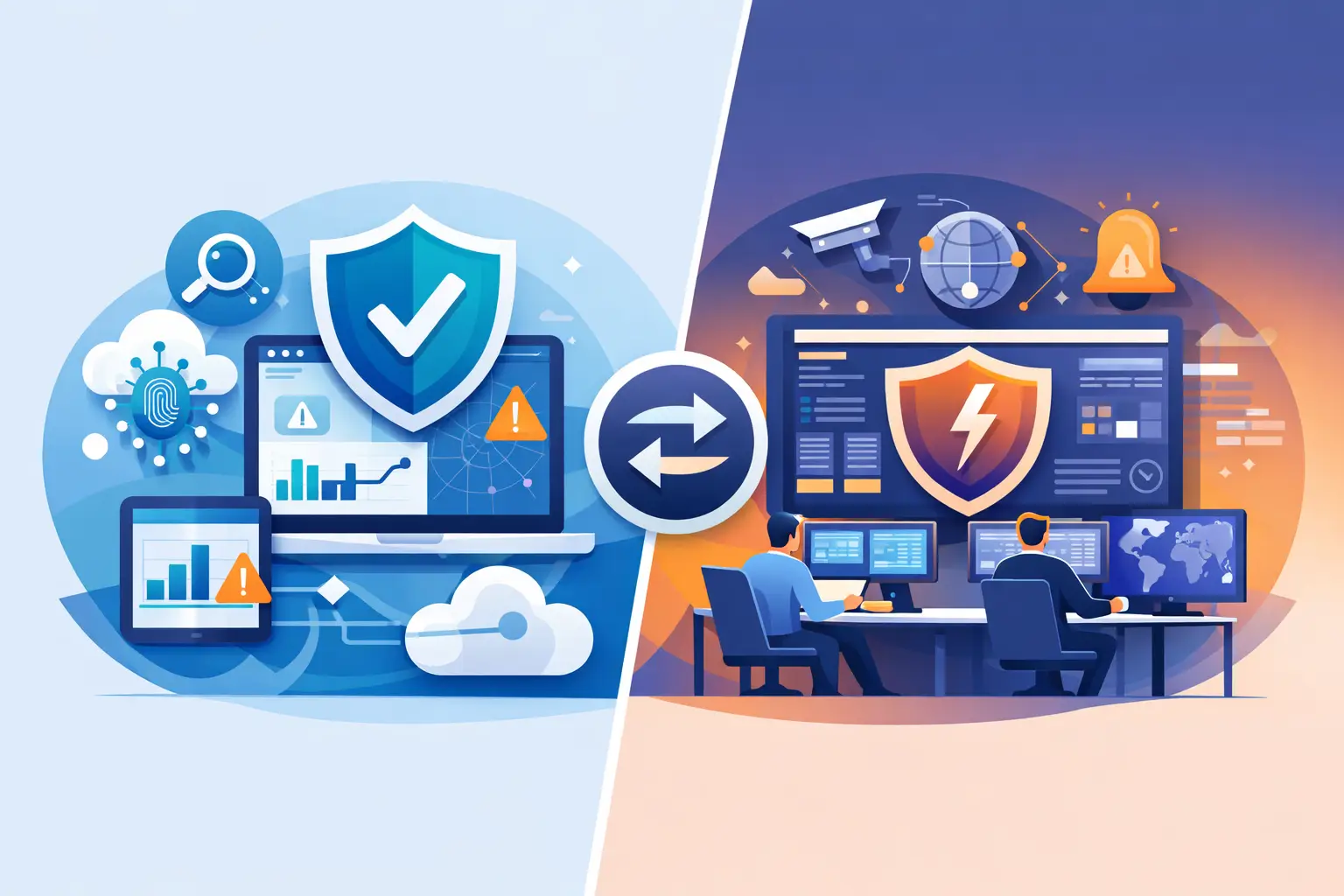
A 2:00 a.m. ransomware alert does not care whether your team calls its provider MDR or SOC as a Service. It cares whether someone has the right telemetry, enough context, clear authority, and a tested process to contain the threat before it spreads. That is why the MDR vs SOC as a Service decision should start with operations, not labels.
Both models can extend a security team, provide 24/7 coverage, and reduce the burden on internal analysts. But they can differ sharply in data ownership, investigation depth, workflow design, response authority, and the level of control your organization retains. Choosing on price or a feature checklist alone often leaves the real problem untouched: alerts still arrive without context, analysts still pivot between disconnected tools, and incidents still wait too long for action.
MDR vs SOC as a Service: The Core Difference
Managed Detection and Response, or MDR, is typically a provider-led service focused on detecting, investigating, and responding to threats. The provider supplies some combination of technology, threat intelligence, detection engineering, and security analysts. Many MDR offerings are centered on endpoint telemetry, although stronger providers extend visibility to identity, cloud, email, network, and other sources.
SOC as a Service is a broader operating model. It provides access to a functioning security operations center without requiring the customer to build and staff every capability internally. Depending on the provider, that can include platform deployment, onboarding, monitoring, triage, incident investigation, threat hunting, reporting, and response support. It may use the customer’s existing tools, the provider’s platform, or a combination of both.
The categories overlap. An MDR provider may market its service as SOC as a Service, and a SOC as a Service provider may include MDR capabilities. The practical distinction is scope. MDR often leads with managed detection and response. SOC as a Service should be evaluated as a full operational capability: how alerts enter the workflow, who investigates them, what evidence is available, who approves containment, and how outcomes are reported.
Start With the Operating Problem, Not the Service Name
Security leaders rarely need another portal. They need a dependable way to move from noisy telemetry to a defensible decision. The right model depends on where that workflow is currently breaking.
An organization with a capable internal SOC may need MDR to cover a defined gap, such as after-hours monitoring, endpoint expertise, or advanced threat hunting. In this situation, the internal team can retain incident ownership while the provider improves detection coverage and escalates verified threats. This works best when integrations, escalation paths, and responsibilities are explicit.
A lean security team facing broad visibility gaps may need SOC as a Service instead. If firewall, endpoint, Microsoft 365, identity, and cloud alerts are landing in separate consoles, adding a narrowly focused managed service can create another handoff rather than a better process. A broader SOC service can centralize telemetry, normalize investigations, and give the business an accountable 24/7 operations function.
For mature enterprises, the choice may be hybrid. Internal analysts can own business-critical investigations, detection strategy, and executive communications, while an external SOC provides continuous monitoring and surge capacity. The key is not whether work is outsourced. The key is whether every party operates from the same incident context.
What to Compare Beyond Coverage Hours
Twenty-four-hour monitoring is valuable, but it is not enough to define a security outcome. During vendor evaluation, focus on the mechanics of detection and response.
Telemetry breadth and correlation
Ask which data sources the service actually uses in investigations, not just which integrations appear on a compatibility list. Endpoint events are essential, but a compromised identity can be the earliest sign of a serious intrusion. Email telemetry may explain how access was gained. Firewall activity may reveal command-and-control traffic or lateral movement. Cloud audit logs may expose privilege abuse and data access.
A service that correlates those signals into a single case gives analysts the context to distinguish a routine anomaly from an active attack. A service that forwards isolated alerts forces your team to perform the correlation under pressure.
Investigation depth
An alert notification is not an investigation. A useful escalation should identify what happened, which users, assets, and accounts are affected, what evidence supports the finding, the likely attack path, and the recommended action. It should also state confidence and urgency plainly.
Some MDR services excel at confirming endpoint-based threats but have limited ability to investigate across the customer environment. That may be sufficient for a focused use case. It is less effective when incidents routinely cross identity, email, cloud, and network controls.
Response authority
Clarify what the provider can do without waiting for approval. Can it isolate an endpoint, disable a user account, revoke cloud sessions, block an indicator, or only recommend those actions? There is no universal right answer. High-impact actions may require customer approval, particularly in regulated or operationally sensitive environments.
What matters is speed and clarity. Preapproved response playbooks for ransomware, suspicious mailbox rules, impossible travel, and privilege escalation reduce uncertainty when minutes matter. If every action requires an email chain and a manual pivot between tools, the service is monitoring, not materially accelerating response.
Platform access and data control
Ask whether your team can access the underlying cases, raw evidence, detection logic, and reporting data. A black-box service may reduce daily workload, but it can limit your ability to audit decisions, improve controls, or transition providers later.
A unified analyst workspace gives internal teams and managed analysts a shared operating picture. Helxon’s VORXOC approach is designed around that model: correlating security telemetry into one incident workflow so customers can choose self-managed operations or 24/7 managed coverage without fragmenting their process.
When MDR Is the Better Fit
MDR can be the right choice when the operational boundary is narrow and well understood. Your team may already have a SIEM, established incident procedures, and analysts who can investigate cross-environment activity during business hours. You need credible overnight coverage, specialized endpoint detection expertise, or a stronger response function without building another shift.
It can also be a sensible first step for organizations that need to improve risk quickly. A focused deployment can reduce exposure faster than a large security transformation, especially when a team lacks time to redesign its entire SOC.
The trade-off is that MDR may preserve the complexity already slowing the team down. If your analysts must reconcile the provider’s alerts with separate identity, cloud, email, and network consoles, the service can improve detection while leaving investigation friction in place.
When SOC as a Service Is the Better Fit
SOC as a Service is usually the stronger choice when the need is operational coverage across the environment, not a point solution for one telemetry source. It is particularly relevant for organizations with small internal teams, growing hybrid estates, multiple security products, or a backlog of alerts that cannot be investigated consistently.
A well-designed service should give you more than outsourced triage. It should establish a repeatable incident lifecycle: ingest relevant telemetry, correlate signals, prioritize meaningful risk, investigate with context, execute or coordinate response, and report on outcomes. That structure helps leadership see whether security operations are improving, rather than simply receiving more alerts.
The trade-off is that provider fit matters more. A broad SOC service needs strong onboarding, clear runbooks, defined response permissions, and regular tuning. Without those foundations, wider visibility can become wider noise.
Questions That Expose the Real Service Model
Use these questions to move the conversation beyond marketing terms:
- Which telemetry sources are used to investigate an incident, and which are only collected?
- What does an escalation include besides the original alert?
- Which containment actions can be performed immediately, and which require approval?
- Will our analysts work in the same case management workflow as your analysts?
- How are detections tuned, false positives measured, and response times reported?
- What happens when an incident crosses endpoint, identity, email, cloud, and network environments?
The answers reveal whether the provider is adding a monitoring layer or operating an integrated security function.
Build for Control, Not Dependency
The strongest model is the one that improves your response capability while preserving the control your organization needs. Some teams need a specialized MDR partner to extend an established SOC. Others need SOC as a Service because maintaining tools, staffing shifts, and investigating alerts across a fragmented environment has become operationally unsustainable.
Do not treat the choice as permanent. Start with the incidents that create the most risk and delay: ransomware behavior, phishing-led account takeover, lateral movement, or data exfiltration. Then select the service model that gives those investigations the clearest context and the fastest path to action. A better SOC is not defined by who watches the alerts. It is defined by how reliably your organization turns evidence into containment.