
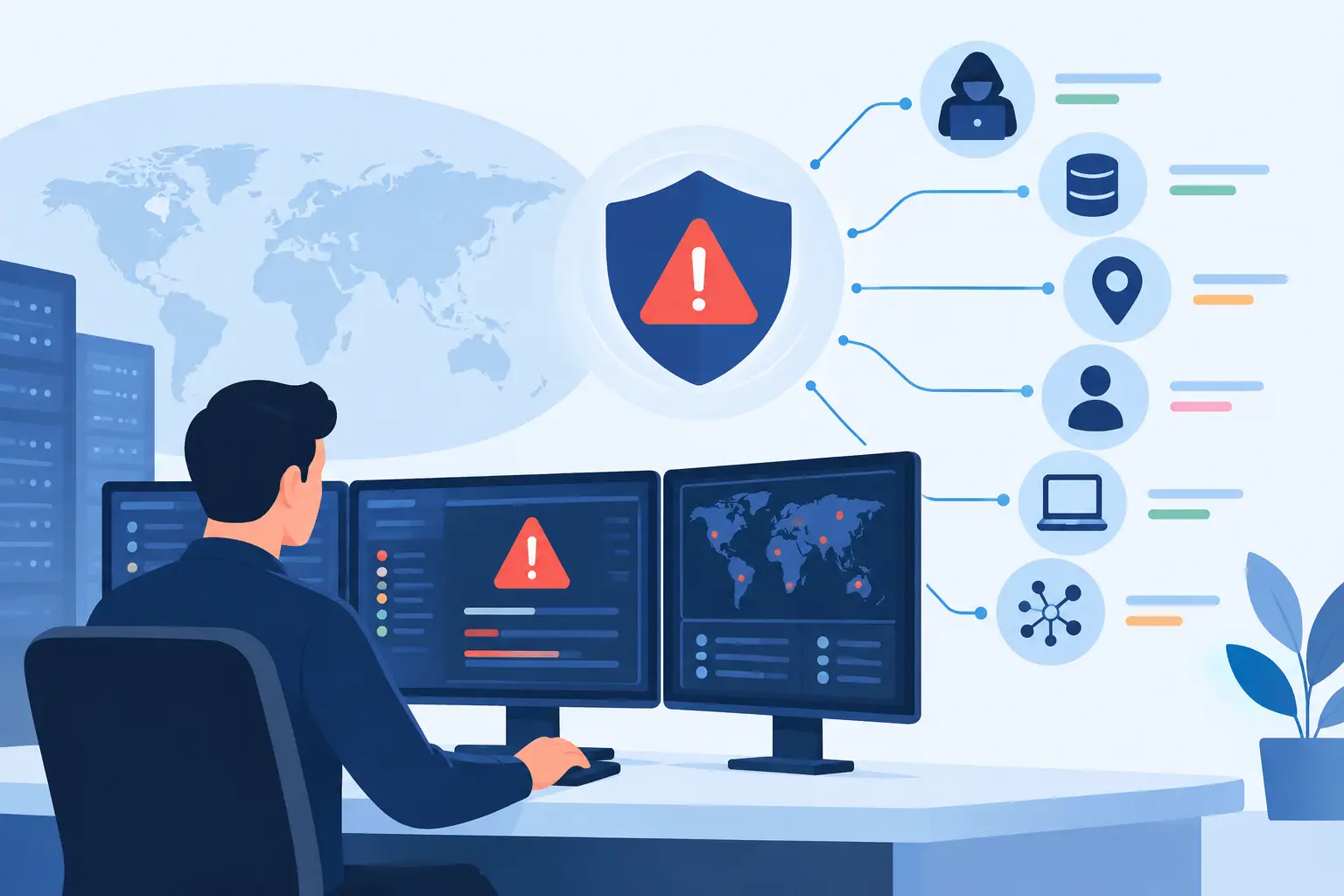
A failed sign-in alert without context is not an incident. It is a question dropped into an analyst queue: Who attempted access? From where? Was the account privileged? Did the same user receive a phishing email, create an unusual session, or access sensitive data afterward? A security alert enrichment guide gives the SOC a repeatable way to answer those questions before alert volume consumes the team.
The operational goal is straightforward: turn isolated telemetry into prioritized, explainable incidents. That means collecting the context analysts need, correlating it across the environment, and presenting a clear next action. Done well, enrichment reduces alert fatigue without hiding real threats. Done poorly, it simply adds more data, more clicks, and more uncertainty.
What security alert enrichment actually does
Security alert enrichment adds relevant evidence to an initial detection. The original signal may come from an endpoint detection tool, firewall, identity provider, email security product, or cloud service. Enrichment connects that signal to the people, assets, activity, and business risk surrounding it.
For example, an endpoint alert for suspicious PowerShell execution becomes more useful when the SOC can immediately see the host owner, asset criticality, process lineage, command-line arguments, recent network connections, identity activity, related email events, and prior alerts tied to the same device. The alert has moved from a technical fragment to an investigation-ready story.
This distinction matters because most security teams do not lack telemetry. They lack a coherent way to use it. Analysts often swivel between consoles to retrieve basic facts, then manually decide whether events are related. That workflow creates delays at precisely the point where ransomware, credential abuse, and lateral movement can accelerate.
Enrichment should therefore support judgment, not replace it. A high-confidence detection may warrant immediate containment even before every field is populated. A low-confidence anomaly may need broader historical context before it earns analyst time. The right depth of enrichment depends on the detection type, asset value, and potential business impact.
The context that changes triage decisions
Not every data point improves an investigation. The best enrichment fields answer questions that affect priority, scope, or response. Four categories consistently matter.
Identity and user context
Identity is often the fastest route to understanding intent and impact. Enrich alerts with the user’s department, role, privilege level, normal location, authentication history, group memberships, and recent account changes. A sign-in from a new country has a different meaning for a traveling sales executive than for a service account that should never authenticate interactively.
Identity context also exposes attack chains that endpoint-only workflows can miss. A successful sign-in after repeated failures, followed by mailbox rule creation and access to a finance share, is not three separate events. It is one developing incident.
Asset and business context
The same malware alert should not receive identical treatment on every device. A developer workstation, domain controller, point-of-sale terminal, production server, and executive laptop carry different operational consequences.
Useful asset enrichment includes hostname, operating system, owner, business unit, environment, criticality, exposure level, known vulnerabilities, and whether the system is internet-facing. This information helps the SOC prioritize based on risk rather than alert source severity alone. Vendor severity is useful input, but it does not understand your business.
Network, cloud, and email context
Modern attacks move across control boundaries. An email attachment can trigger endpoint execution. Stolen credentials can produce cloud activity. A compromised host can establish outbound connections that precede data exfiltration.
Enrichment should capture indicators such as IP reputation, geolocation, domain age, DNS activity, firewall connections, cloud API events, mailbox activity, and file reputation. The objective is not to display every available record. It is to reveal whether the signal is isolated, expected, or part of a broader pattern.
Historical and case context
Analysts need to know what has already happened. Related alerts, prior investigations, previous false-positive decisions, recent remediation actions, and known maintenance windows prevent duplicated effort and inconsistent decisions.
Historical context can also expose slow-moving behavior. A single failed login may be noise. The same account attempting access across multiple systems over several days, paired with unusual privilege requests, deserves a different response.
Build enrichment around the incident, not the tool
Many SOCs attempt enrichment inside each security product. That approach can work for a narrow use case, but it breaks down in hybrid and multi-vendor environments. Context becomes trapped in product-specific dashboards, correlation rules vary by tool, and analysts still have to assemble the incident manually.
A more effective model uses a unified incident workflow. Alerts from endpoint, firewall, cloud, identity, and email controls are normalized, correlated, and grouped around shared entities such as a user, host, IP address, domain, or campaign. The analyst works the incident rather than chasing every individual alert.
This is where correlation and enrichment must operate together. Correlation determines what belongs in the same investigation. Enrichment explains why the combined activity matters. Without correlation, the SOC gets a richer version of the same alert flood. Without enrichment, the SOC gets grouped events with insufficient evidence to act quickly.
Helxon’s VORXOC is designed around this operational model: bringing cross-environment telemetry into one analyst workspace so investigations, response decisions, and reporting are not spread across disconnected tools.
A practical security alert enrichment workflow
Start by mapping the alerts that consume the most analyst time. Do not begin with every detection source. Focus on recurring, high-volume workflows such as suspicious sign-ins, phishing reports, endpoint malware, impossible travel, privileged account activity, and outbound connections to suspicious infrastructure.
For each alert type, define three things: the decision an analyst must make, the evidence needed to make it, and the action that follows. For a suspected phishing incident, the decision may be whether the message reached other users or led to credential use. Relevant evidence includes sender reputation, recipient count, URL and attachment analysis, delivery status, click activity, mailbox searches, and identity events after delivery.
Then set enrichment expectations by tier. Critical detections should pull high-value context automatically and open an incident with recommended containment steps. Medium-confidence alerts may collect core evidence and wait for validation. Low-risk signals may be retained for correlation rather than generating a standalone case. This preserves analyst capacity while keeping weak signals available when a larger pattern emerges.
Automation should handle collection, correlation, deduplication, and routine actions with clear guardrails. For instance, an account can be automatically challenged or temporarily disabled when several high-confidence indicators align. But irreversible actions, such as deleting cloud resources or isolating a business-critical server, may require approval. Speed matters, but uncontrolled automation can create its own outage.
Measure whether enrichment is improving the SOC
More fields in an alert do not prove value. Track operational outcomes that show whether analysts are moving faster and making better decisions.
Useful measures include mean time to acknowledge, mean time to investigate, mean time to contain, alert-to-incident conversion rate, duplicate alert reduction, false-positive rate, and the percentage of incidents closed with documented evidence. For leadership, connect these metrics to analyst workload, coverage gaps, and risk reduction on critical assets.
Review closed incidents regularly. If analysts repeatedly open another console for the same fact, add that context to the enrichment workflow. If a field is rarely used, remove it or move it out of the primary view. Effective SOC design is disciplined about reducing noise, including noise created by enrichment itself.
Common enrichment failures to avoid
The first failure is treating enrichment as a data collection project. Sending every log field into an incident screen creates visual clutter and slows triage. Prioritize evidence that changes a decision.
The second is relying entirely on external threat intelligence. Reputation data can help, but a clean IP address does not make suspicious behavior safe, and a flagged domain may be harmless in the context of approved business activity. Local environment context often carries more weight.
The third is ignoring data quality. Incomplete asset inventories, stale ownership records, inconsistent user identifiers, and unsynchronized timestamps weaken correlation. Before expanding automation, validate the identity and asset data that your enrichment depends on.
Finally, avoid designing workflows around ideal analyst availability. A mature enrichment process should support a staffed internal SOC, a lean team, or managed 24/7 coverage. Incidents do not wait for the next shift, and neither should the context required to contain them.
The best enriched alert gives an analyst fewer places to look and a clearer reason to act. That is the standard worth designing for: not more security data, but faster decisions backed by evidence.