
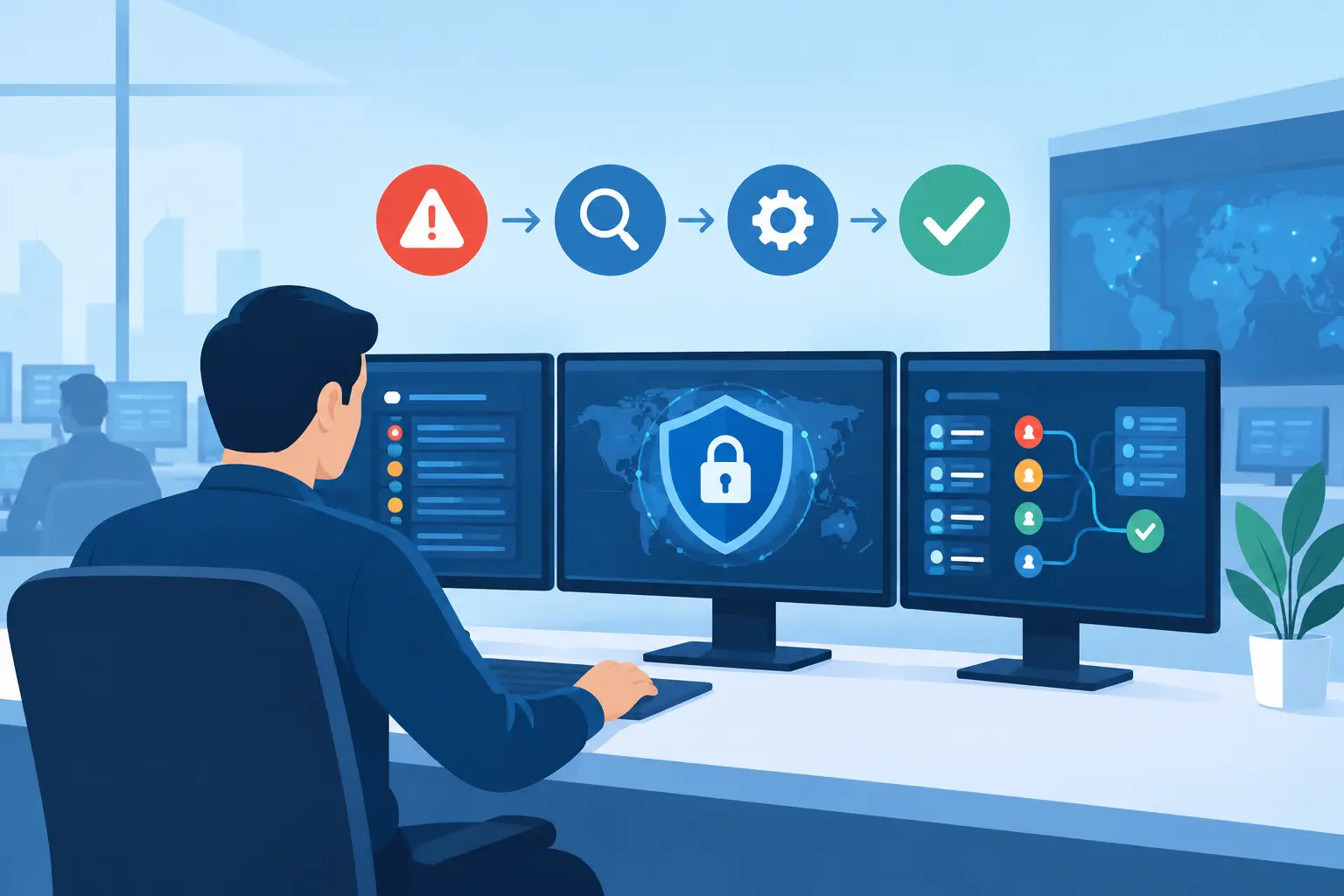
A security case management review is not a paperwork exercise. It is a direct assessment of whether your SOC can move from an alert to a defensible decision without losing time, evidence, or ownership along the way. When cases live across SIEM dashboards, ticket queues, chat threads, spreadsheets, and analyst memory, the organization does not have a repeatable response process. It has a collection of individual workarounds.
For SOC leaders, the review should answer a practical question: can an analyst see the full story of a security event, assign the right action, document the outcome, and close the loop quickly enough to limit risk? If the answer depends on which analyst is on shift or which tool generated the alert, the workflow needs attention.
What a Security Case Management Review Should Measure
Security case management connects detections, evidence, analyst actions, communications, decisions, and remediation tasks into one record. Reviewing it means examining the operational path of actual cases, not simply checking whether a ticketing system is available.
Start with a representative sample of closed and active cases. Include high-volume events such as phishing and endpoint malware, plus higher-impact investigations involving identity abuse, lateral movement, ransomware indicators, or suspected data exfiltration. The goal is to identify where context disappears, handoffs slow down, and decisions become difficult to defend.
A useful review looks at five operating measures:
- Time to triage: How long does it take to determine whether an alert needs investigation?
- Time to contain: Once malicious activity is confirmed, how quickly can the team isolate, disable, block, or otherwise contain it?
- Evidence completeness: Does the case retain the alerts, telemetry, enrichment, analyst notes, and actions needed to explain the outcome?
- Ownership clarity: Is one person or team accountable for the next action at every stage?
- Closure quality: Does closure show why the case was resolved, what was remediated, and whether follow-up work is required?
These measures reveal more than average response times. They show whether the SOC is operating from shared context or repeatedly rebuilding it under pressure.
Follow the Case From Alert to Closure
The fastest way to expose process gaps is to trace a case chronologically. Pick an incident that required more than a simple false-positive disposition and reconstruct what happened from the first alert through final closure.
Examine how alerts become cases
Not every alert deserves a case. If every low-confidence detection creates one, analysts spend their shifts closing duplicates and documenting noise. If thresholds are too high, meaningful signals are ignored until a larger incident forces attention.
Review the logic that creates cases. Look for duplicate alerts from endpoint, identity, firewall, cloud, and email tools that describe the same activity. A user who receives a malicious email, launches a payload, and authenticates from an unusual location may trigger several alerts. Those signals should become one investigation with connected evidence, not separate tickets assigned to different analysts.
This is where fragmented tools create avoidable work. The analyst should not need to manually correlate usernames, IP addresses, hostnames, hashes, and timestamps across disconnected consoles before deciding whether an incident exists.
Test the quality of investigation context
Open several cases as if you are the on-call analyst. Can you immediately identify the affected user, asset, source, timeline, related alerts, severity, and current containment status? Or must you search multiple tools before the first meaningful decision?
Strong case management presents relevant telemetry in the context of the incident. It links an endpoint process tree to identity activity, email delivery data, firewall connections, and cloud events when those sources are related. It also preserves the timeline of analyst actions, so the next shift can understand what has been checked and why a decision was made.
Context does not mean placing every log line into a case. Excess data can slow investigations just as much as missing data. The right standard is relevance: enough evidence to validate the detection, determine scope, and direct the next response action.
Review assignment and escalation paths
A case can be technically complete and still fail operationally when ownership is unclear. Review assignment history. How often does a case move between analysts, teams, or queues before someone takes action? How long does it sit unassigned after a severity change? Are escalation rules based on business impact, affected systems, and confidence, or only on a generic severity label?
A mature workflow distinguishes between investigation ownership and remediation ownership. A SOC analyst may validate a compromised account, while an identity team disables it and an endpoint team reimages an affected device. The case should keep those tasks connected without forcing the analyst to chase status through email or chat.
For organizations using a managed SOC, this distinction matters even more. The provider must have clear authority for defined containment actions, clear escalation paths for approvals, and a shared record of work completed. A 24/7 service does not reduce accountability. It makes operating boundaries more important.
Find the Friction That Inflates Response Time
Most case management delays are not caused by analysts working slowly. They are caused by repetitive context gathering, manual routing, unclear playbooks, and tools that do not share state.
Look for recurring friction in case notes and analyst interviews. Common indicators include analysts copying evidence into tickets, reopening cases because the original closure lacked detail, manually checking the same enrichment sources on every alert, or waiting for another team to confirm an action that could be automated under a defined policy.
Also compare the stated process with what analysts actually do. A playbook may say that a suspicious login requires user, device, location, MFA, and privilege checks. If analysts must open five consoles and build the timeline themselves, the playbook is correct but the operating model is inefficient.
Automation can reduce this burden, but only when it supports sound decisions. Automatically enriching a case, collecting evidence, opening remediation tasks, or disabling a clearly compromised account can save critical minutes. Automatically closing ambiguous detections without enough safeguards can conceal real threats. The right level of automation depends on detection confidence, asset criticality, and the potential business impact of a wrong action.
Make Case Data Useful to Analysts and Leaders
Case management is often evaluated only as an analyst workflow. That misses its role in operational reporting. Leadership needs credible answers to basic questions: What incidents are affecting the business? Where is response time improving or deteriorating? Which attack paths generate the most workload? Are teams closing cases quickly because risk is reduced, or because the queue is being managed down?
A security case management review should test whether reporting can separate volume from risk. A lower number of cases may indicate better prevention, improved correlation, or overly aggressive suppression. More closed cases may reflect efficiency, or it may mean analysts are closing weakly documented investigations to meet a service-level target.
Useful reporting connects outcomes to operational causes. For example, phishing cases may decline after email controls are tuned, while identity-related cases rise because new cloud applications create more authentication telemetry. That context helps security leaders justify investments in integrations, detection engineering, staffing, or managed coverage.
The strongest reports are grounded in the same case record analysts use. When executive metrics must be assembled manually from multiple tools, confidence drops and reporting cycles become slow.
Define the Target Operating Model
After the review, prioritize improvements based on the biggest operational constraints rather than attempting a wholesale process redesign. If analysts are spending most of their time correlating duplicate alerts, unified detection and incident correlation should come first. If investigations are complete but containment waits on handoffs, focus on task orchestration, authority models, and integrations with identity and endpoint controls.
For some teams, the answer is a consolidated platform that brings telemetry and response workflow together. Helxon's VORXOC model is designed around this operational need, giving analysts a shared incident workspace across endpoint, firewall, cloud, identity, and email data rather than another disconnected console.
For other organizations, the immediate gap is coverage. A lean internal team may need a managed SOC to handle first-line triage and overnight investigations, while retaining approval authority for business-sensitive actions. The best model depends on internal expertise, regulatory requirements, the maturity of existing integrations, and the speed expected for containment.
Do not treat the review as a one-time audit. Revisit a sample of cases after major tooling changes, new cloud deployments, or material shifts in threat activity. The practical standard is simple: every case should make the next decision easier than the last. When the workflow consistently preserves context, assigns action, and records outcomes, the SOC gains the speed and control it needs when an alert becomes a real incident.