
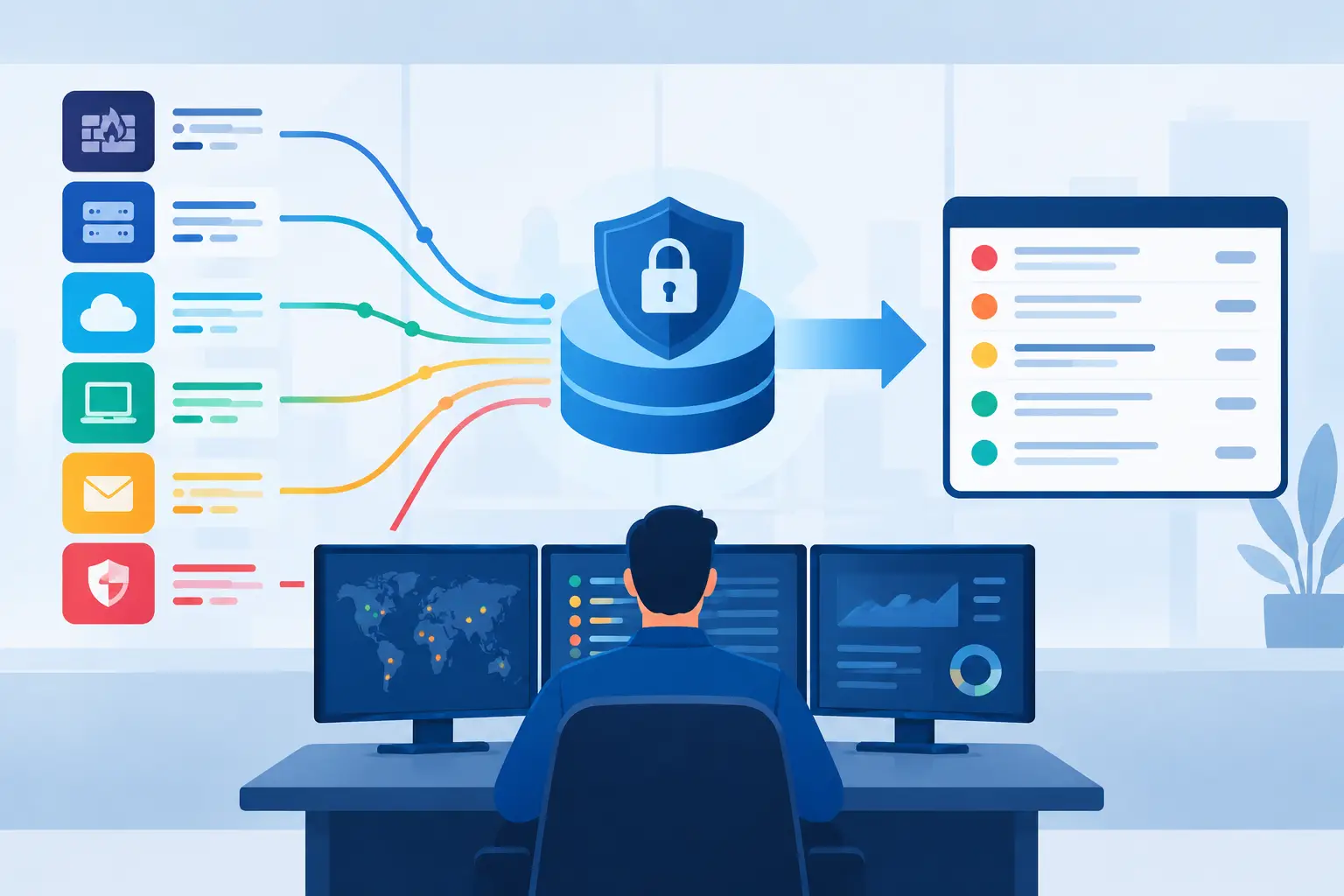
A failed sign-in in Microsoft Entra ID, a suspicious PowerShell command on an endpoint, and a firewall connection to a known-bad IP may describe one intrusion. Yet they often arrive in the SOC as three differently formatted alerts with incompatible usernames, timestamps, hostnames, and severity labels. Analysts lose time translating the data before they can investigate it.
This security event normalization guide explains how to turn inconsistent telemetry into usable security evidence. The objective is not to make every log look identical. It is to preserve the source detail analysts need while applying a common structure that makes correlation, triage, reporting, and response faster.
What security event normalization actually solves
Security event normalization converts source-specific records into a consistent schema. A firewall may call a device `src_ip`; an endpoint tool may call it `remoteAddress`; a cloud audit source may nest it inside a JSON object. Normalization maps each value to a predictable field without discarding where it came from.
That sounds like a data management task. In practice, it is an operations decision. When identity events, endpoint activity, email telemetry, cloud logs, and network data use a common vocabulary, detection logic can follow behavior across control boundaries. A rule no longer needs separate logic for every vendor's field names just to identify impossible travel, credential misuse, lateral movement, or data exfiltration.
The alternative is familiar: detection content becomes brittle, correlation fails silently, and analysts manually reconcile records during every meaningful incident. More data does not fix that problem. Structured, reliable data does.
Security event normalization guide: Start with decisions
Do not begin by attempting to normalize every available field from every source. That approach creates a long implementation cycle and a schema full of fields no one uses. Start with the investigations your SOC must complete quickly.
For ransomware, that may mean relating endpoint process activity, file changes, privileged account use, network connections, and backup-system events. For phishing, the priority may be sender identity, recipient, message disposition, URL or attachment indicators, user click activity, and subsequent authentication events. For cloud account compromise, it may center on user identity, authentication method, source location, session context, API action, and privilege changes.
These use cases reveal which entities and actions must be comparable across sources. They also expose gaps. If an analyst cannot connect an email recipient to an endpoint user or map a cloud identity to a privileged account, the issue may not be detection coverage. It may be inconsistent identity normalization.
Define a canonical schema that analysts recognize
A canonical schema is the common data model used for normalized events. It should be broad enough to support multiple telemetry types but practical enough for analysts and engineers to use consistently. Avoid an overly academic model that requires specialists to interpret basic fields.
At a minimum, establish consistent fields for time, event category, activity, outcome, severity, user or service identity, asset identity, source and destination network attributes, process details, cloud resource context, and observables such as domains, hashes, URLs, and IP addresses. Keep both a normalized value and source-specific context where it matters.
For example, an `authentication` category could cover VPN logins, SaaS sign-ins, Active Directory authentication, and privileged access events. The activity field can distinguish login, token creation, multifactor challenge, password reset, or access denial. The outcome field should use a controlled set of values such as success, failure, blocked, or unknown.
Controlled values matter because vendors use severity and outcome labels inconsistently. One product's "high" can be another product's informational event. Rather than blindly carrying source severity into the core model, retain the original rating and assign normalized severity based on your SOC's triage policy.
Preserve the raw record and its provenance
Normalization should never become a black box. Analysts need the original event when they question a parser result, validate a detection, or investigate vendor-specific details. Store the raw event or a retrievable immutable reference alongside the normalized record.
Also preserve provenance: the originating product, integration, tenant, collector, parser version, ingestion time, and normalization status. These details support auditability and make pipeline failures easier to isolate. If a SaaS provider changes an API field, a parser version and error rate can show exactly when coverage changed.
This separation solves a common false choice. Teams do not have to choose between clean correlation data and full-fidelity forensic detail. They need both, with a clear relationship between them.
Normalize the fields that drive correlation
Some normalization errors have a much greater operational cost than others. Focus validation effort on the fields that join events into a single investigation.
Identity is usually the hardest. The same person may appear as an email address, a short username, a user principal name, an employee ID, a cloud object ID, or a service account. Normalize to a durable primary identifier where possible, while retaining aliases and the identity provider context. Do not assume `j.smith` is globally unique across domains or tenants.
Asset identity needs the same discipline. Hostnames change, private IP addresses are reused, and cloud workloads can be short-lived. Use stable device IDs, cloud instance IDs, subscription or account identifiers, and authoritative asset inventory data when available. A hostname remains useful, but it should not be the only key.
Time deserves equal attention. Normalize timestamps to UTC, preserve the source timezone if supplied, and distinguish event time from collection time and ingestion time. Delayed logs can otherwise look like late attacker activity, distorting timelines and automated correlation windows.
Network context is another frequent source of mistakes. Mark whether an address is internal, external, translated, proxy-derived, or observed at a particular enforcement point. A firewall's source IP and an identity provider's client IP may both be accurate while representing different points in the same connection path.
Build the pipeline for change, not just onboarding
A practical normalization pipeline has four stages: parse the source record, map it to the canonical schema, enrich key entities, and validate the output. Each stage should be observable and independently testable.
Parsing extracts data from raw formats such as JSON, syslog, CSV, APIs, and proprietary event structures. Mapping applies field names, event categorization, and controlled values. Enrichment adds context such as asset ownership, business unit, criticality, threat intelligence matches, user role, or known administrative behavior. Validation checks that required values are present and that mappings behave as expected.
Treat parsers and mappings as production code. Version them, test them against representative event samples, and monitor changes in field population, parse failures, and event-category distribution. A source can remain connected while becoming operationally useless if a vendor update causes critical fields to go blank.
It also helps to define a minimum quality threshold by source. High-value identity and endpoint sources may require complete user, asset, action, and timestamp fields before they are allowed into correlation rules. Lower-value telemetry can still be retained for hunting, but it should not create misleading automated relationships.
Handle trade-offs without weakening investigations
Normalization is not a mandate to flatten every event into generic labels. Over-normalization removes the distinctions that make a source useful. For example, cloud control-plane actions, endpoint process telemetry, and email message events should share core entities and outcomes, but they should retain specialized fields relevant to their domains.
There is also a cost trade-off. Fully enriching every low-value event can increase storage and processing requirements without improving decisions. Apply richer enrichment to high-risk sources, critical assets, privileged identities, and events that enter active incident workflows. Use lighter processing for broad telemetry retained primarily for search and historical analysis.
False consistency is another risk. If one source reports a blocked connection and another reports a detection after execution, both may be security events, but they should not be normalized into the same outcome. Accurate distinctions improve severity scoring and prevent response automation from acting on incomplete evidence.
Measure whether normalization is improving the SOC
A normalized schema is only valuable when it reduces operational friction. Track parser success rates, required-field completeness, duplicate event rates, and the percentage of detections that correlate across more than one telemetry domain. These measures show whether the data pipeline is trustworthy.
Then measure analyst impact. Look for reductions in time to establish scope, time to identify the affected user or asset, time to validate an alert, and time to contain confirmed threats. If analysts still open several consoles to reconstruct a basic timeline, the data may be normalized but the workflow is not.
A unified analyst workspace matters here. Platforms such as Helxon's VORXOC can correlate normalized telemetry from firewall, endpoint, cloud, identity, and email environments into one incident workflow. The operational goal is not simply centralized logs. It is a case where the analyst can see the relevant entities, evidence, and response actions without moving between disconnected tools.
Make normalization a SOC operating discipline
Ownership should be clear. Detection engineers may own mappings and content validation, platform teams may manage collection reliability, and analysts should provide feedback on fields that are missing or misleading during investigations. Security leadership should set the priority based on business risk, not on which integration is easiest to configure.
Review normalization coverage when new applications, identity providers, endpoint tools, or cloud accounts are introduced. The schema itself will evolve, but the core principle should remain stable: every important event must be understandable in context and usable in an investigation.
The strongest test is simple. When a real incident crosses email, identity, endpoint, cloud, and network controls, your SOC should be able to follow the attacker’s path as one connected story. If the team must translate five vendor dialects before it can act, normalization is still unfinished.