
A phishing email lands in a user's inbox. Minutes later, the same user signs in from an unfamiliar location, creates an inbox rule, and downloads an unusual volume of files from a cloud application. Each event may look routine in isolation. Together, they describe an active account takeover.
That is the operational value of security telemetry. It gives a SOC the evidence needed to connect activity across the environment, establish what happened, and act before an incident expands. The problem is not usually a lack of data. It is that critical evidence is scattered across tools, normalized inconsistently, and presented to analysts as disconnected alerts.
For security leaders under pressure to reduce response times without continually adding headcount, the goal is not to collect every possible log. It is to collect the right signals, preserve their context, and turn them into investigations that analysts can move through quickly.
What Security Telemetry Actually Means
Security telemetry is the continuous operational data generated by systems, users, applications, and infrastructure. It includes the logs, events, network observations, and security findings that show what is happening across an organization.
A firewall connection record, endpoint process execution, cloud audit event, identity sign-in, email delivery event, and data access record are all forms of telemetry. Their value rises when they can be correlated around a user, device, IP address, workload, or timeline.
This distinction matters. A raw log is evidence. A security alert is a system's opinion about that evidence. A workable incident is a structured view that brings the relevant evidence and alerts together so an analyst can validate risk, understand scope, and choose a response.
Traditional security operations often force teams to cross these boundaries manually. An analyst receives an alert in one console, pivots to another for identity activity, opens a third tool to inspect endpoint behavior, then documents findings elsewhere. The investigation slows down precisely when speed matters most.
The Telemetry Sources That Matter Most
Coverage should follow the ways attackers gain access, move, execute, and remove data. For most hybrid environments, the highest-value sources are identity, endpoint, network, cloud, and email telemetry.
Identity telemetry establishes who did what
Identity data is central to modern detection because compromised credentials are often the entry point. Sign-in attempts, MFA outcomes, privilege changes, conditional access decisions, token activity, and group membership changes help analysts distinguish normal access from suspicious behavior.
Identity telemetry is particularly effective when paired with endpoint or cloud context. A successful sign-in from a new location may not warrant action on its own. The same sign-in followed by suspicious PowerShell activity or new mailbox forwarding rules deserves immediate attention.
Endpoint telemetry shows execution and persistence
Endpoint data reveals processes, command lines, file changes, registry modifications, network connections, and security control activity. It is essential for confirming whether a suspicious action actually executed and whether it spread.
For ransomware investigations, endpoint telemetry can connect early behaviors such as credential dumping or remote service creation to encryption activity. Without that sequence, teams may see isolated alerts without recognizing the incident's progression.
Network telemetry provides movement and reach
Firewall, DNS, proxy, VPN, and network detection data exposes communication patterns that endpoint tools alone may miss. It can show a workstation reaching known malicious infrastructure, a server communicating with an unexpected external host, or systems moving laterally across internal segments.
Network data can be high volume, so indiscriminate retention and ingestion create cost and usability problems. The practical decision is to prioritize telemetry that supports threat hunting, incident reconstruction, and high-confidence detections rather than treating every packet-related record as equally valuable.
Cloud and email telemetry capture common attack paths
Cloud audit records show changes to workloads, storage, access policies, and administrative settings. Email telemetry shows message delivery, attachment behavior, URLs, post-delivery actions, and mailbox configuration changes. Together, these sources are critical for phishing, business email compromise, cloud account takeover, and data exfiltration investigations.
The strongest detections cross domains. A malicious email attachment becomes more meaningful when it aligns with endpoint execution. A cloud storage download becomes more urgent when it follows anomalous identity behavior and precedes a new external sharing rule.
Why More Data Does Not Automatically Improve Detection
SOC teams are often told that visibility is the answer. Visibility is necessary, but unmanaged telemetry can create a new failure mode: analysts spend their day sorting duplicates, chasing low-context alerts, and switching between consoles to reconstruct basic facts.
Three issues commonly undermine security operations.
First, data arrives without a common context. Different tools may describe the same host, user, or IP address differently. If those entities cannot be resolved reliably, correlation becomes fragile and investigations remain manual.
Second, detections are built around single events rather than behavior chains. An impossible-travel event, suspicious attachment, or unusual command may all be useful signals. None should automatically become a high-priority incident without supporting evidence and business context.
Third, response workflows are disconnected from detection workflows. Analysts can identify a serious threat but still need to move into separate products to isolate a device, disable a user, block an indicator, or open a case. Every handoff adds delay and increases the chance that containment is incomplete.
The answer is not to suppress everything. It is to correlate, prioritize, and automate with discipline. A low-severity event can remain available for investigation while only becoming an urgent incident when related telemetry raises its confidence.
Building a Security Telemetry Strategy for Operations
An effective program starts with response requirements, not a vendor's ingestion checklist. Ask what evidence an analyst needs to investigate the incidents that pose the greatest business risk: ransomware, credential theft, phishing, lateral movement, privileged access abuse, and data exfiltration.
From there, define a practical operating model.
Normalize around investigation entities
Users, devices, IP addresses, domains, applications, and cloud resources should be consistently identified across data sources. This makes it possible to answer basic questions quickly: Which user owns this endpoint? What else did this IP touch? Which alerts relate to this mailbox?
Normalization is not glamorous, but it determines whether a unified view is genuinely useful or simply a larger repository of disconnected records.
Correlate incidents, not just alerts
A SOC needs an incident view that groups related signals into a timeline with clear severity, affected entities, supporting evidence, and recommended next actions. Analysts should not have to decide whether five alerts from three products describe one attack or five separate problems.
Correlation also improves executive reporting. Leaders need to know what was contained, how long it took, what assets were affected, and where exposure remains. Alert counts do not answer those questions.
Automate repeatable containment carefully
Automation should remove routine analyst work, not eliminate judgment where business impact is uncertain. Enriching an IP, collecting user context, tagging a case, or opening a ticket are low-risk actions. Isolating a production server or disabling an executive account may require approval or specific guardrails.
The right balance depends on the environment's maturity and tolerance for disruption. Mature teams may automate high-confidence containment. Lean teams may begin with guided workflows that provide a fast, consistent path for analysts or managed responders.
Measure operational outcomes
Telemetry investments should be evaluated by what they change in the SOC. Useful measures include mean time to acknowledge, mean time to contain, percentage of alerts consolidated into incidents, analyst time spent on manual enrichment, and coverage across critical attack paths.
These measures expose whether a program is reducing alert fatigue or merely moving it to a different console.
From Telemetry to a Unified Incident Workflow
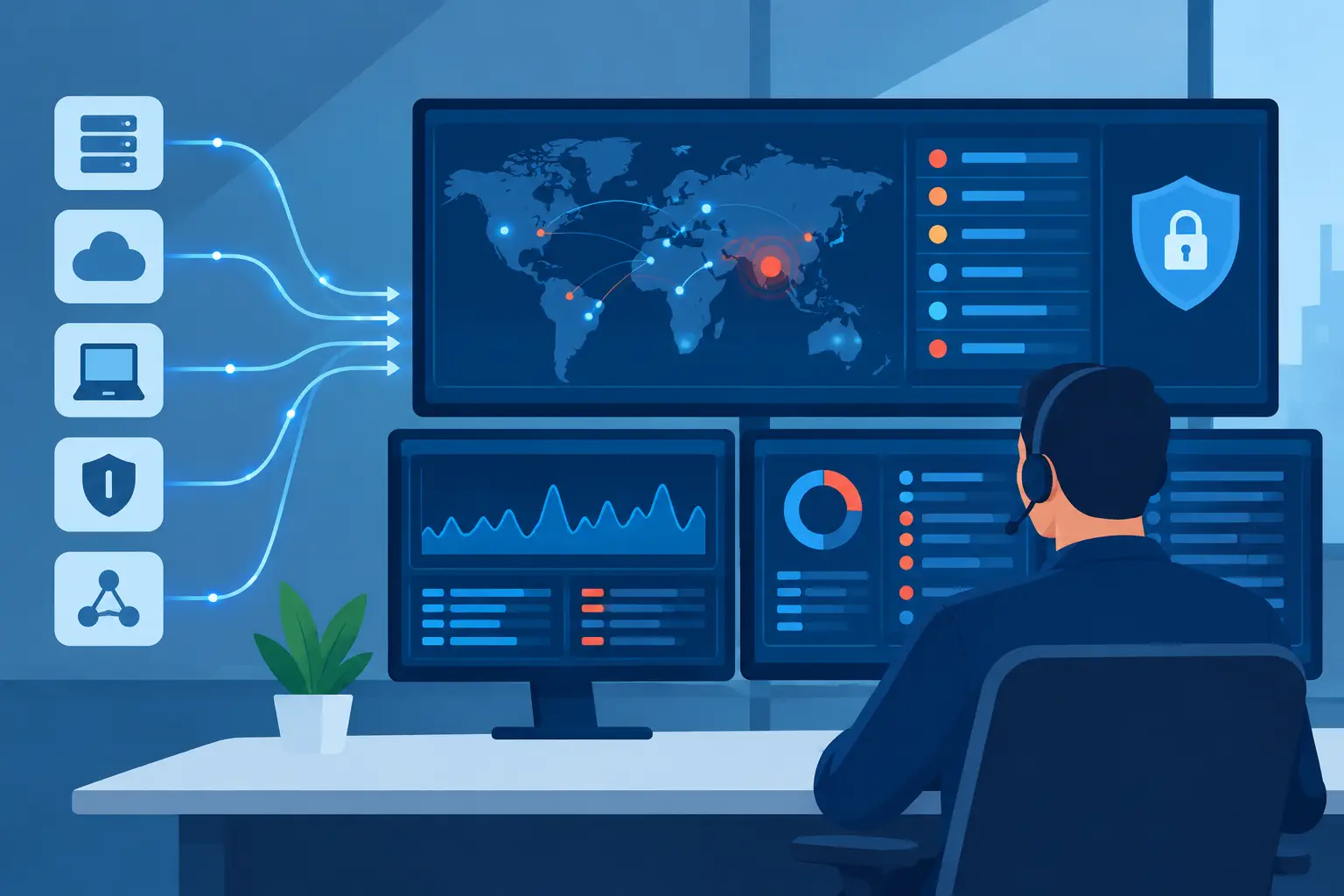
The operational end state is straightforward: security data from firewall, endpoint, cloud, identity, and email environments should converge into one investigation workflow. Analysts need a prioritized incident, the supporting evidence, the affected entities, and response actions in the same working context.
This is where a platform approach can replace the friction of separate SIEM, SOAR, and point detection workflows. Helxon's VORXOC is designed around that outcome, correlating cross-environment telemetry into incidents that teams can investigate and remediate without constant console switching. Organizations can operate the platform directly or use it with 24/7 managed SOC coverage when internal staffing does not match the risk window.
Tool consolidation is not automatically the right answer for every organization. Some enterprises have deeply embedded systems that must remain in place. But even in those environments, the SOC benefits when telemetry and response are coordinated through a coherent analyst workspace rather than a collection of handoffs.
A useful next step is to choose one recurring investigation that routinely consumes too much analyst time, such as phishing with credential theft or suspicious privileged access. Map the telemetry required to validate it, the tools analysts touch, and the actions needed to contain it. The gaps in that workflow will show exactly where better correlation can turn data into faster decisions.