
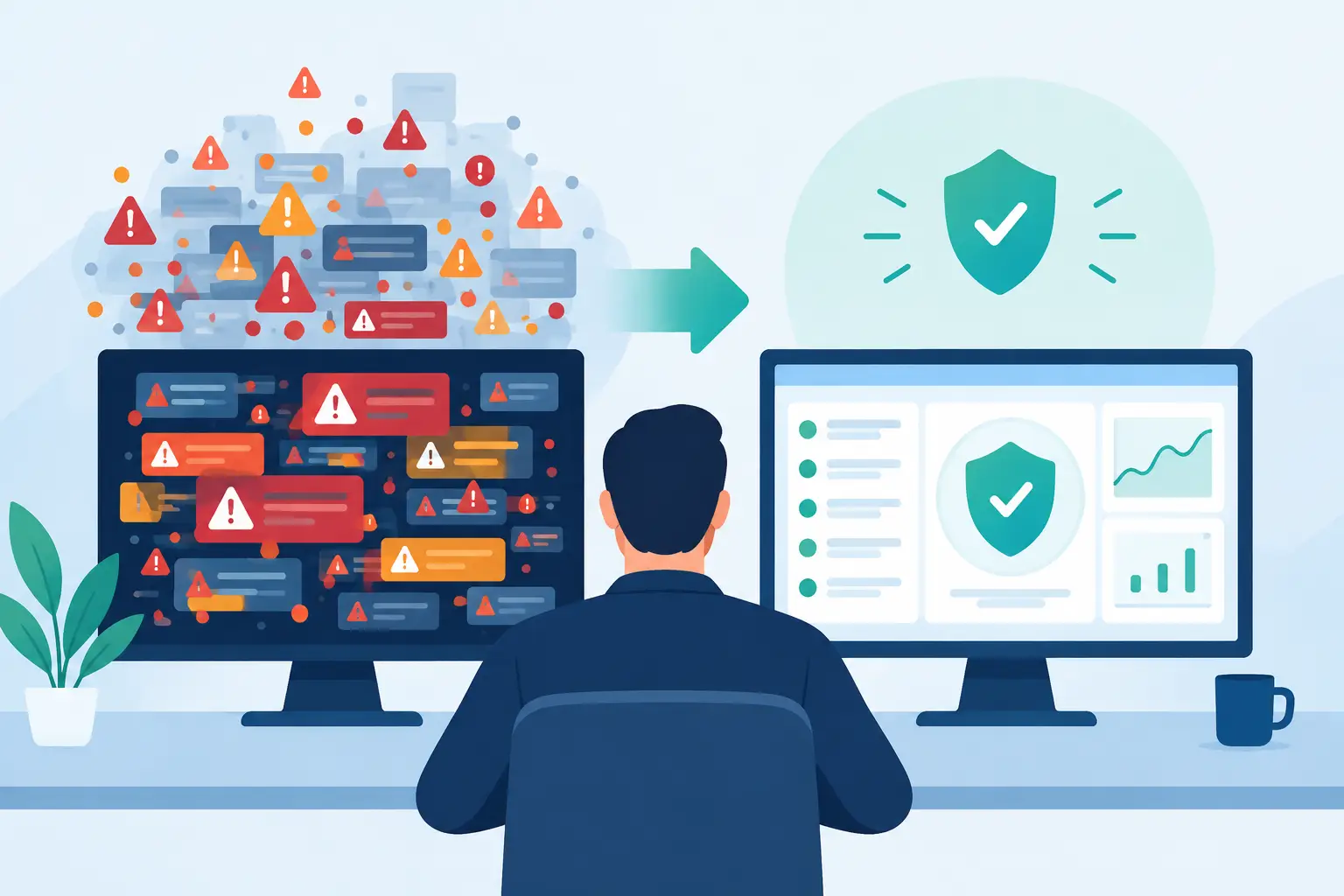
A SIEM replacement success story is rarely about swapping one log repository for another. It is about changing the daily reality of the SOC: fewer disconnected screens, fewer low-value alerts, faster access to evidence, and a clear path from detection to containment. For security leaders under pressure to improve coverage without adding analysts, that operational change is the real outcome.
Consider a representative enterprise security team operating across Microsoft 365, cloud workloads, endpoint security, firewalls, and identity systems. The team had invested heavily in its existing SIEM, but the platform had become the center of a costly workflow problem. Logs arrived, rules fired, and dashboards looked complete. Yet analysts still spent too much of each shift gathering context manually, sorting duplicate alerts, and deciding whether an event represented a real incident.
The SIEM was not failing because it lacked data. It was failing because data alone did not create an investigation.
The Starting Point: A SOC Buried in Activity
The SOC received thousands of alerts each day. Most were informational, repetitive, or lacked enough context for an analyst to make a confident decision. A suspicious sign-in alert might appear in one console, endpoint behavior in another, and email telemetry in a third. Correlating those signals depended on analyst experience and time.
That created three practical risks. First, meaningful threats could remain buried under routine activity. Second, response quality varied by analyst because every investigation required manual enrichment. Third, leadership could see alert counts and ticket volumes but had limited visibility into how quickly the team was moving from detection to validated action.
The cost was not limited to licensing. The organization was paying for data ingestion, retention, integrations, multiple analyst consoles, and the labor required to bridge gaps between them. Adding more detection content made the noise problem worse unless it also improved context and prioritization.
This is where many SIEM replacement projects go wrong. Teams start with a feature checklist, then reproduce the same architecture in a newer product. The better question is simpler: what must change in the analyst workflow for the replacement to be a success?
A SIEM Replacement Success Story Starts With Workflow
The team defined success in operational terms before selecting a platform. It needed to consolidate evidence from core security controls, reduce duplicate alert handling, and create incidents that told analysts what happened, who was affected, and what action to take next. It also needed reporting that could show security leadership whether response performance was improving.
Rather than moving every data source on day one, the team prioritized the telemetry most relevant to active investigations: identity events, endpoint detections, firewall activity, cloud signals, and email security telemetry. This approach produced value faster and prevented the migration from becoming a data-retention exercise disguised as a modernization project.
The replacement platform correlated related events into a unified incident workflow. Instead of receiving separate alerts for an impossible-travel sign-in, a risky mailbox rule, and endpoint credential access, analysts could assess those events as part of one investigation. The incident included the affected user, devices, timeline, evidence, severity, and response options.
That change matters because analysts do not respond to raw logs. They respond to an attacker’s behavior across systems.
From Alert Triage to Incident Ownership
Before the replacement, triage was an exercise in opening tabs. An analyst would receive an alert, look up the user in an identity console, check endpoint activity, search firewall logs, review recent emails, then create or update a case. Even when the alert was benign, the investigation consumed time.
With a unified workflow, initial enrichment occurred before the incident reached the analyst queue. Related telemetry was grouped, duplicate signals were suppressed, and known context was attached to the case. Analysts could spend their time validating suspicious behavior rather than assembling the basic facts.
The difference was especially visible in phishing investigations. A reported phishing email could be connected to the recipient, clicked URLs, sign-in activity, mailbox changes, and endpoint behavior. If the incident showed no follow-on activity, the team could close it with documented evidence. If it showed a compromised identity and suspicious access, containment could begin immediately.
The result was not that every alert disappeared. A mature SOC should expect security events and ambiguous cases. The improvement was that the queue became more actionable. Analysts had clearer priorities, fewer duplicate investigations, and a more consistent way to document decisions.
Measuring the Change That Matters
A replacement project needs metrics that reflect operating reality, not just technical deployment progress. The team tracked alert volume, but it treated volume as a supporting metric rather than the goal. Fewer alerts do not automatically mean better detection.
The metrics that changed management conversations were mean time to acknowledge, mean time to investigate, mean time to contain, percentage of alerts closed as duplicates or false positives, and analyst effort per incident. The team also tracked coverage by source type and attack scenario, including phishing, ransomware indicators, lateral movement, privilege escalation, and data exfiltration.
Within the first operating period, the SOC could see where time was being recovered. Analysts were no longer manually stitching together the same evidence across siloed tools. Incident ownership was easier to assign, and handoffs between shifts contained a complete investigation record rather than scattered notes.
For the CISO, reporting became more defensible. Instead of explaining that the team had processed a high number of alerts, security leadership could show which incidents required action, how quickly containment occurred, and where detection coverage had improved. That is a stronger case for investment because it ties the platform directly to risk reduction and operational efficiency.
What Made the Replacement Work
Technology alone did not create the outcome. The project succeeded because the team made several disciplined decisions.
First, it did not attempt a blind lift-and-shift of every legacy correlation rule. Many existing rules reflected years of exceptions, temporary tuning, and outdated assumptions. The team reviewed detection logic against current threats and actual investigation value.
Second, it treated integrations as workflows, not connectors. Pulling telemetry from an endpoint or identity tool is only useful if the data helps an analyst reach a decision faster. Each integration was evaluated by the context it provided, the response actions it enabled, and the incidents it improved.
Third, it planned for ownership. The internal SOC retained control of incident priorities, escalation paths, and response decisions. For after-hours coverage and surge capacity, the organization could use a managed model without creating a separate workflow or losing visibility into the work being performed.
That deployment flexibility is particularly relevant for lean teams. Some organizations need a platform their analysts run directly. Others need 24/7 analyst coverage. A unified platform such as Helxon VORXOC can support either model while keeping incidents, evidence, and reporting in the same operational workspace.
The Trade-Offs Teams Should Expect
Replacing a SIEM requires decisions that cannot be avoided by choosing a newer product. Historical data retention may remain in the legacy environment for a period, especially when compliance requirements demand it. Some niche sources may not deserve immediate migration if they rarely influence investigations. Detection engineering also needs attention during the transition so coverage does not drift.
There is also a balance between automation and control. Automating enrichment, deduplication, and low-risk response actions can reduce workload significantly. Automating disruptive actions, such as disabling accounts or isolating systems, requires clear approval rules and confidence in the detection logic. The right threshold depends on the organization’s risk tolerance, asset criticality, and incident response maturity.
The strongest projects run both environments long enough to validate priority use cases, then retire redundant workflows deliberately. Keeping the old stack indefinitely “just in case” preserves cost and complexity. Retiring it too quickly can leave blind spots. A phased approach gives the SOC evidence for each decision.
The Real Definition of Success
The best SIEM replacement outcome is not a new dashboard or a lower ingestion bill, although both may be welcome. It is a SOC where analysts can see the full incident, decide with confidence, and act before a threat becomes business disruption.
Start by mapping where investigations stall. If the answer is scattered telemetry, duplicate alerts, manual enrichment, or slow handoffs, the replacement strategy should focus on those bottlenecks first. A security platform earns its place when it gives the team more control over risk and more time to respond to what actually matters.