
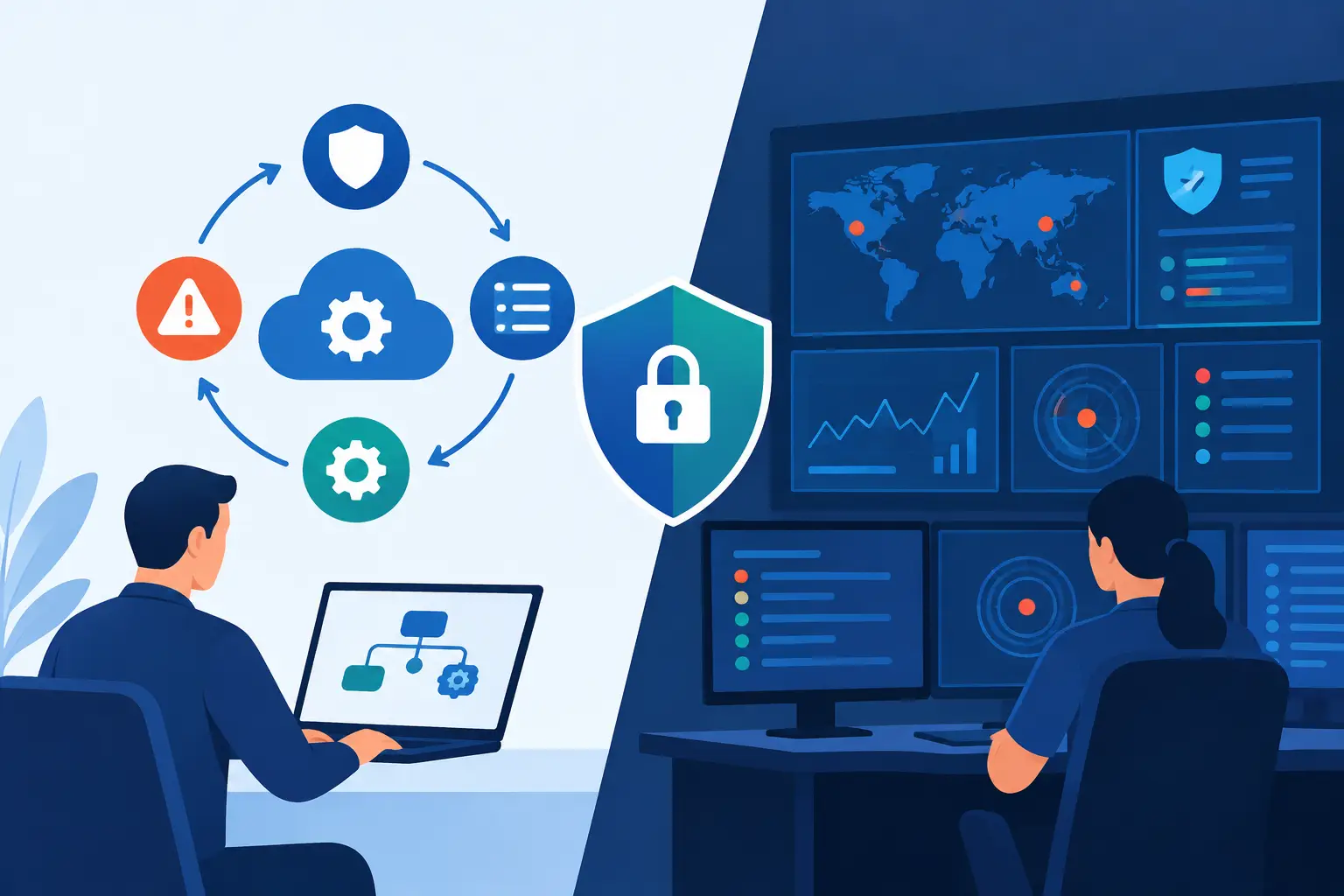
A SOC manager rarely asks whether automation is useful. The real question behind SOAR vs SOC platform is whether another tool will remove operational friction or add another console, integration project, and source of failure. That distinction matters when analysts are already working through duplicate alerts, incomplete evidence, and investigations that move slowly because context is scattered across systems.
SOAR can improve a specific part of the security workflow. A modern SOC platform can go further by bringing detection, investigation, response, and operational visibility into one working environment. The better choice depends on the gaps in your current stack, the maturity of your team, and whether you need a point solution or a simpler operating model.
SOAR vs SOC Platform: The Core Difference
SOAR stands for security orchestration, automation, and response. It is designed to connect security tools, trigger predefined workflows, enrich alerts, and automate repetitive response actions. A common SOAR playbook might pull reputation data for a suspicious IP address, open a ticket, notify an analyst, isolate a device, and document the result.
A SOC platform is broader. It is the environment where a security team ingests and correlates telemetry, prioritizes incidents, investigates related activity, coordinates response, and reports on outcomes. Depending on the platform, it may combine capabilities traditionally split across SIEM, SOAR, case management, threat intelligence, analytics, and reporting.
The practical difference is scope. SOAR primarily orchestrates actions between tools. A SOC platform is intended to organize the work itself, from the first signal through containment and closure.
That does not mean every SOC platform replaces SOAR in every environment. Organizations with mature SIEM deployments, highly customized playbooks, and large automation teams may retain dedicated orchestration. But for teams burdened by disconnected workflows, a unified platform can eliminate the handoffs that make response slower than it should be.
Where Traditional SOAR Delivers Value
SOAR is valuable when analysts repeatedly perform the same low-risk, well-defined tasks. Phishing triage is a familiar example. A playbook can collect message headers, check URLs and attachments, search for similar emails, enrich indicators, and create a case for review. This reduces manual work and gives analysts a consistent process.
SOAR also helps enterprises coordinate actions across tools that were never built to operate together. It can connect endpoint protection, firewalls, identity systems, ticketing platforms, threat intelligence sources, and collaboration tools. For a team with established detection engineering and disciplined process ownership, this can improve response speed without forcing a full platform change.
The trade-off is that orchestration only works as well as the underlying data, integrations, and playbook design. If alerts arrive without meaningful context, automating enrichment may make triage faster without making decisions better. If integrations break or APIs change, playbooks require maintenance. If every exception needs a custom branch, the automation program can become another specialized system that only a few people understand.
SOAR also does not inherently solve detection quality. It cannot independently resolve duplicate alerts, normalize conflicting telemetry, or show an analyst the full path of an attack unless those capabilities exist in the systems feeding it.
Why SOC Platforms Are Replacing Fragmented Workflows
Security operations has historically been assembled tool by tool: a SIEM for logs, EDR for endpoints, email security for phishing, a SOAR product for playbooks, and a ticketing system for case tracking. Each may be effective on its own. The operational problem emerges when analysts must pivot among all of them to answer basic questions: What happened? Which user, host, and cloud resources are involved? Is this one incident or five related alerts? What action has already been taken?
A SOC platform addresses that problem by making correlation and investigation part of the default workflow. Telemetry from firewall, endpoint, cloud, identity, and email environments is brought together around the incident rather than left in separate tool views. Analysts can assess the alert, supporting evidence, affected assets, and response status from a single workspace.
That changes the role of automation. Instead of using a separate orchestration layer to move evidence among products, the platform can apply automation within the investigation flow. It can enrich an alert, group related events, prioritize by risk, guide containment, and document the case while preserving analyst control.
For mid-market and enterprise teams, this model often produces a more immediate operational gain: fewer context switches, less alert fatigue, faster investigations, and clearer accountability. It can also reduce stack sprawl by replacing overlapping functions rather than adding another layer to manage.
Compare the Operating Model, Not Just the Features
A feature checklist can make SOAR and SOC platforms look similar. Both may offer integrations, playbooks, automated actions, dashboards, and case management. The more useful comparison is how each option changes an analyst's daily work.
With a standalone SOAR deployment, the analyst may still begin in a SIEM or EDR console, investigate in several other products, and use SOAR to run enrichment or response procedures. The workflow can be effective, but the analyst remains responsible for joining the evidence across systems.
With a unified SOC platform, the incident is the center of the workflow. The platform correlates evidence before and during investigation, then presents the analyst with a connected view of activity. Automation is not a destination in another console. It is built into the actions and decisions that move the case forward.
This distinction is especially relevant for ransomware, lateral movement, and data exfiltration investigations. These incidents cross multiple control points. An endpoint alert may be the first sign, while the evidence needed to confirm severity sits in identity logs, firewall traffic, cloud activity, and email records. A platform that correlates those signals can reduce the time spent assembling the story.
Questions to Ask Before You Buy
Start with the source of your operational delay. If your SIEM produces good, well-prioritized incidents and analysts mainly need to automate repetitive steps, a SOAR investment may be the logical next move. Focus on playbook coverage, integration reliability, approval controls, error handling, and the ongoing resources needed to maintain automation.
If the delay begins earlier - noisy detections, siloed telemetry, manual correlation, unclear case ownership, or weak reporting - a broader SOC platform is usually the stronger fit. Ask how it ingests data across your environment, correlates related signals, prioritizes incidents, supports guided investigations, and records analyst actions for auditability.
Also evaluate deployment ownership. Some organizations want direct control of a self-managed platform. Others need 24/7 coverage but do not want to build a large internal SOC. A platform that supports both internal operations and managed SOC delivery can provide flexibility without requiring separate technology stacks.
Finally, measure the outcome in operational terms. Look beyond the number of integrations or automated playbooks. Track mean time to acknowledge, mean time to investigate, mean time to contain, alert-to-incident conversion, analyst workload, and the number of tools required to close a case. Those metrics reveal whether the architecture is actually improving security operations.
A Practical Path Forward
The choice is not always SOAR or SOC platform. A large security program may use both, particularly when it has specialized automations that reach deeply into business systems. But buying SOAR to compensate for fragmented visibility can create more complexity than it removes.
For organizations looking to consolidate SIEM, automation, and incident workflows, platforms such as Helxon's VORXOC are built around a different premise: correlate the telemetry first, give analysts a complete incident workspace, and apply automation where it shortens safe decisions. That approach keeps investigation and remediation connected instead of asking analysts to stitch them together.
Start with one high-friction workflow, such as phishing, suspicious identity activity, or endpoint-to-cloud lateral movement. Map every console, handoff, and manual lookup required to close it. The gaps in that workflow will show whether you need more orchestration, a unified SOC platform, or both.