
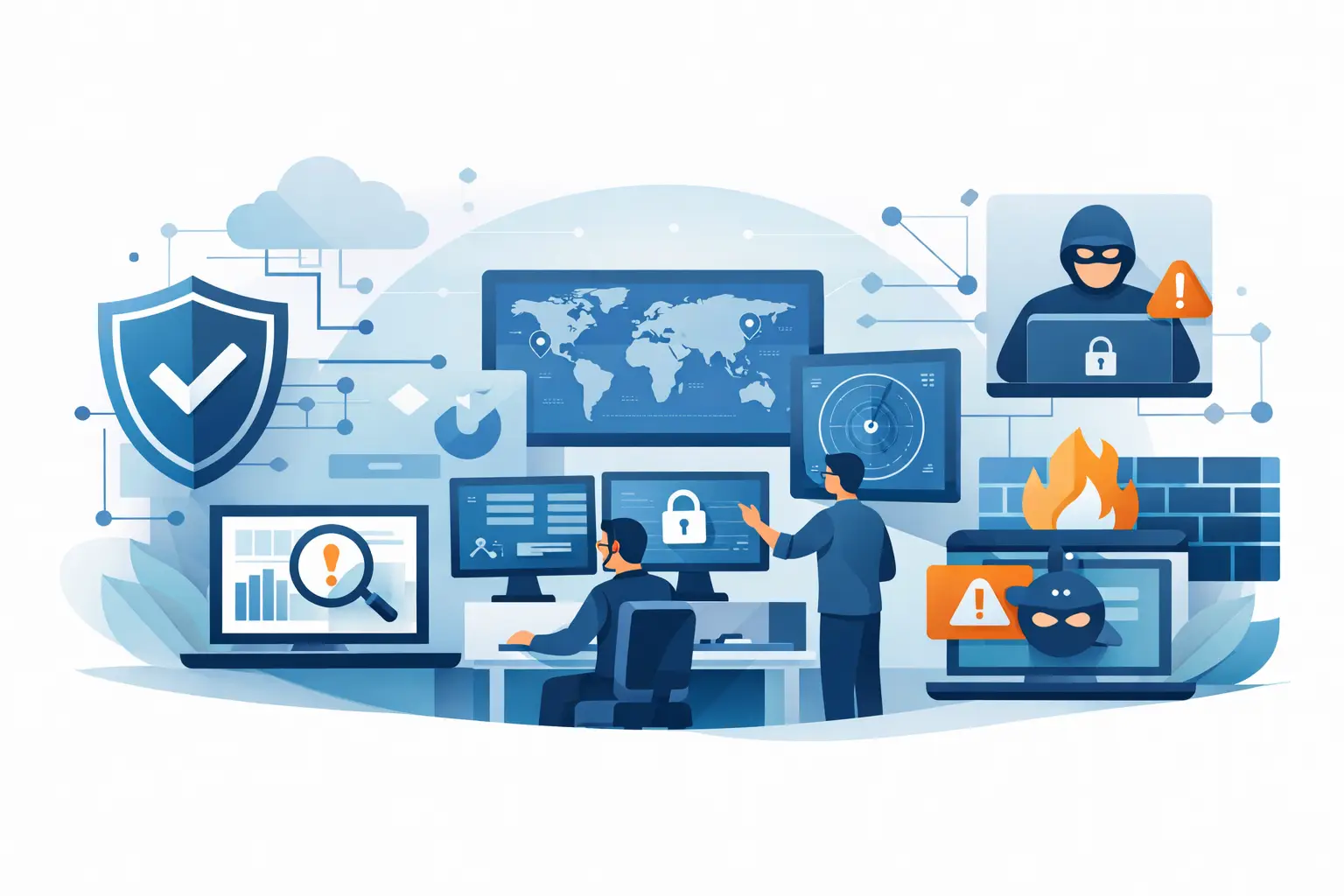
At 2:00 a.m., an attacker does not care whether your team is short-staffed, whether your SIEM rules are noisy, or whether three separate consoles need to be checked before anyone can decide if an alert matters. That gap between what threats do in real time and what most internal teams can reasonably cover is exactly why SOC as a service has moved from a nice-to-have to a practical operating model.
For many organizations, the problem is not a lack of security tools. It is too many tools, too little context, and not enough analyst time to connect endpoint signals, firewall events, identity anomalies, cloud telemetry, and email threats into one clear incident path. SOC as a service is valuable when it closes that gap. It becomes even more valuable when it does so without forcing teams to give up visibility or operational control.
What SOC as a service actually means
SOC as a service is a managed security operations model in which an external provider delivers monitoring, detection, investigation, and response support using a centralized platform and analyst team. Depending on the service design, that support may include 24/7 alert triage, threat hunting, incident investigation, response guidance, containment actions, reporting, and ongoing tuning.
That definition sounds straightforward. In practice, the quality of the service depends on how the provider operates. Some providers mostly forward alerts from existing tools. Others act more like a true extension of your security team, correlating telemetry across your environment and working from a shared incident workflow.
That difference matters because most SOC problems are workflow problems. If the service still relies on disconnected data sources, brittle rule sets, and manual swivel-chair investigation, outsourcing the function does not fix much. It just moves the pain to another company.
Why organizations buy SOC as a service
Most buyers are trying to solve a specific operational constraint, not check a compliance box. They need to reduce alert fatigue, shrink response time, and improve coverage without hiring a full bench of analysts, engineers, and threat hunters.
For a mid-market security leader, the math is usually hard to ignore. Building a 24/7 internal SOC requires staffing across shifts, management oversight, engineering support, tuning, reporting, and process maturity. Even well-funded teams struggle to maintain that consistently. Lean teams often end up with business-hours monitoring, after-hours gaps, and a backlog of alerts no one fully trusts.
Enterprises face a different version of the same problem. They may have internal talent, but their environments are spread across cloud, identity, endpoint, network, and email layers, often with overlapping tools and inconsistent workflows. In that case, SOC as a service can offload routine triage, improve coverage, or supplement internal operations with around-the-clock execution.
The common thread is efficiency. Buyers want stronger detection and response without adding more stack sprawl or more analyst drag.
The real test: does the service reduce operational friction?
A good SOC service should not just watch alerts. It should make the entire security operation easier to run.
That starts with telemetry correlation. If suspicious PowerShell activity on an endpoint, a risky sign-in, and outbound traffic anomalies sit in different places with no unified context, analysts lose time reconstructing the story. A service built on a unified SOC platform can connect those signals into one incident, cutting investigation time and reducing the chance of missing lateral movement or data exfiltration.
It also means response should be tied to evidence, not guesswork. If an analyst can see the user, device, email, cloud, and network context in one workflow, containment decisions get faster and cleaner. You spend less time escalating internally just to validate whether an alert is real.
This is where modern SOC platforms change the economics of managed services. Instead of layering people on top of fragmented tools, the provider can operate from one analyst workspace built to reduce noise and speed investigation. That model is materially different from a traditional MSSP approach that depends on ticket volume and alert forwarding.
What a strong SOC as a service model should include
The baseline is 24/7 monitoring, triage, and escalation. That is table stakes. The more important question is what happens after the alert appears.
A strong service should correlate data across endpoint, firewall, cloud, identity, and email sources rather than treating each control point in isolation. It should investigate incidents in a shared case workflow, not across scattered consoles and disconnected tickets. It should also support real response actions, whether that means host isolation, account disablement, blocking indicators, or coordinated handoff to your internal team.
Good reporting matters too, but not as a vanity dashboard. Security leaders need defensible visibility into incident volume, analyst actions, dwell time, use case coverage, and areas where tuning is improving outcomes. If reporting cannot show what was detected, how it was resolved, and where the service is reducing operational burden, it is not helping leadership make decisions.
The best services also recognize that not every customer wants the same operating model. Some want fully managed 24/7 coverage. Others want internal teams to retain control during business hours and rely on external analysts for overnight monitoring or surge support. Flexibility is not a side feature. It is often what makes the model workable.
SOC as a service vs. building in-house
This is not a simple outsourced-versus-internal debate. It depends on your team maturity, staffing model, and technology posture.
If you already have a mature internal SOC with strong engineering depth, you may not want to hand off operations entirely. In that case, the better move may be a platform that consolidates detection, investigation, and response workflows while giving you the option to add managed coverage where needed.
If your team is lean, distributed, or buried under alert noise, SOC as a service is often the faster route to meaningful coverage. You get analyst capacity, operational process, and service continuity without waiting through a long hiring cycle.
There are trade-offs. An internal SOC gives you direct ownership and tight alignment with business context, but it is expensive and hard to scale. A managed service gives you coverage and expertise, but only if the provider gives you transparency into operations and does not turn your environment into a black box.
That is why platform visibility matters so much. The strongest model gives customers a choice: run the SOC yourself, outsource it fully, or combine both on the same operating foundation.
Where traditional models tend to break down
Many security teams have already tried some version of outsourced monitoring and came away unimpressed. Usually, the failure was not the idea of managed operations. It was the architecture underneath it.
Traditional SIEM-heavy models often require constant tuning, expensive data handling, and separate orchestration layers to get anything close to usable response. Analysts then bounce between tools to gather evidence, which creates delay and inconsistency. Over time, customers receive a high volume of alerts, limited context, and too many escalations that still require internal validation.
That is not a service problem alone. It is a tooling problem.
Modern SOC as a service works better when the service is built on a platform designed to unify telemetry and incident handling from the start. For example, a provider operating on one analyst workspace can correlate suspicious identity activity with endpoint telemetry and email delivery patterns fast enough to catch a phishing-led compromise before it spreads. That is a better outcome than delivering three separate alerts and asking the customer to connect them.
How to evaluate a provider without wasting time
Ask direct operational questions. What data sources are natively correlated? How does the provider investigate cross-domain incidents? What response actions can they take directly, and what requires customer approval? How is noise reduced before alerts reach your team? What does the escalation path look like at 3:00 a.m.? Can your team see the same incidents, evidence, and actions in the same platform?
Also ask how the service handles specific use cases. Ransomware, business email compromise, credential abuse, lateral movement, and data exfiltration are good tests because they expose whether the provider can work across multiple controls in one workflow.
If the answers sound tool-centric rather than workflow-centric, be careful. Buyers do not need more products watching the same events. They need an operating model that produces faster, clearer decisions.
A modern example of that approach is a service built on the same platform customers can also run themselves, which removes the usual divide between managed visibility and internal control. That matters because operating flexibility is often what keeps a SOC model useful as the business changes.
The best reason to choose SOC as a service is not that it outsources security. It is that it gives your team a cleaner, faster way to execute security operations with fewer blind spots and less wasted motion. If a service does that, it is not filling a staffing gap. It is fixing how the SOC works.