
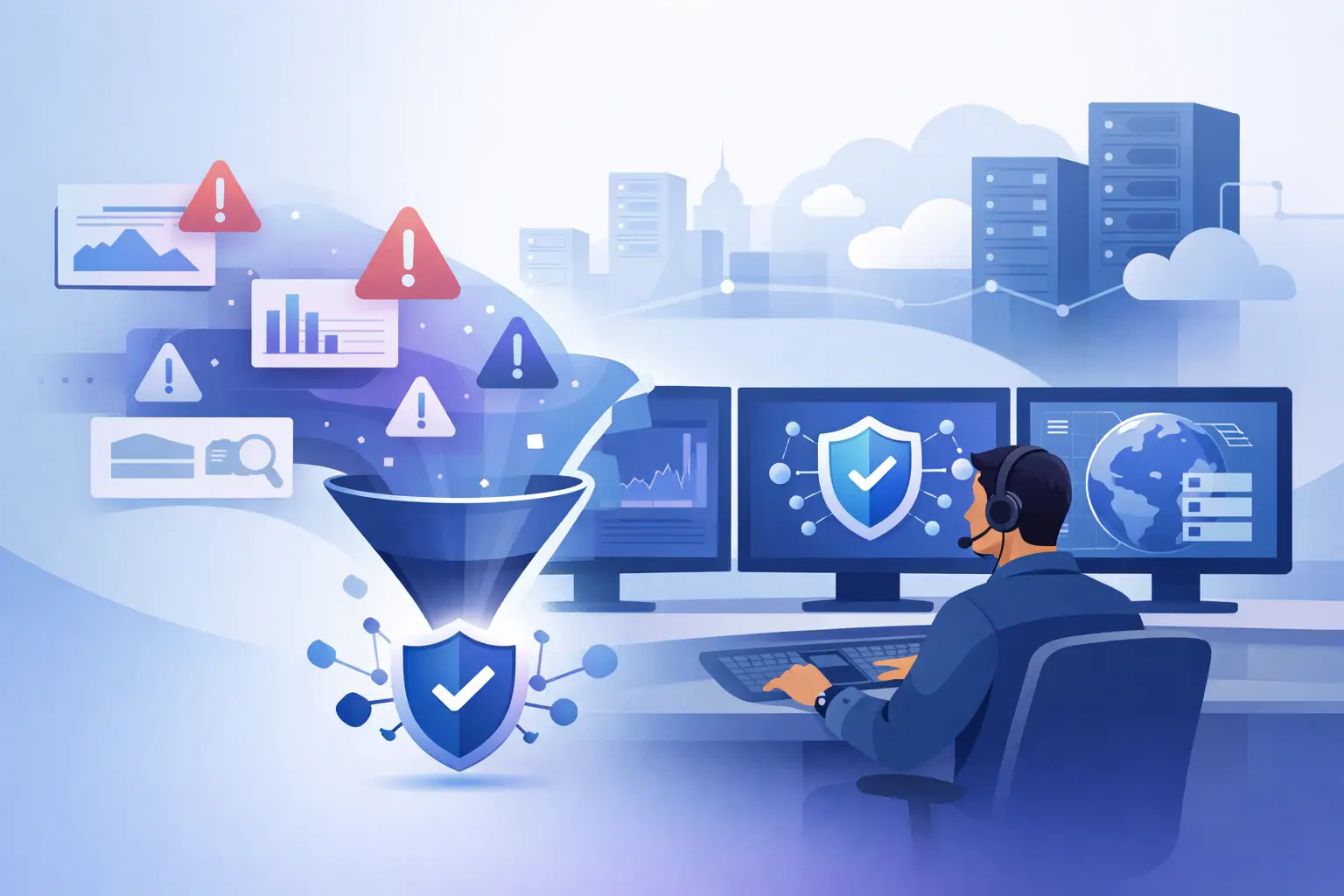
A SOC consolidation case study is most useful when it starts with the operational reality: analysts are not short on alerts. They are short on time, context, and confidence. When firewall, endpoint, cloud, identity, and email data live in separate tools, every investigation becomes a manual exercise in assembling evidence that should already be connected.
This representative composite case study reflects a common mid-market enterprise environment: a lean internal security team supporting a hybrid estate, several security products, and a growing expectation for rapid, defensible incident response. The organization did not have a detection problem. It had a workflow problem.
SOC Consolidation Case Study: The Starting Point
The security team used a traditional SIEM for log collection and searches, an automation platform for selected response playbooks, endpoint tooling for containment, a separate email console, firewall management interfaces, and cloud-native security portals. Each tool had value on its own. Together, they created friction.
A suspicious sign-in alert might begin in the identity platform. An analyst would then pivot to the endpoint console to determine whether a device showed malicious activity, search the SIEM for related network connections, check email telemetry for phishing activity, and open the firewall console to investigate outbound traffic. The process was familiar, but it was slow and inconsistent. Two analysts could investigate the same alert in two different ways and reach different levels of confidence.
The cost was not limited to analyst hours. Alert queues grew during busy periods. Escalations lacked consistent evidence. Leaders could see ticket volume, but they had limited visibility into which incidents mattered, how quickly the team had contained them, or where delays occurred.
The team initially considered adding more automation. That would have accelerated a few repetitive actions, but it would not have solved the central issue: automation cannot compensate for fragmented incident context. Before automating more steps, the organization needed to make the investigation itself coherent.
Defining What Consolidation Had to Deliver
The team did not set out to replace every security product. That is rarely the right objective. Firewalls, endpoint agents, identity providers, email controls, and cloud security services still generate essential telemetry and enforce controls. The objective was to replace the disconnected operating layer between detection and response.
The modernization effort focused on four operational requirements:
- One incident workspace that correlates related signals across security domains.
- A prioritized queue that reduces duplicate and low-context alert handling.
- Guided investigation and response actions that analysts can execute from the same workflow.
- Reporting that shows exposure, response performance, and operational bottlenecks in terms leadership can use.
These requirements shaped the selection process. A platform could not simply ingest logs and produce another dashboard. It had to help an analyst answer practical questions quickly: Is this activity malicious? What assets, identities, and data are affected? What happened first? What should be contained now? Has the threat returned?
Replacing Tool Switching With an Incident Workflow
The organization deployed a unified SOC platform, using Helxon's VORXOC as the analyst workspace. Existing security controls remained in place, while their telemetry was correlated into a common incident view. This approach avoided the disruption of ripping out functional tools simply to meet a consolidation target.
Instead of treating an email alert, an identity anomaly, and suspicious endpoint behavior as unrelated events, the platform associated them when the evidence pointed to the same attack path. Analysts could see the user, device, source, destination, process activity, and relevant prior events without opening a chain of separate consoles.
That distinction changed the working day. The team stopped measuring success by how many alerts it closed and started measuring whether it could quickly establish incident scope, apply the right response, and document the decision.
A phishing-led account takeover investigation
One representative scenario began with a phishing email that bypassed preventive controls. The user entered credentials into a fraudulent site, followed by an unfamiliar sign-in attempt from a new location. Soon after, the compromised account accessed cloud resources and initiated unusual mailbox activity.
In the prior model, these events arrived through separate queues. The email analyst could identify the message, while the identity analyst investigated the sign-in. The cloud activity might not receive attention unless a specific rule triggered. Correlation depended on someone recognizing the pattern under pressure.
In the consolidated workflow, the email event, identity events, and cloud actions were grouped into a single incident. The analyst could trace the sequence, confirm the affected user and resources, disable active sessions, reset credentials, and preserve the investigation record. The response still required judgment. It was faster because the evidence was already organized around the incident rather than distributed across products.
A lateral movement investigation
The same benefit appeared in a ransomware-preparation scenario. An endpoint alert identified suspicious credential dumping behavior. Network telemetry later showed unusual authentication traffic, while another endpoint displayed remote execution activity.
Without correlation, those signals may look like separate medium-priority alerts. With a shared incident timeline, the analyst could recognize a likely lateral movement pattern, identify the initial host, isolate affected endpoints, restrict the compromised identity, and search for related activity across the environment.
The operational advantage was not just speed. It was control. Containment decisions were based on the full path of activity, reducing the risk of isolating one machine while leaving the attacker active elsewhere.
What Changed for the SOC Team
The clearest improvement was a reduction in investigative overhead. Analysts spent less time copying identifiers between interfaces, chasing incomplete tickets, and revalidating information that another tool already held. That time moved toward higher-value work: validating threat hypotheses, tuning detections, and improving response procedures.
Alert fatigue also became more manageable. Consolidation does not mean every alert disappears. It means related detections can be evaluated as one incident, and low-value noise does not compete as aggressively with high-risk activity. A shorter queue is useful, but a better-prioritized queue is more valuable.
For the SOC manager, reporting became more defensible. Rather than presenting a collection of tool-specific statistics, the team could report on incident volumes, severity trends, time to triage, time to containment, recurring attack paths, and the systems most frequently involved in security events. This created a direct link between SOC operations and risk discussions with leadership.
The Trade-Offs That Matter
SOC consolidation is not a license to centralize blindly. The quality of a unified workflow depends on integration depth, telemetry coverage, detection logic, and the discipline of the operating team. If key data sources are missing or poorly normalized, the incident view can still be incomplete.
There is also a real governance decision around automation. Mature teams may want analysts to approve containment actions for critical servers, executive accounts, or production cloud workloads. Other environments may need automatic isolation when ransomware behavior crosses a defined threshold. The right model depends on business tolerance for disruption and the reliability of the detection signal.
Deployment ownership matters as well. A capable internal SOC may use the platform to consolidate its own operations. A lean team may prefer 24/7 managed analyst coverage, especially when alert volume outside business hours creates unacceptable exposure. Both approaches benefit from the same unified workflow. The difference is who owns investigation and response execution.
How to Evaluate a Consolidation Initiative
A practical evaluation should begin with incident workflow, not a feature checklist. Ask analysts to walk through a recent phishing investigation, suspicious login, data exfiltration event, or endpoint compromise. Track how many consoles they open, how much evidence they manually collect, where decisions stall, and which response actions require separate handoffs.
Then test whether a proposed platform can correlate the actual telemetry sources in the environment, not just a polished demo dataset. Verify that it provides useful context at the incident level, supports the response actions your team needs, and produces reporting that can stand up to leadership and audit scrutiny.
The strongest SOC modernization programs do not promise a world without alerts. They give security teams a clearer path from signal to decision to containment. When the next high-confidence incident arrives, the useful question is no longer which console to open first. It is whether the team has enough connected evidence to act before the attacker gains more ground.