
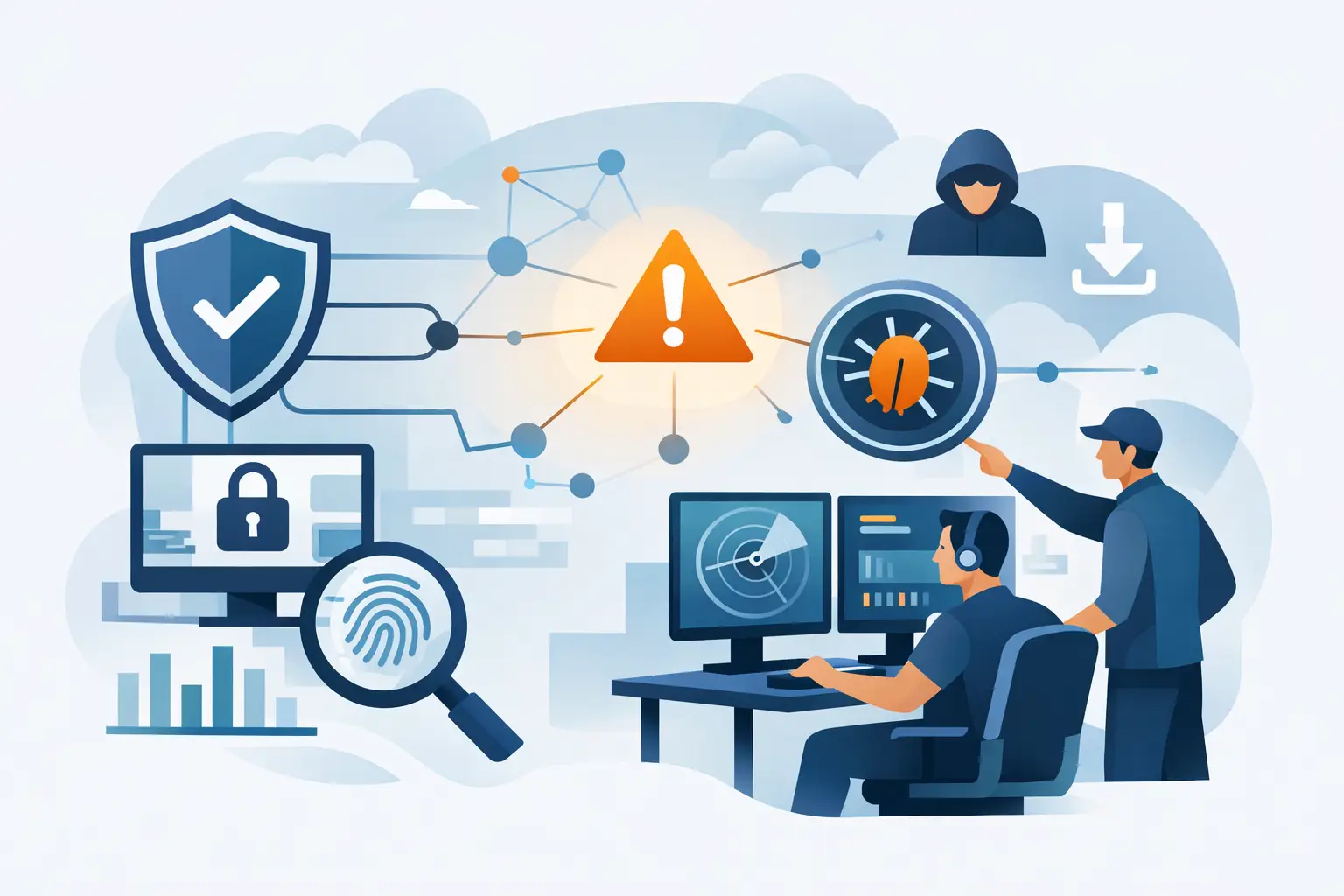
Security teams rarely fail because they lack alerts. They fail because threat detection and response breaks down between signal, context, and action. One tool flags suspicious endpoint behavior, another shows identity anomalies, a third holds email telemetry, and the firewall logs sit somewhere else entirely. Analysts spend their time stitching together fragments while adversaries keep moving.
That gap is where modern SOC performance is won or lost. If your team cannot see related activity across systems in one workflow, detection quality suffers and response slows down. The result is familiar - alert fatigue, longer dwell time, inconsistent investigations, and too much effort spent proving what happened after the fact.
Why threat detection and response still underperforms
Most organizations have invested heavily in security tools, yet many SOCs still operate with limited operational clarity. The problem is not simply coverage. It is fragmentation.
Traditional environments often split core tasks across separate SIEM, SOAR, endpoint, email, identity, and cloud consoles. Each platform may do part of the job well, but the analyst experience becomes disjointed. Alerts arrive without enough context. Correlation is shallow or delayed. Automation exists, but only after significant custom engineering. Even mature teams can end up with a stack that looks comprehensive on paper and feels slow in practice.
This is where trade-offs matter. Best-of-breed tooling can make sense when a team has deep in-house engineering resources and a clear integration strategy. But many mid-market and enterprise SOCs are operating under pressure to improve outcomes without adding headcount. In those environments, tool sprawl usually creates more friction than value.
Threat detection and response performs best when the system is designed around analyst decision-making, not just data collection. That means telemetry needs to be correlated across endpoint, firewall, cloud, identity, and email sources in a way that produces incidents, not just alerts. It also means response actions need to happen from the same operating plane where the investigation occurs.
What effective threat detection and response looks like
A functional SOC does three things well. It detects suspicious activity with enough fidelity to matter, it gives analysts immediate context, and it supports fast containment without forcing constant platform switching.
High-performing teams do not chase every alert equally. They prioritize based on evidence chains. A phishing email tied to a risky sign-in, followed by unusual endpoint behavior and privilege escalation, is not four separate events. It is one developing incident. The faster your platform treats it that way, the faster your analysts can make the right call.
This is especially important for the attack paths most organizations face every week. Ransomware rarely begins and ends on one control point. Phishing campaigns cross email, identity, and endpoint telemetry. Lateral movement surfaces in identity events, endpoint signals, and network activity. Data exfiltration may appear benign in isolation unless cloud and endpoint context are evaluated together.
Good detection without response is expensive visibility. Good response without clear detection is guesswork. The operational target is a closed loop where telemetry, triage, investigation, and remediation are connected.
Detection quality depends on correlation, not volume
More alerts do not equal better security. In fact, excess alerting often hides the incidents that matter most. What analysts need is better correlation logic and cleaner case construction.
When telemetry from multiple controls is normalized into one incident workflow, the team can evaluate sequence, timing, asset criticality, user behavior, and environmental context together. False positives drop because isolated noise is less likely to escalate into a full incident. True positives move faster because the evidence is already assembled.
There is no universal threshold for what counts as enough correlation. A highly distributed enterprise with complex cloud estates will need broader telemetry coverage and stronger identity mapping than a more centralized environment. But the principle holds across both: detection quality improves when context is built in early, not added manually after triage.
Response speed depends on workflow design
Many SOC delays have little to do with analyst skill. They come from workflow design. If an analyst has to pivot across five consoles to validate a host, check user risk, isolate a device, and notify stakeholders, response time expands even when the decision is obvious.
A better model keeps investigation and action tightly connected. If the incident is confirmed, the analyst should be able to isolate an endpoint, disable an account, block an indicator, or escalate to managed coverage from the same workspace. That is where operational clarity translates into measurable outcomes.
Automation helps, but only when used with discipline. Over-automating immature workflows can create new failure points. Under-automating known repetitive tasks wastes analyst cycles. The right balance depends on the team, the risk tolerance, and the maturity of playbooks. For most organizations, automating enrichment and initial containment steps produces faster gains than trying to fully automate every incident type.
The case for a unified operating model
The strongest argument for consolidating security operations is not convenience. It is control.
A unified operating model gives SOC leaders one place to measure alert volume, investigation time, escalation quality, and response outcomes. It gives analysts one coherent workflow instead of a collection of loosely connected tools. It also gives executives a more defensible picture of security performance because the reporting is tied to actual incidents and actions, not disconnected system outputs.
This is why many teams are rethinking the old SIEM plus SOAR assembly model. The issue is not that these categories are irrelevant. The issue is that many deployments become costly to maintain and difficult to adapt. Engineering overhead grows. Content tuning lags. Analysts compensate for missing context with manual work. Meanwhile, leadership is still asking for faster response and stronger coverage.
A platform approach can reduce that drag if it genuinely unifies telemetry, incident handling, and remediation instead of simply putting another dashboard on top of the stack. That distinction matters. Surface-level consolidation does not fix broken workflows.
For organizations that want internal control, this model supports self-managed operations without forcing security teams to become full-time integration engineers. For organizations that need coverage depth or 24/7 execution, the same platform can support managed SOC delivery. That flexibility matters because operating models change. A company might start with outsourced monitoring, then bring more activity in-house later, or keep overnight coverage managed while internal teams own daytime investigations.
How to evaluate your current threat detection and response model
If you are assessing whether your SOC is actually improving, start with operational questions rather than feature checklists.
How long does it take to move from alert to validated incident? How often do analysts need to leave the main workflow to gather context? Can the team correlate endpoint, cloud, email, firewall, and identity activity in one case without manual stitching? Are common response actions available immediately, or do they require multiple handoffs? And when leadership asks what improved last quarter, can you show fewer false positives, shorter investigation times, or faster containment?
Those answers usually expose the real bottleneck. Sometimes the issue is weak telemetry coverage. More often, it is that the telemetry exists but the workflow around it is too fragmented to be efficient.
This is where a modern SOC platform can materially change outcomes. Helxon, for example, is built around the idea that analysts need one operational workspace where telemetry becomes incidents and incidents become action. That is a practical fix for teams dealing with stack sprawl, alert fatigue, and rising response expectations.
Where teams should focus next
The next improvement in SOC performance will not come from adding another isolated detection source. It will come from reducing the distance between evidence and action.
For some organizations, that means consolidating tools. For others, it means replacing brittle handoffs with a unified workflow. For lean teams, it may mean pairing platform consolidation with managed analyst coverage so the environment is monitored and acted on around the clock. The right answer depends on staffing, complexity, and how much operational ownership the organization wants to keep.
What does not depend is this: threat detection and response has to be judged by speed, clarity, and outcomes, not by the number of tools collecting data. If your analysts are still acting as the integration layer between disconnected systems, the model is already costing more than it should.
The strongest SOCs are not the ones with the biggest stacks. They are the ones where the path from signal to action is short, clear, and repeatable.