
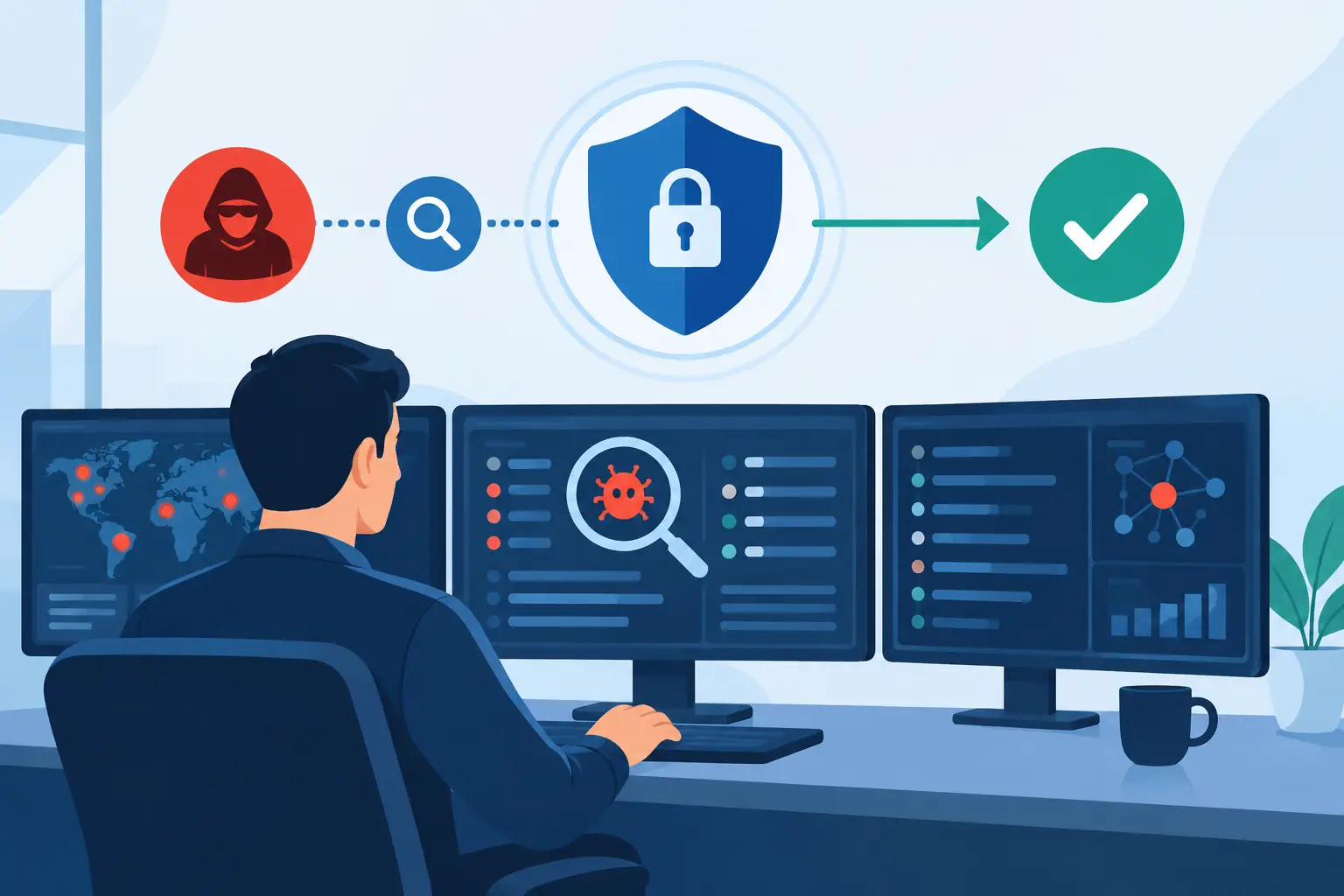
A suspicious sign-in from a new location is rarely just an identity alert. It may connect to a phishing email, a compromised endpoint, an impossible-travel event, and outbound traffic to a known malicious domain. Threat investigation tools determine whether analysts can see that chain quickly or spend an hour moving between consoles, copying indicators, and trying to reconstruct what happened.
For SOC leaders, the issue is not a lack of data. Most teams already collect more telemetry than they can reasonably review. The operational failure happens when that data remains fragmented across endpoint, identity, cloud, firewall, email, and network tools. Alerts pile up, analysts lose context, and true incidents compete with routine noise for attention.
What Threat Investigation Tools Must Do
Effective threat investigation tools turn isolated detections into an evidence-backed incident. That means gathering relevant activity around an alert, connecting it to users, hosts, identities, files, IP addresses, and cloud resources, then helping the analyst decide what to do next.
A detection alone is not an investigation. An alert that says a user clicked a malicious link may be accurate, but it does not answer the questions that drive response: Was the credential used afterward? Did the endpoint launch a payload? Did the user access sensitive data? Has the same campaign reached other mailboxes?
The right platform reduces the number of manual pivots needed to answer those questions. It should correlate telemetry automatically, preserve the evidence trail, and keep investigation, containment, and reporting in the same operational workflow. The goal is not to eliminate analyst judgment. It is to reserve that judgment for decisions that require it.
The Core Capabilities That Matter
Unified telemetry and entity context
Threat investigations slow down when analysts must search each security product separately. A useful investigation workspace brings together firewall logs, endpoint activity, identity events, cloud audit records, email telemetry, and network signals around the entities involved in an incident.
Context must be usable, not merely centralized. Analysts need a timeline that shows what occurred before and after an alert, the assets and accounts involved, related indicators, and similar activity elsewhere in the environment. A single view of a user, device, or IP address can expose patterns that are nearly invisible in disconnected consoles.
This is especially valuable in hybrid environments. A compromised account may begin in Microsoft 365, move through a VPN connection, and end with access to an on-premises server. No single telemetry source tells that complete story.
Correlation that reduces alert noise
High alert volume is often a correlation problem. Security tools generate detections based on their own limited viewpoint, which can create multiple alerts for one attack or hundreds of low-value events around normal behavior.
Strong investigation tooling groups related signals into a single incident and prioritizes activity based on evidence, asset criticality, user risk, and attack behavior. This prevents an analyst from treating every event as a separate case. It also makes escalation more defensible because the case includes the underlying facts rather than a bare severity label.
Correlation must remain transparent. If a platform raises the priority of an incident, analysts should be able to see why: a known malicious domain, a privileged identity, lateral movement behavior, repeated failed logins, or suspicious data transfer. Black-box scoring can save time at first, but it creates risk when teams cannot explain the result to incident commanders or auditors.
Automation with analyst control
Automation is most valuable when it removes repeatable work. Enriching an IP address, checking file reputation, collecting endpoint details, opening a case, assigning an owner, or searching for the same indicator across the environment are appropriate actions to automate.
Containment requires more care. Disabling an account, isolating an endpoint, blocking a domain, or revoking cloud sessions can stop an active attack, but each action can also disrupt business operations. The right approach depends on the organization, incident type, and confidence level.
For high-confidence ransomware behavior on a workstation, automated endpoint isolation may be justified. For a single anomalous sign-in to a critical executive account, an approval step may be the safer choice. Investigation tools should support both models through clearly defined playbooks, permissions, and audit trails.
Case management and evidence preservation
A security incident is not resolved when the alert disappears. Teams need a record of what was observed, what actions were taken, who approved them, and whether follow-up work remains. This is essential for handoffs between shifts, post-incident review, compliance reporting, and leadership communication.
When case management lives outside the investigation workflow, analysts duplicate notes and evidence. Details get lost, and the final report often becomes an expensive reconstruction effort. A connected case workflow keeps alerts, enrichment, investigation notes, response actions, and resolution status together.
Threat Investigation Tools for Common Attack Paths
The most useful evaluation method is to test tools against the incidents your team sees most often, not a generic feature checklist. Consider how the platform supports a real investigation from first signal through containment.
For phishing, the workflow should connect the delivered message to clicked URLs, affected recipients, authentication events, mailbox rules, endpoint activity, and related campaign indicators. The question is not simply whether the email was malicious. It is whether the attack progressed.
For ransomware, speed and scope are central. Analysts need to see suspicious process behavior, file changes, privilege escalation, remote access activity, lateral movement, and affected hosts. The platform should make it straightforward to isolate devices, block indicators, and identify other systems showing the same early-stage behavior.
For identity compromise, investigators need to correlate login history, multifactor authentication events, privilege changes, OAuth consent activity, VPN access, cloud actions, and endpoint evidence. A suspicious login may be benign travel. It becomes urgent when it is followed by mailbox forwarding rules, role escalation, or access to sensitive repositories.
For data exfiltration, the investigation should connect unusual access patterns with cloud storage activity, outbound network traffic, new destinations, account privilege, and asset sensitivity. A large upload is not automatically malicious. Context determines whether it is an approved business process, a misconfiguration, or an active breach.
How to Evaluate the Right Platform
Tool consolidation is not automatically an improvement. A platform that promises broad coverage but cannot ingest your critical data sources, explain its correlations, or execute response actions will simply add another console. Evaluate the operational workflow, not just the product category on the label.
Ask vendors to demonstrate these five capabilities using your own scenarios:
- Ingest and normalize telemetry from the endpoint, identity, cloud, email, firewall, and network controls you already operate.
- Correlate multiple related alerts into one incident with a visible evidence trail.
- Investigate an entity across sources without requiring analysts to run separate searches in separate tools.
- Automate enrichment and response actions with role-based controls and approval paths.
- Produce incident records and metrics that show investigation time, response time, alert reduction, and containment activity.
Deployment effort also matters. A large enterprise with an established SOC may prioritize customization, retention controls, and integrations with existing processes. A lean security team may need a faster path to consolidated visibility and guided response. Neither model is inherently better. The right choice depends on internal expertise, coverage requirements, and how much operational ownership the organization wants to retain.
A Modern SOC Needs One Operating View
Traditional SIEM, SOAR, EDR, and point tools can each provide real value. The problem begins when analysts become the integration layer between them. Every manual pivot increases response time and makes it harder to maintain a consistent incident record.
A unified platform such as Helxon's VORXOC is designed to replace that fragmented experience with one analyst workspace. By correlating security telemetry and response workflows in one place, it gives teams a practical way to reduce alert fatigue without giving up control over the evidence and actions behind each incident.
The best investment is not the tool with the longest feature list. It is the one that helps your team reach a confident decision faster, contain verified threats with less friction, and explain the outcome clearly when leadership asks what happened.