
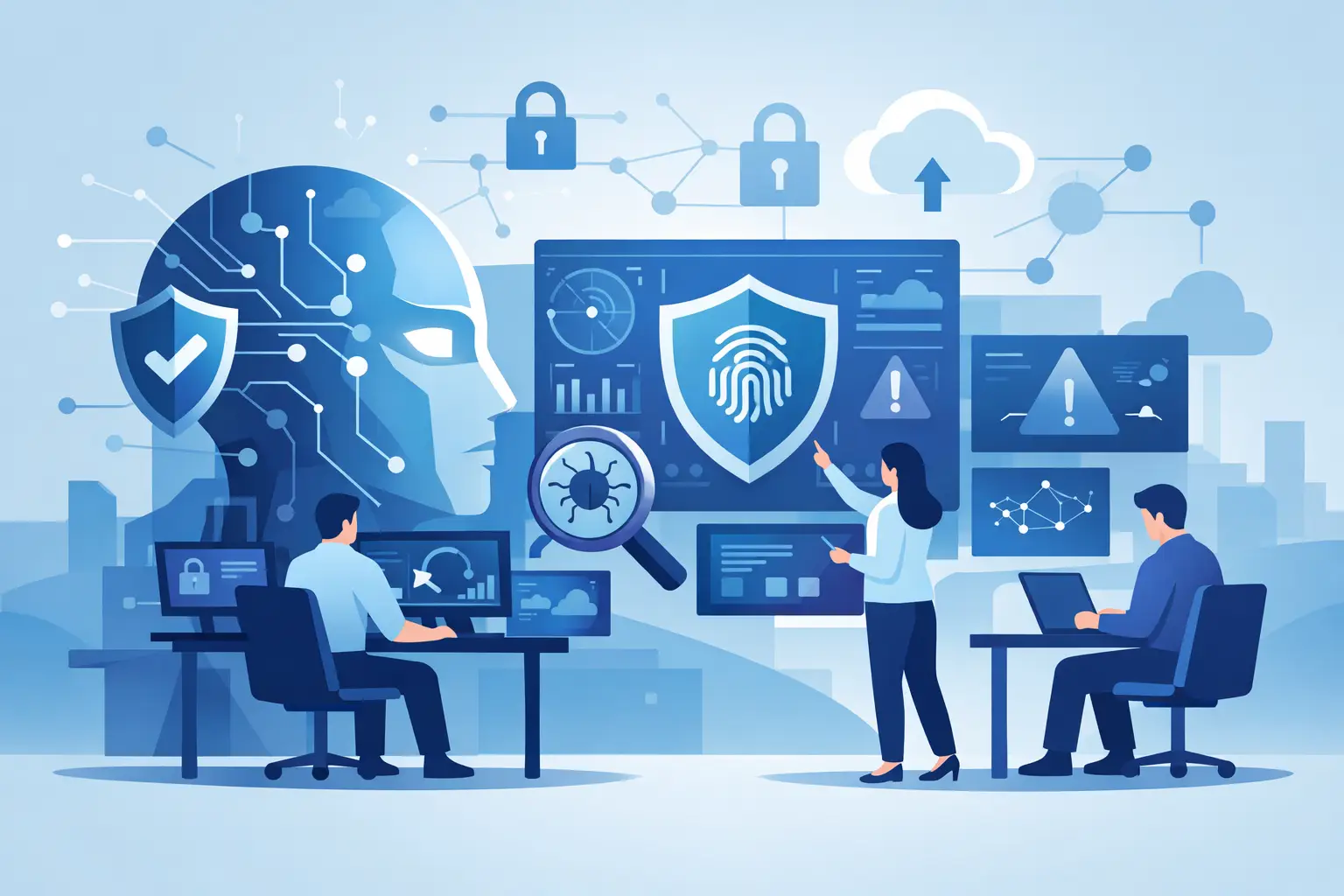
If your analysts are still pivoting across five consoles to validate one incident, the problem is not staffing alone. It is architecture. An ai driven soc platform is supposed to reduce noise, compress investigation time, and give teams a clearer path from detection to response. If it does not do those three things, it is adding complexity under a more current label.
That distinction matters because many security teams are being asked to improve response metrics while working inside fragmented environments. Firewall telemetry lives in one place, endpoint data in another, identity signals somewhere else, and email threats arrive with little context unless an analyst manually stitches the story together. The result is predictable: high alert volume, inconsistent triage, slow escalation, and too much dependence on the individual experience of whoever is on shift.
An AI-driven SOC platform should not be judged by whether it includes machine learning or a copilot interface. It should be judged by whether it fixes broken SOC workflows.
Where traditional SOC operations lose time
Most SOC inefficiency starts before the incident is confirmed. Analysts spend too much time deciding whether an alert deserves attention at all. That happens when detections are generated without enough context, correlation is weak, and the platform forces users to investigate data source by data source instead of incident by incident.
In practice, this creates three expensive problems. First, alert fatigue sets in because analysts repeatedly review low-value signals with little enrichment. Second, real threats take longer to validate because assembling evidence is manual. Third, response quality becomes uneven because each analyst develops their own process for triage and containment.
SIEM and SOAR stacks often contribute to this problem when they are deployed as separate layers with separate logic. One tool collects and stores. Another automates. A third presents endpoint findings. A fourth handles case management. Integration is possible, but it usually requires time, tuning, and ongoing care. For lean teams, that maintenance burden can become its own operational risk.
What an ai driven soc platform should actually do
The best way to evaluate an ai driven soc platform is to ignore feature theater and look at the analyst workflow. Can the platform collect telemetry across endpoint, firewall, cloud, identity, and email environments, correlate it into a single incident, and drive the next best actions without requiring constant manual pivoting?
That is the real test. AI has value when it improves signal quality and accelerates decisions. It is far less useful when it simply generates more text around the same disconnected data.
A capable platform should start by normalizing and correlating security telemetry from multiple controls. If a user receives a phishing email, authenticates from an unusual location, triggers endpoint defense events, and begins suspicious lateral movement, those signals should not appear as four unrelated alerts. They should become one incident with a timeline, asset context, user context, and recommended response options.
This is where AI can make a measurable difference. It can cluster related detections, suppress obvious duplicates, surface unusual combinations of activity, and help prioritize incidents based on behavior, asset sensitivity, and attack progression. That does not remove the analyst from the loop. It gives the analyst a cleaner starting point.
AI is useful when it reduces analyst effort
Security leaders should be careful about over-rotating toward autonomy claims. Full automation sounds efficient until a false positive isolates the wrong host or disables the wrong account. In security operations, speed matters, but control matters just as much.
A practical AI-driven SOC platform helps analysts move faster without obscuring the reasoning behind a decision. It should show why alerts were grouped, what evidence supports severity, and which response action is being recommended. The strongest platforms make automation governable. You can automate enrichment and routine containment while preserving approval steps for higher-impact changes.
That balance is especially important in hybrid environments where infrastructure, cloud services, identity providers, and endpoint controls are spread across vendors. AI can bridge complexity, but only if the platform is built to operate across that complexity rather than sitting on top of it.
The role of unified incident workflow
A SOC does not become more effective because data is centralized alone. It becomes more effective when investigation and response are centralized too. That is why workflow design matters as much as detection logic.
In a modern platform, an analyst should be able to move from alert review to investigation to containment in one workspace. Evidence should already be attached. Related assets and users should already be visible. Response actions should be available in context, whether that means isolating an endpoint, blocking an indicator, disabling an account, or escalating for deeper review.
Without that unified workflow, teams fall back into swivel-chair operations. Every pivot adds time. Every manual handoff creates room for inconsistency. Every separate queue increases the chance that part of the incident story gets missed.
This is why platform consolidation is not just a budget conversation. It is an operational performance conversation. Replacing disconnected SIEM, SOAR, and case handling workflows with one coherent analyst workspace can reduce mean time to investigate just as meaningfully as adding more detections.
Use cases that reveal platform quality
The easiest way to evaluate platform claims is through common attack paths. Ransomware, phishing, lateral movement, and data exfiltration all expose whether correlation and response are truly integrated.
Take phishing. A weak platform identifies the email event and leaves the analyst to discover whether the user clicked, whether credentials were entered, whether mailbox rules changed, and whether endpoint activity followed. A stronger platform connects those events automatically and elevates the incident based on progression, not isolated signals.
The same pattern applies to lateral movement. One authentication anomaly rarely tells the whole story. But when unusual login activity is tied to endpoint process execution, privilege changes, and network movement, the threat becomes clearer. AI should help assemble that chain quickly, not force analysts to build it manually from logs.
Data exfiltration is another good test. The signal often develops across systems: identity access, cloud storage activity, endpoint behavior, and outbound network patterns. If the platform cannot correlate those layers into a coherent incident, detection quality will always depend too heavily on individual analyst persistence.
Deployment model matters more than vendors admit
Not every organization wants to operate the SOC the same way. Some teams want direct control over detections, triage, and response. Others need 24/7 coverage without building overnight analyst capacity in-house. A serious platform should support both realities.
That means deployment flexibility matters. An internal team may want self-managed operations with strong workflow and automation support. Another organization may want the same platform delivered as a managed service so that analysts, detections, and response execution are available around the clock. The underlying requirement is consistency. Whether the SOC is self-run or managed, the platform should provide the same visibility, incident structure, and response rigor.
This is one reason Helxon’s approach stands out. Instead of forcing customers to choose between fragmented tooling and outsourced opacity, it gives them a unified SOC platform with the option to operate it directly or consume it as a service.
What buyers should ask before choosing a platform
The best buying questions are operational. How many tools will analysts still need open during an active investigation? How much tuning is required to correlate across firewall, endpoint, cloud, identity, and email sources? Can response actions be executed inside the same workflow where incidents are investigated? How clearly does the platform explain why an alert was prioritized?
It is also worth asking what happens after deployment. Some platforms look efficient during a demo but rely on heavy engineering effort to stay useful. Others may offer broad integrations but weak incident logic, which means centralized ingestion without meaningful workflow improvement. A platform that reduces stack sprawl on paper but increases management overhead in practice is not solving the right problem.
For most SOC leaders, the real objective is simpler: reduce alert fatigue, improve investigation speed, and make response more consistent without scaling headcount at the same rate as telemetry.
That is the standard an AI-driven SOC platform should be held to. Not whether it sounds advanced, but whether it gives your team sharper context, fewer dead ends, and faster control when an incident starts to move. The right platform should make your SOC feel less like a collection of tools and more like an operating system for security decisions.