
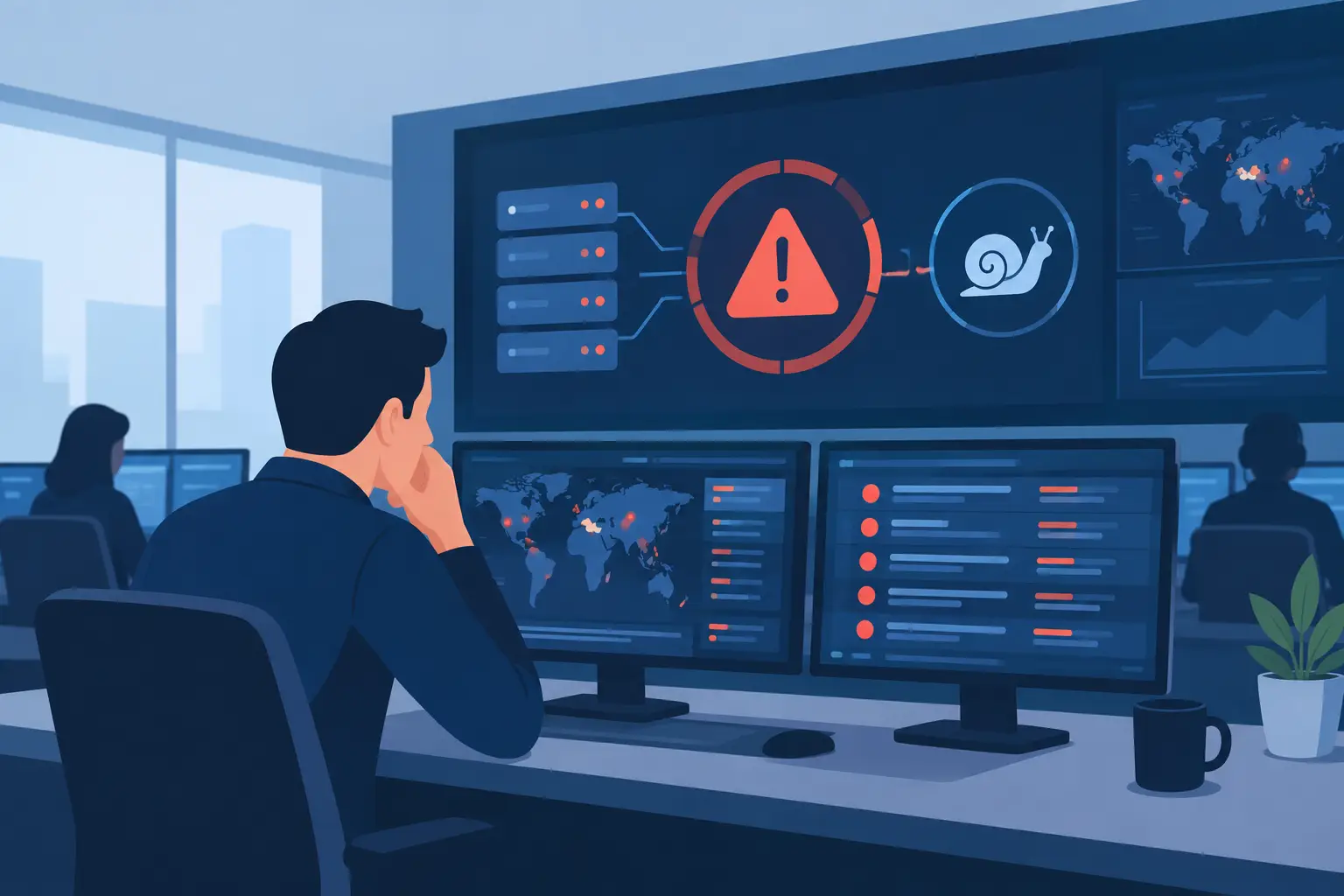
A suspicious sign-in becomes a compromised account. A phishing email becomes an endpoint foothold. A few minutes of uncertainty can turn a containable security event into lateral movement, data exposure, or ransomware.
So, what causes slow incident response? Usually, it is not a lack of effort from the SOC. It is an operating model that forces analysts to chase incomplete alerts across disconnected tools, manually assemble context, and wait for decisions that should already be clear. Faster response starts by removing the friction between detection, investigation, containment, and reporting.
What Causes Slow Incident Response?
Slow incident response is the cumulative result of delays at every stage of the security workflow. An alert may arrive quickly, but if an analyst cannot determine whether it is real, identify the affected assets, understand the user and identity context, or execute an approved containment action, detection speed has limited value.
The most common causes are alert overload, fragmented telemetry, weak prioritization, manual investigation, and unclear ownership. These problems often reinforce one another. High alert volume creates queues. Fragmented tools make each alert slower to investigate. Unclear procedures add approval delays. By the time the team confirms an incident, the attacker has had more time to act.
Alert fatigue hides the incidents that matter
Many SOCs receive more alerts than their analysts can reasonably review. A firewall, endpoint protection platform, identity provider, cloud environment, email security gateway, and SIEM may each generate signals about the same activity. Without correlation, the team sees separate notifications instead of one incident with a clear attack narrative.
This creates two forms of delay. First, analysts spend time dismissing duplicates, low-confidence detections, and expected administrative behavior. Second, genuinely dangerous activity may be buried in a queue behind lower-risk work. Severity labels alone do not solve this problem. A high-severity alert without asset criticality, user context, and related events may still require extensive manual validation.
The goal is not simply to create fewer alerts. It is to create fewer analyst decisions. A useful incident workflow groups related evidence, scores risk using business context, and presents the next investigative step without requiring an analyst to rebuild the story from raw logs.
Fragmented tools fragment the investigation
Traditional security operations often depend on a collection of specialized tools. Each may perform its intended function well, but the analyst experience breaks down when every investigation requires switching between consoles, copying indicators, comparing timestamps, and searching for related activity.
Consider a possible account takeover. The SOC may need to review identity logs for unusual authentication, email telemetry for a malicious link, endpoint activity for browser or credential access, firewall data for outbound connections, and cloud logs for changes to permissions or data access. If each source lives in a separate interface, the analyst becomes the integration layer.
That approach does not scale. It also creates inconsistent investigations because different analysts may search different sources or interpret evidence differently. Centralized visibility is not just a convenience feature. It is a response-time control that reduces the number of handoffs and manual searches required before containment.
Missing context makes every alert a research project
An alert is rarely enough to justify a disruptive action. Blocking a user, isolating a server, or disabling an account can affect business operations, particularly in environments with critical production systems or shared service accounts. Analysts need confidence before they act.
Confidence comes from context: who owns the asset, whether it is business-critical, whether the user is privileged, what processes ran before the detection, which hosts communicated with the system, and whether the behavior appears elsewhere in the environment. When this information is unavailable or spread across ticketing systems, CMDB records, and separate security tools, response slows down.
There is a trade-off. Teams should not automate disruptive actions on weak evidence. But they also should not require a manual investigation for every well-understood threat. The practical model is to enrich incidents automatically, then apply response actions according to confidence, affected asset class, and established business rules.
Manual Triage Creates a Growing Backlog
Manual triage is necessary for ambiguous and novel activity. It becomes a bottleneck when it is the default for routine cases. Analysts often spend valuable time collecting IP reputation, checking user roles, searching endpoint history, confirming device ownership, and documenting actions in a separate case-management system.
These steps are not inherently wrong. The problem is repetition. If the same enrichment and correlation steps occur in every investigation, they should be handled by the platform wherever possible. Automation should collect evidence and prepare the case, while analysts apply judgment to the decisions that require it.
This distinction matters because automation without analyst control can create risk. An aggressive playbook that isolates a critical server based on a false positive can be as disruptive as the attack itself. Effective response automation is governed, auditable, and specific. It can revoke a suspicious session, block a known malicious domain, or open a prioritized case when the evidence meets defined conditions. For higher-impact actions, it can route the analyst a complete incident record and an approved response path.
Poor prioritization treats every asset the same
A suspicious process on a disposable test endpoint is not equivalent to the same process on a domain controller, finance workstation, or executive account. Yet many detection pipelines lack the business context to make that distinction early.
Without asset and identity prioritization, the SOC works from alert order rather than business risk. This can lead to fast handling of minor events while critical incidents wait. Attackers benefit from that gap, especially when they target identities and systems with broad access.
Risk-based prioritization combines detection confidence with factors such as privilege level, asset sensitivity, internet exposure, known vulnerabilities, active threat intelligence, and evidence of lateral movement. It does not eliminate analyst review. It directs the limited analyst attention to the activity with the greatest potential business impact.
Unclear ownership delays containment
Incident response can stall even after the SOC identifies the threat. Who can disable the account? Who approves endpoint isolation? Is the network team responsible for blocking the indicator? Does legal need to be notified before evidence is collected from a particular system?
These questions should not be answered during an active incident. Mature response operations establish ownership in advance, define escalation paths, and document decision thresholds. The SOC needs authority to perform preapproved actions quickly, particularly for high-confidence threats such as active ransomware behavior, confirmed credential theft, or command-and-control communication.
For organizations using a managed SOC, responsibility boundaries require even more precision. The provider needs defined access, response authority, communication channels, and escalation contacts. A 24/7 monitoring service cannot compensate for an approval model that leaves urgent containment actions waiting until the next business day.
Measure the Delays, Not Just the Final Metric
Mean time to respond is useful, but it can hide where the process is failing. A team may improve the overall number while still taking too long to acknowledge critical alerts or contain active threats. Measure the workflow in stages: time to detect, time to acknowledge, time to validate, time to contain, and time to recover.
These measures reveal different operational problems. Slow validation often points to missing context or poor correlation. Slow containment may indicate limited automation or unclear authority. Long recovery times can expose gaps in IT coordination, backup readiness, or remediation procedures.
The right benchmark depends on the organization’s environment and risk tolerance. A SOC supporting a hospital, manufacturer, or financial services firm may require different containment thresholds than a team protecting a lower-risk SaaS environment. What matters is that targets are explicit, measurable, and tied to credible attack scenarios.
Build a Response Workflow That Moves With the Threat
Faster response does not require adding another dashboard to an already crowded SOC. It requires connecting telemetry, investigation, case handling, and response in one operational workflow. A unified analyst workspace can correlate signals across identity, endpoint, firewall, cloud, and email sources so the team sees an incident instead of a scattered collection of alerts.
Helxon’s VORXOC approach is built around that operational requirement: reduce alert fatigue, give analysts the context to make decisions faster, and support response without forcing teams to manage a fragmented SIEM and SOAR stack. The deployment model can vary between a self-managed SOC and managed 24/7 coverage, but the underlying need is the same - clear ownership, complete evidence, and timely action.
The useful question for security leaders is not whether the team can investigate every alert eventually. It is whether the team can recognize, validate, and contain the incidents that matter before an attacker reaches the next stage.