
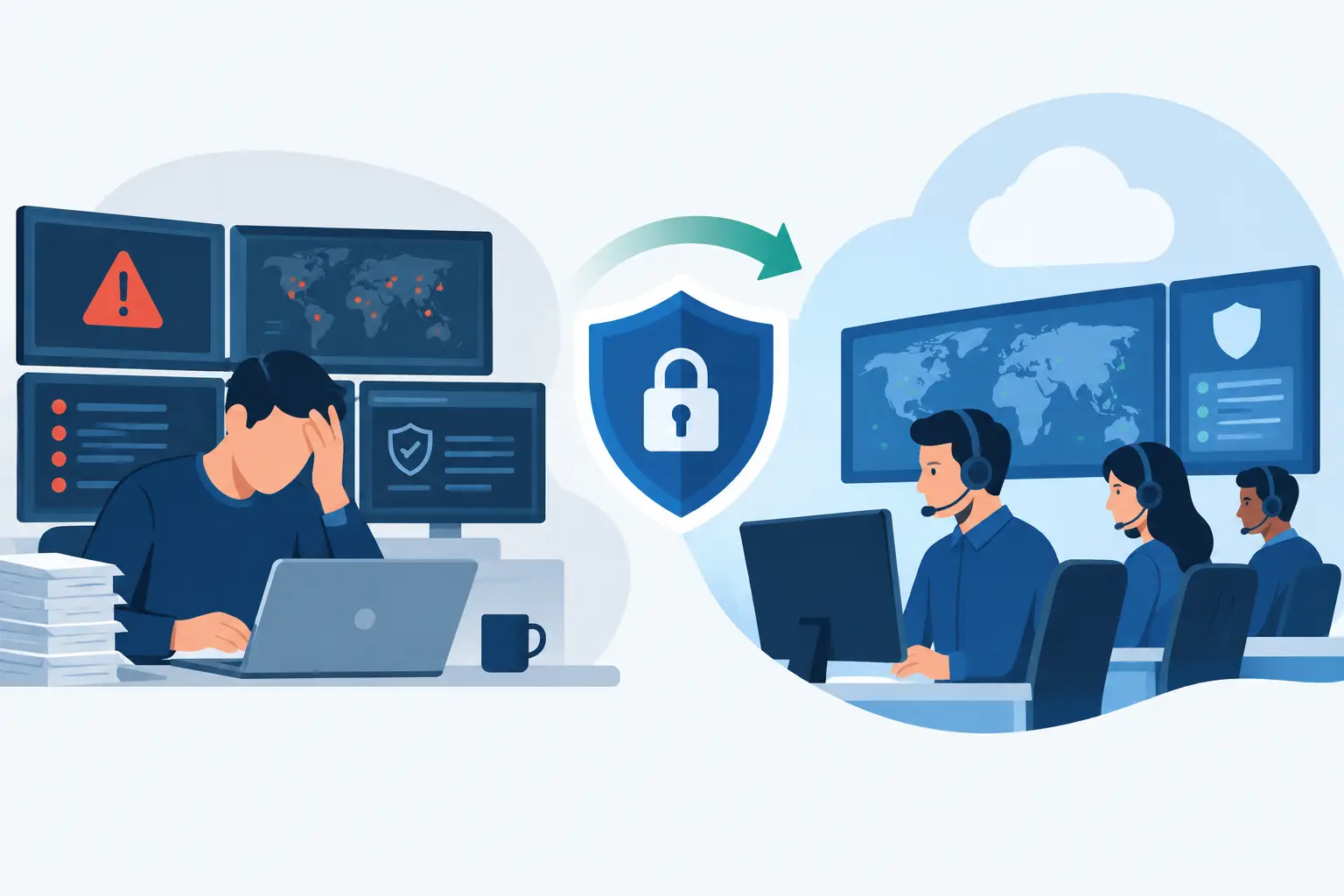
A ransomware alert at 2:13 a.m. is not a staffing problem in theory. It is an operational problem in practice. If no one can validate the alert, trace the affected identity and endpoint activity, and contain the threat before business hours, risk is accumulating while the SOC is offline. That is often the moment security leaders begin asking when to outsource security operations.
The answer is not simply when the team is busy. Every SOC is busy. The more useful question is whether internal resources can consistently detect, investigate, and respond across the environments that matter most. For many mid-market and enterprise teams, outsourcing becomes the right move when coverage gaps, fragmented tools, and alert volume make timely action unreliable.
7 Signs It Is Time to Outsource Security Operations
1. Critical alerts wait until the next business day
A weekday-only SOC can be appropriate for a limited environment with strong preventative controls and low exposure. It becomes difficult to defend when the organization operates cloud workloads, remote endpoints, identity platforms, email systems, and externally accessible applications around the clock.
Attackers do not schedule credential abuse, phishing follow-on activity, or lateral movement for staffed hours. If high-severity alerts regularly sit unreviewed overnight, on weekends, or during holidays, 24/7 coverage is no longer a nice-to-have capability. It is a material detection and response gap.
Outsourced SOC coverage can close that gap without forcing an internal team to build a shift model, recruit overnight analysts, and absorb the management overhead that comes with a round-the-clock operation.
2. Analysts spend more time sorting alerts than investigating threats
High alert volume is not proof of strong security. It often signals that detection logic, telemetry sources, and workflows are disconnected. Analysts bounce between firewall consoles, endpoint tools, cloud logs, identity records, email security dashboards, and a SIEM that provides more events than context.
The result is alert fatigue. Analysts repeatedly validate the same types of benign activity, while meaningful patterns are harder to see. A compromised account that triggers identity, VPN, endpoint, and email signals may look like four separate tickets instead of one developing incident.
Outsourcing is worth considering when internal analysts are trapped in manual triage and cannot reserve time for threat hunting, detection engineering, incident improvement, or strategic risk reduction. A managed team should not merely watch the same noisy queue. It should correlate telemetry, prioritize incidents based on risk, and provide investigation context that makes decisions faster.
3. Your SOC stack is expensive but still lacks a coherent workflow
Many organizations have accumulated capable tools without creating an effective security operation. They may own a SIEM, SOAR platform, endpoint detection tool, cloud security product, email security service, and firewall management console, yet the analyst workflow remains manual and fragmented.
This is a common trigger for considering a managed model, but tool sprawl alone does not mean an organization must fully outsource. In some cases, consolidating telemetry and incident workflows gives the existing team enough capacity to retain ownership. In others, a unified platform plus external analysts is the faster path to measurable coverage.
The key test is operational: Can an analyst move from alert to validated incident to remediation with complete context in one workflow? If the answer requires five consoles, multiple exports, and several handoffs, the current model is slowing response regardless of how many tools are licensed.
4. Hiring has become the bottleneck for better coverage
Building an internal SOC requires more than hiring a few analysts. It requires shift coverage, escalation paths, onboarding, training, quality assurance, detection content maintenance, incident playbooks, and management capacity. Turnover can reset much of that investment quickly.
For lean security teams, the choice is often not between a fully staffed internal SOC and an outsourced SOC. It is between accepting partial coverage or extending the team with specialized operational support. Outsourcing can provide immediate access to analysts and established response processes while internal leaders focus on security architecture, business alignment, and high-impact remediation.
This trade-off matters most when headcount requests are repeatedly delayed, open roles remain unfilled, or the current team is carrying an unsustainable on-call burden. A service provider cannot replace internal accountability, but it can remove the need to staff every monitoring and triage function internally.
5. Incident response is inconsistent or difficult to measure
A SOC should be able to answer basic questions with evidence: How quickly are critical alerts acknowledged? How long does validation take? Which incident types recur? Which teams own containment? Where do investigations stall?
If those answers depend on anecdotal updates or manually assembled reports, leadership does not have a reliable view of security operations. That makes it harder to justify investment, demonstrate improvement, or identify control failures before they become incidents.
A mature outsourced security operation should bring defined service levels, documented escalation procedures, incident records, and reporting that maps activity to business risk. This does not mean every organization needs identical response commitments. A healthcare environment, financial services organization, and regional manufacturer may have different escalation requirements. It does mean expectations must be explicit, tested, and visible.
6. Hybrid and multi-vendor environments are creating blind spots
Security operations become harder as the environment expands. A business may run Microsoft identity services, cloud workloads in more than one platform, remote endpoints, legacy network controls, SaaS applications, and third-party email defenses. Each source contains part of the story, but no individual console provides the whole story.
This is where outsourced coverage can deliver value beyond staffing. The provider needs the ability to correlate telemetry across those environments, identify related activity, and investigate the attack path rather than treating every alert as an isolated event.
For example, a phishing incident should not end with a message quarantine decision. The investigation may need to determine whether the user entered credentials, whether sign-in behavior changed, whether mailbox rules were created, whether the endpoint executed a payload, and whether the account touched sensitive systems. When internal teams cannot perform that correlation consistently, outsourcing can materially improve detection quality.
7. The business needs faster improvement, not another long SOC project
Some organizations can build and mature an internal SOC successfully. They have the budget, leadership commitment, analyst pipeline, and time to standardize processes. If that describes your organization, outsourcing every function may not be necessary.
But organizations under immediate pressure often cannot wait 12 to 18 months for a new SIEM deployment, integrations, playbooks, staffing, and tuning cycles to produce reliable outcomes. They need better visibility and response performance now, without adding another disconnected tool to the stack.
That is the strongest case for a modern SOC as a Service model: it pairs technology consolidation with operational execution. Instead of sending analysts into a patchwork of consoles, a unified workspace can connect firewall, endpoint, cloud, identity, and email telemetry to a single incident workflow. Platforms such as Helxon's VORXOC are designed around this model, giving organizations the option to retain direct control or add managed 24/7 analyst coverage on the same operational foundation.
What to Keep In-House When You Outsource
Outsourcing security operations should extend internal control, not remove it. The strongest model is usually shared responsibility. The provider handles monitoring, triage, investigation, and defined response actions, while internal security and IT leaders retain authority over business context, risk decisions, major containment steps, and long-term security priorities.
Before selecting a provider, define what can be executed automatically, what requires approval, and who owns escalation for each incident type. Isolating a clearly compromised endpoint may be pre-approved. Disabling an executive account, shutting down a production server, or blocking a business-critical integration may require internal confirmation. These decisions should be reflected in playbooks, not negotiated during an active incident.
Also examine data visibility and reporting. Your team should be able to review incidents, understand why alerts were prioritized, see response actions, and measure service performance. A black-box managed service can reduce workload, but it can also create dependency and weaken executive reporting. Operational clarity is a requirement, not an add-on.
Outsourcing Is a Decision About Coverage and Control
The best time to outsource is before a known gap becomes a breach investigation. If alerts are aging, analysts are overwhelmed, coverage ends at 5 p.m., or the security stack is producing noise instead of answers, the current operating model is already signaling its limits.
Choose a model that gives the business continuous detection and faster response while preserving visibility into what is happening, why it matters, and who is taking action. The goal is not to hand off security responsibility. It is to ensure that responsibility can be executed at the speed an incident demands.