
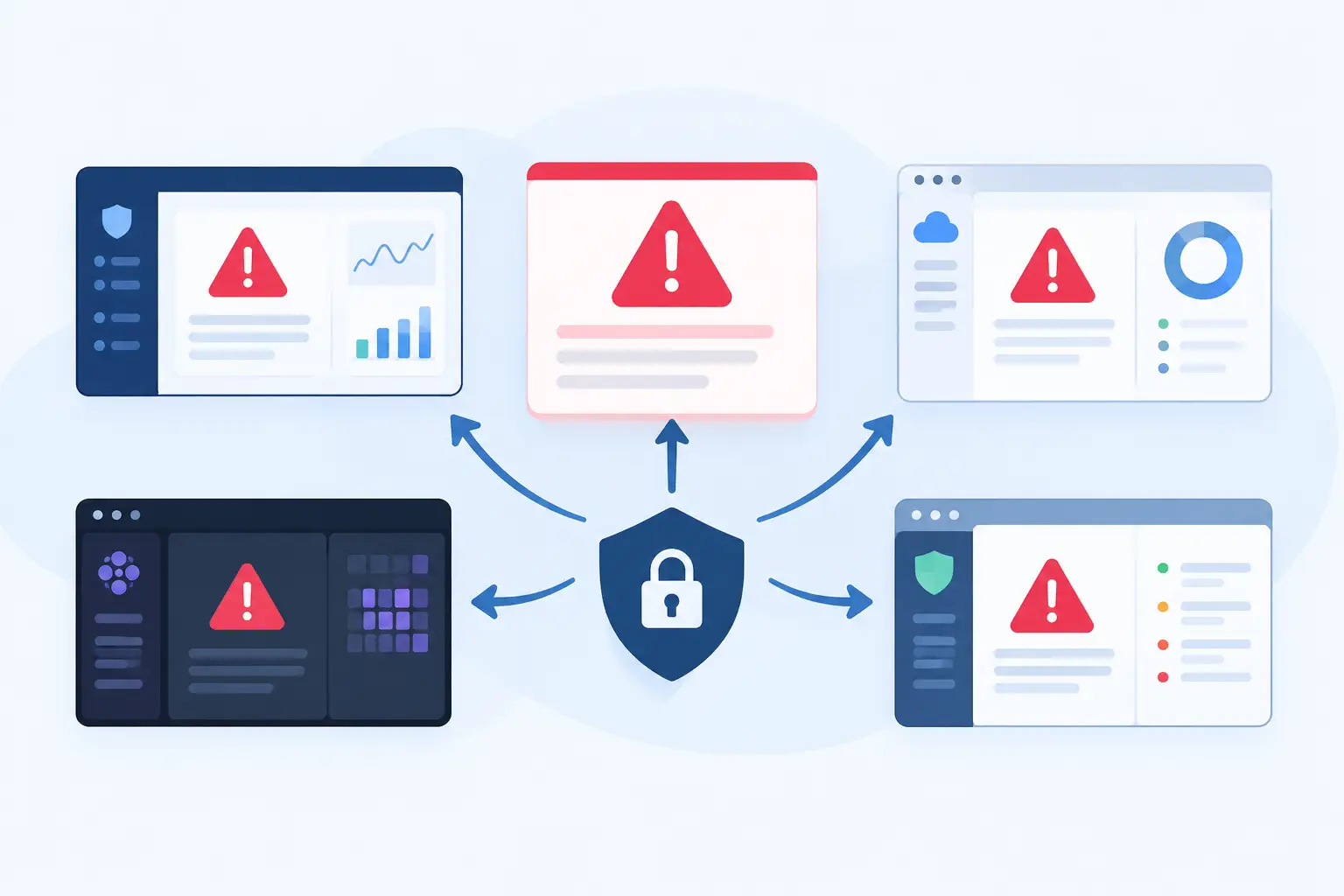
A phishing campaign triggers an email alert, an endpoint alert, an identity alert, and a firewall alert within minutes. Four tickets appear in the queue. Four analysts may touch them. Yet the security team is investigating one incident.
That is why alerts duplicate in many SOCs: the environment sees related evidence through disconnected tools, but the operating model treats each signal as a separate event. The result is more than annoyance. Duplicates consume analyst time, inflate incident metrics, obscure attack progression, and create the false impression that the SOC is under constant siege.
The fix is not simply to suppress more alerts. Security teams need to understand where duplication enters the pipeline, distinguish harmful duplication from useful corroboration, and build a workflow that turns many signals into one defensible incident.
Why alerts duplicate in security operations
Duplicate alerts usually reflect an architecture problem, a detection engineering problem, or both. Modern enterprises collect telemetry from endpoint detection tools, firewalls, email security, identity providers, cloud platforms, vulnerability scanners, and legacy SIEM rules. Each system has its own logic, timing, severity model, and asset identifiers.
When those systems are not correlated at the incident level, they all report what they can see. An endpoint tool may flag PowerShell execution. Identity telemetry may report an unusual sign-in. Email security may identify the original malicious attachment. None of those alerts is necessarily wrong. The failure occurs when the SOC has no reliable way to connect them to the same user, host, campaign, or attack sequence.
There is also a timing issue. One rule may alert immediately on a suspicious process, while another generates a correlated alert after enrichment runs five minutes later. If the SOC platform does not recognize that the two alerts concern the same entity and time window, analysts receive duplicates that look unrelated.
The most common sources of duplicate alerts
Overlapping detection rules
Detection content often grows faster than it is governed. A team may deploy a vendor rule, add a custom SIEM query, enable a managed detection rule, and retain a legacy correlation rule for the same behavior. All four can detect credential dumping, suspicious inbox forwarding, or remote service execution.
Overlap is not inherently bad. Different detections can provide resilience and capture variations in attacker behavior. It becomes a problem when every rule creates an independent ticket without considering whether a stronger rule has already established the same finding. Teams need clear ownership of detection logic and a routine process for identifying rules that repeatedly alert on the same entities, indicators, and behaviors.
Duplicate data ingestion
The same event can enter the SOC through more than one path. For example, endpoint telemetry may be forwarded directly into a SIEM and also arrive through a cloud data connector. Firewall logs may be collected by an agent and sent again through Syslog. A managed service provider may forward enriched alerts while the organization also ingests the original vendor alerts.
This issue can be difficult to spot because the records may not be identical. Timestamps can vary, field names can change, and one source may add enrichment. Analysts see two credible alerts, but both originated from the same underlying activity. Source-level deduplication should use stable event identifiers where available, then apply normalized fields such as device ID, user ID, process hash, and event time when identifiers differ.
Entity mismatch across tools
Tools rarely describe the same asset in the same way. One may use a hostname, another a fully qualified domain name, another an internal device ID, and another an IP address that changed after a DHCP renewal. Identity systems add aliases, service accounts, shared mailboxes, and multiple user principal names.
Without entity normalization, correlation fails even when the evidence is clearly connected. This is especially common in hybrid environments where on-premises Active Directory, cloud identity, endpoint tooling, and network telemetry have evolved independently. A usable entity model resolves those variations into a consistent view of the user, device, application, and network relationship.
Automation that opens tickets too early
Many SOCs automate alert-to-ticket creation before correlation and enrichment occur. This improves apparent speed, but it also creates a queue full of low-context records. An orchestration workflow may then open additional tickets after gathering threat intelligence, checking for lateral movement, or detecting related mailbox activity.
Automation should accelerate decisions, not multiply work. Where possible, the platform should enrich and correlate first, then create or update a single incident record. A ticket should represent analyst work to be performed, not every raw detection emitted by every security product.
Duplicates are not always noise
A zero-duplicate goal is unrealistic and can be dangerous. Multiple signals can confirm a high-confidence attack. If a phishing alert, impossible-travel alert, and endpoint execution alert all point to the same user, that convergence may be exactly what turns an uncertain event into a priority incident.
The operational question is not, “How do we eliminate every repeated signal?” It is, “How do we preserve the evidence while presenting it as one investigation?” Analysts still need to see each contributing alert, its source, its timestamps, and its detection logic. They should not need to pivot between four consoles or close three redundant tickets to understand what happened.
This distinction matters for compliance and incident reporting as well. Suppressing data can weaken the audit trail. Correlating data retains evidence while reducing queue volume and providing a clearer narrative of attacker activity.
How to reduce duplicate alerts without losing coverage
Start with measurement. Track duplicate rate by detection source, rule, entity, and incident type. A useful baseline is the percentage of alerts that analysts close as related to an existing case, along with the time spent merging or dismissing them. This identifies whether the primary issue is a noisy rule, duplicate ingestion, weak entity resolution, or fragmented case management.
Next, review detections in context rather than one rule at a time. For high-volume behaviors, compare the trigger conditions, lookback windows, severity, and required entities. If two rules detect the same action but one provides more reliable context, make that rule the primary alert and convert the other into supporting evidence or a lower-priority signal.
Correlation logic should connect alerts using more than a single indicator. Matching only on an IP address will create false groupings in shared network environments. Better correlation considers a combination of user, host, process, email message ID, cloud resource, technique, time window, and campaign attributes. The right threshold depends on the use case. Ransomware behavior may justify aggressive grouping around a host and short time window, while account compromise may require correlating activity across several systems over hours or days.
Finally, make incident ownership explicit. Once an incident exists, new matching evidence should attach to it, update risk, and notify the assigned analyst when necessary. It should not start the workflow from scratch. A unified analyst workspace can preserve the supporting alerts, enrichment, response actions, and decision history in one case rather than scattering them across SIEM, SOAR, endpoint, and ticketing tools.
Build the queue around incidents, not products
Security products are designed to detect within their domain. The SOC exists to investigate across domains. That difference should shape the operating model.
Platforms such as Helxon VORXOC are built around this incident-first approach, correlating telemetry from endpoint, firewall, identity, cloud, and email environments into a single workflow. The practical value is not another dashboard. It is fewer disconnected investigations, faster confirmation of real threats, and a clearer path from detection to containment.
The most effective duplicate-alert reduction programs also include change control. Every new connector, detection package, or automation playbook should be tested for its effect on existing alert volume and correlation behavior. A rule that is valuable in isolation can still create operational drag when it duplicates a control already producing higher-quality evidence.
A SOC queue should tell analysts what requires action now, what evidence supports that decision, and what has already been investigated. When duplicate alerts are treated as an incident-design problem instead of a ticket-cleanup problem, teams regain time for the work that actually reduces risk.