
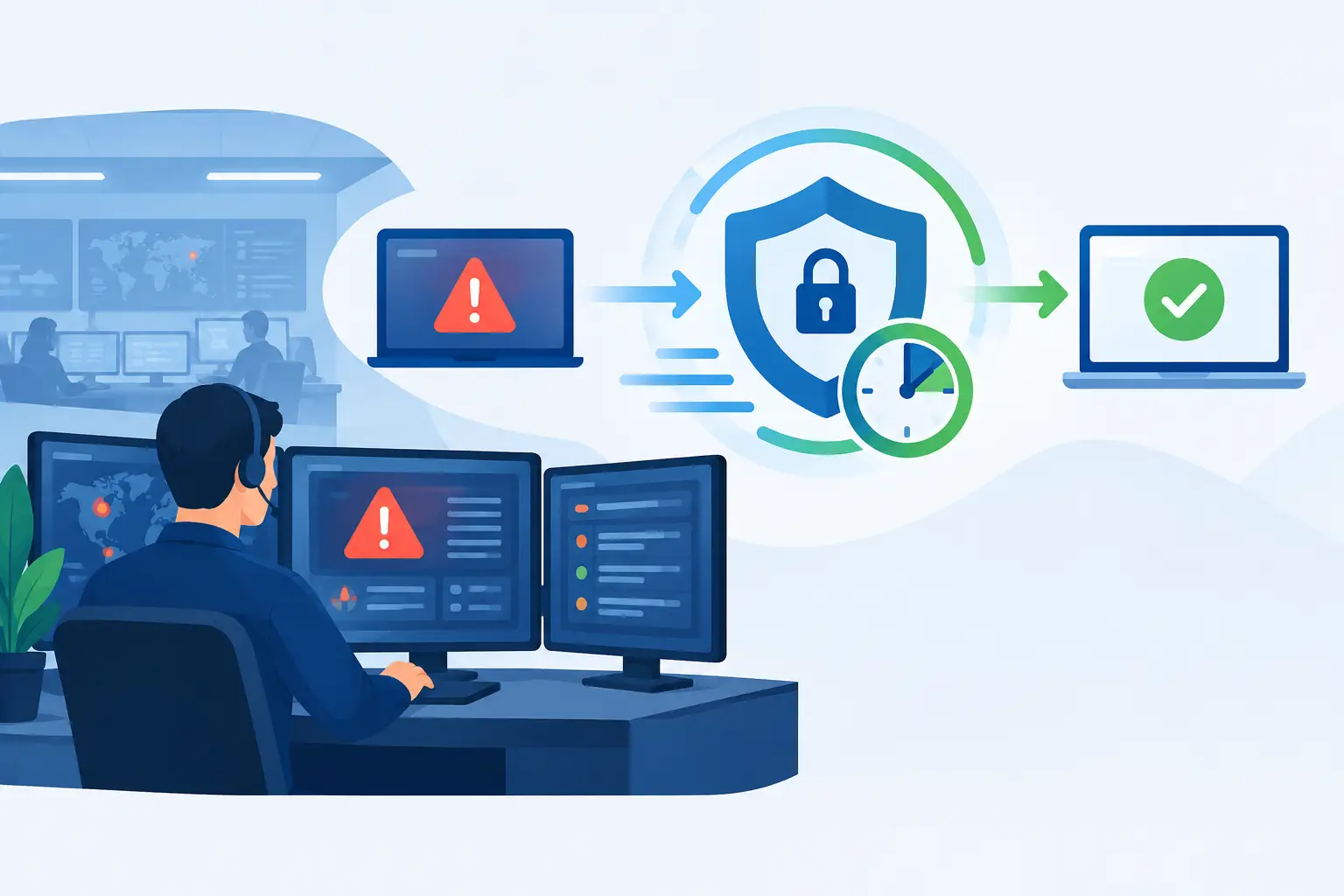
A suspicious login is not an incident. A malicious email is not necessarily an incident. Even a confirmed endpoint alert is only the beginning of the work. Incident remediation is the disciplined process of containing a verified threat, removing its foothold, restoring normal operations, and proving that the environment is safe to return to service.
For security teams under pressure, the gap between detection and remediation is where risk compounds. Analysts can identify a phishing campaign in minutes, then lose hours gathering endpoint evidence, tracing identity activity, opening firewall consoles, and coordinating changes across IT teams. The longer that gap remains open, the more opportunity an attacker has to move laterally, escalate privileges, or exfiltrate data.
Why Incident Remediation Breaks Down in Modern SOCs
Most organizations do not struggle because they lack security tools. They struggle because the tools do not produce one operational picture. Email telemetry lives in one console, endpoint activity in another, cloud audit events in a third, and identity signals somewhere else. An analyst is left to reconstruct the attack manually while alert queues keep growing.
That fragmentation creates three expensive problems. First, containment decisions are delayed because the available evidence is incomplete. Second, analysts repeat work as they pivot across consoles and copy details into tickets. Third, leadership receives incident updates that are difficult to defend because the timeline, scope, and actions are scattered across systems.
The operational consequence is familiar: teams close alerts without fully resolving the underlying exposure, or they overreact and disrupt legitimate users and systems. Neither outcome is acceptable. Effective remediation requires enough context to act quickly, but enough precision to avoid creating a business outage while trying to prevent one.
Incident Remediation Is More Than Containment
Containment is urgent, but it is only one phase. Isolating a device can stop an active endpoint threat. Disabling a user account can interrupt account takeover. Blocking a domain can halt a phishing campaign. These actions matter, yet none alone confirms that the threat is gone.
A complete incident remediation workflow moves through four connected decisions: establish scope, contain the threat, eradicate persistence and exposure, then validate recovery. Each decision should be captured in the incident record, including what was observed, what action was taken, who approved it, and what evidence confirmed success.
Establish scope before the attack expands
The first question is not simply, “What fired the alert?” It is, “What else is connected to this activity?” A compromised identity may be associated with risky sign-ins, new mailbox forwarding rules, cloud API calls, VPN sessions, and endpoint activity. A ransomware indicator may connect to a process tree, a file share, suspicious authentication attempts, and other hosts communicating with the same infrastructure.
Scope determines the right response. If a phishing email was delivered but never opened, removing the message may be sufficient. If a user entered credentials and an attacker established mailbox rules, the response needs to include password reset, session revocation, rule removal, log review, and a search for activity against related accounts.
This is why correlation matters. The SOC needs a timeline that brings together firewall, endpoint, cloud, identity, and email data around the user, device, IP address, process, or indicator at the center of the incident.
Contain with actions that match confidence
Containment should be decisive, but it should not be reckless. Mature teams define actions according to confidence and business impact. High-confidence malware executing on a workstation may justify immediate device isolation. A single anomalous sign-in from a trusted employee traveling internationally may require verification before account suspension.
The best operating model uses preapproved response actions for common, well-understood scenarios while preserving analyst control for ambiguous cases. Useful actions include isolating an endpoint, killing a malicious process, disabling or locking an account, revoking sessions, blocking an IP or domain, quarantining a message, and disabling a risky cloud access key.
Automation is valuable when the conditions are clear. It becomes dangerous when it treats every detection as equivalent. The goal is not to automate every action. The goal is to reduce the time between verified evidence and the safest effective response.
Eradicate persistence, not just symptoms
Attackers often leave more behind than the original alert reveals. A compromised endpoint may contain scheduled tasks, new local accounts, remote access tooling, malicious browser extensions, or modified security settings. A cloud compromise may involve new OAuth grants, access keys, role assignments, or virtual machines launched for persistence.
Eradication requires analysts to identify how access was obtained and how it could be regained. That may mean removing malicious artifacts, patching the exploited vulnerability, rotating credentials, resetting tokens, correcting misconfigurations, and checking whether the attacker reached adjacent systems.
This step is where incident remediation often loses momentum. The initial threat looks contained, so the team moves to the next alert. A unified incident workflow keeps eradication tasks visible and assigned until the evidence shows that the original path is closed.
Validate recovery with evidence
Returning a device or account to normal operation should be a deliberate decision. Validation confirms that systems are functioning, required controls remain enabled, malicious activity has stopped, and the remediation itself did not introduce a new operational problem.
For an endpoint, validation may include a clean scan, restored security controls, no repeat command-and-control traffic, and monitored reintroduction to the network. For an identity incident, it may include confirmed credential rotation, revoked sessions, removed persistence mechanisms, and no recurrence of suspicious sign-ins over an agreed monitoring period.
The standard is not “we took action.” The standard is “we can show why this incident is resolved.” That distinction matters to auditors, executives, and the teams responsible for keeping the business running.
Build a Remediation Workflow Around the Incident
An alert-centric workflow forces analysts to investigate isolated signals. An incident-centric workflow groups related activity into one operational case, preserving the timeline, entities, evidence, actions, and ownership. It reduces alert fatigue because the team works the threat, not every duplicate symptom of the threat.
For a ransomware scenario, that means connecting suspicious file encryption behavior with endpoint process activity, authentication events, lateral movement indicators, and outbound network traffic. The incident should show which assets are affected, which accounts were used, what containment actions are complete, and what remains unresolved.
This model also improves handoffs. A Tier 1 analyst can validate and escalate a correlated incident with the relevant context already attached. A Tier 2 or incident response lead can make containment decisions without repeating the initial investigation. IT operations can receive clear, actionable requests instead of vague messages asking them to “check a server.”
Helxon’s VORXOC platform is designed around this operational reality: consolidating telemetry and response work into a single analyst workspace so teams can move from detection to defensible action without stitching together disconnected tools.
Measure the Part of Response That Actually Matters
Mean time to detect is useful, but it does not tell leadership whether the organization can stop damage. A fast detection that sits unresolved for six hours is not a strong security outcome. SOC leaders should track time to triage, time to containment, time to eradication, and time to validated recovery.
They should also measure the quality of remediation. How often do incidents reopen? How many containment actions are reversed because they affected legitimate operations? How many hours are spent manually gathering context from separate systems? Which incident types repeatedly require escalations or outside support?
These measures expose where process and tooling are creating friction. They also make the business case for consolidation clearer. If analysts spend most of their shift navigating consoles rather than investigating threats, additional alerts will not improve security. Better workflows will.
The Trade-Off: Speed Versus Disruption
Every remediation decision involves a trade-off. Isolating a finance executive’s laptop during quarter-end may prevent attacker movement, but it can also interrupt critical work. Disabling a service account can stop suspicious access, but it may take down an application. Waiting for more evidence reduces the risk of a false positive, but gives a real attacker more time.
There is no universal rule that resolves these tensions. The right action depends on threat confidence, asset criticality, available compensating controls, and the attacker’s apparent objective. What security teams can control is decision quality: accurate context, defined authority, tested playbooks, and a clear record of why an action was chosen.
The strongest remediation programs do not promise zero disruption. They give analysts the visibility and control to choose the smallest action that reliably stops the threat, then validate that the business can safely continue. That is how a SOC turns incident response from a stream of urgent tickets into a disciplined operating function.