
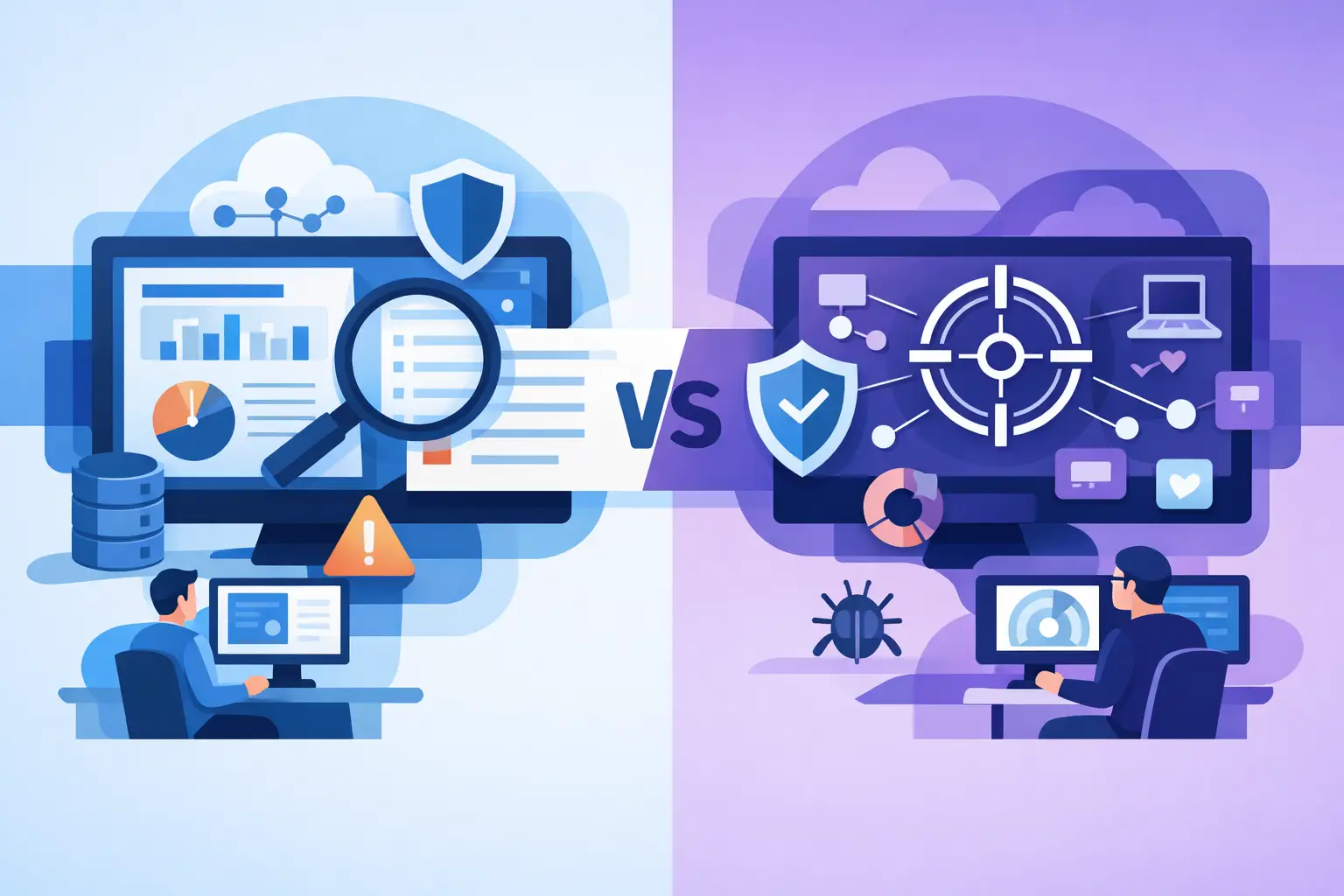
A SIEM vs XDR comparison becomes urgent when the SOC is buried in alerts but still lacks the context to answer a basic question: what happened, what is affected, and what should the team do next? The wrong decision can preserve a familiar tool while extending investigation times, adding integration work, and forcing analysts to pivot between disconnected consoles.
The better question is not whether SIEM or XDR is universally superior. It is which operating model gives your team the visibility, investigation depth, retention, and response control required for your environment. For many organizations, the answer is a combined architecture or a modern security operations platform that reduces the boundaries between collection, detection, investigation, and action.
SIEM vs XDR comparison: the core difference
A security information and event management platform, or SIEM, is designed to collect, normalize, search, retain, and correlate logs from many sources. It can ingest firewall events, endpoint logs, cloud audit trails, identity activity, application logs, network telemetry, and more. SIEM has long been central to enterprise security operations because it provides broad visibility, historical search, reporting, and support for regulatory requirements.
Extended detection and response, or XDR, is designed around detection and response across security domains. It typically correlates higher-value telemetry from endpoint, identity, email, cloud, and network controls to identify attacker behavior and present it as a prioritized incident. XDR emphasizes analyst workflow: connecting signals, reducing noise, guiding investigation, and enabling containment or remediation actions.
The distinction matters operationally. SIEM starts with data management and broad log analytics. XDR starts with security outcomes and correlated detection. A SIEM can detect sophisticated threats, but often requires deliberate onboarding, parsing, detection engineering, tuning, and analyst-led investigation. XDR can accelerate investigations, but its data coverage, retention, and integration depth vary significantly by vendor.
Where each platform performs best
SIEM is strongest when broad ingestion and long-term visibility are non-negotiable. Organizations with complex compliance obligations, custom applications, specialized infrastructure, or a need to investigate months of historical activity often need SIEM-level collection and retention. A mature detection engineering team can also use SIEM to build tailored rules around business-specific threats that a packaged XDR detection may not understand.
That breadth has a cost. Every log source needs onboarding, normalization, validation, and ongoing maintenance. More data can increase cloud ingestion and storage costs. More rules can create more alerts. Without disciplined use cases and tuning, a SIEM becomes an expensive archive that analysts visit only after an incident is already underway.
XDR performs best when the immediate problem is fragmented investigations. A phishing email, suspicious identity login, malicious endpoint process, and outbound connection may each appear as separate events in separate tools. XDR is built to correlate that activity into one incident, connect the entities involved, and help the analyst determine whether it is a real attack.
This approach can sharply reduce alert fatigue. Instead of asking an analyst to manually join endpoint, email, identity, and cloud evidence, XDR presents an attack storyline and often includes response options such as isolating a host, disabling an account, blocking an indicator, or opening a guided case. The trade-off is that an XDR platform may be strongest inside its native ecosystem or across a defined set of supported integrations. It should not be assumed to provide unlimited log collection or replace every compliance reporting requirement.
The operational test: what happens after an alert?
Technology comparisons often focus on detection counts. SOC performance is decided after detection, when an analyst needs context and authority to act.
In a traditional SIEM workflow, a rule fires based on correlated events. The analyst reviews the alert, searches related logs, pivots into endpoint, firewall, cloud, identity, or email consoles, gathers evidence, determines scope, then manually executes or triggers a response. This can work well, particularly with experienced analysts and well-designed integrations. But each pivot adds delay, and each disconnected tool creates the risk of incomplete context.
In an XDR workflow, the platform should consolidate related evidence around an incident. The analyst sees affected users, devices, IP addresses, processes, mailboxes, and cloud resources in a single investigation path. The platform may score severity based on behavior and offer automated containment. That reduces mean time to investigate, but only when the correlations are accurate and the response actions are governed properly.
For a SOC manager, the practical measure is not whether a vendor claims AI or automation. Ask how many console changes are required to validate an incident, how many alerts become actionable cases, and how quickly an analyst can contain a confirmed threat. Those numbers expose whether the platform improves operations or merely adds another dashboard.
Data coverage, retention, and detection engineering
Data strategy is often the deciding factor in a SIEM vs XDR comparison. SIEM generally supports a wider range of raw and semi-structured data sources. That is valuable for investigations involving custom business systems, operational technology, legacy infrastructure, or audit trails that do not fit neatly into an endpoint, identity, cloud, or email category.
XDR generally works with more curated security telemetry. Curated data is easier to analyze because it carries security context and standardized entities. It can produce higher-confidence detections with less engineering effort. However, security teams should verify what data is retained, how long it remains searchable, whether raw records are available, and whether third-party sources receive the same correlation quality as native sources.
Detection engineering follows the same pattern. SIEM gives teams more freedom to build custom rules, queries, dashboards, and threat hunts. That flexibility is valuable, but it demands skilled ownership. XDR reduces that burden with built-in analytics and cross-domain detections, though it may offer less control over underlying logic.
The right balance depends on your team. A large SOC with dedicated detection engineers may want extensive SIEM control. A lean security team that needs faster outcomes may prioritize prebuilt correlation and guided response. Many enterprises need both: wide collection for visibility and compliance, plus incident-centric workflows that prevent analysts from spending their day stitching evidence together.
Response automation: useful only with control
SIEM does not inherently provide response orchestration. Organizations often add a SOAR platform to automate enrichment, ticketing, notifications, containment, and case management. This can be effective, but it creates another integration layer to build and maintain. The result is frequently a stack of SIEM, SOAR, endpoint tools, email security, identity controls, ticketing systems, and custom playbooks.
XDR commonly includes response actions and workflow automation as part of the product. That can simplify execution, especially for repeatable events such as commodity phishing, malware on a managed endpoint, or suspicious account activity. Automation should still be tiered. Automatically enriching an alert is low risk. Automatically isolating a domain controller or disabling a privileged user account demands stricter policy, approval, and audit controls.
A modern SOC platform should provide both speed and governance: clear ownership, case history, evidence preservation, approvals where needed, and an audit trail that leadership can defend. The goal is not maximum automation. It is reliable reduction of attacker dwell time without creating unnecessary business disruption.
Cost is more than licensing
SIEM pricing can be difficult to forecast because it is often tied to data volume, events per second, storage, or query activity. Teams may respond by limiting ingestion, shortening retention, or excluding sources that later matter during an investigation. Those compromises weaken visibility.
XDR pricing may be simpler when it is tied to protected users, endpoints, or workloads. But the total cost still depends on what must remain outside the platform. If your XDR does not cover critical firewall, SaaS, application, or custom telemetry, additional tools and analyst effort can erase the apparent savings.
Measure total operational cost, not just the quote. Include tool administration, integration maintenance, detection tuning, data retention, analyst training, incident investigation time, and the staffing required to provide 24/7 coverage. A lower-cost platform that produces slow, manual investigations is not necessarily the less expensive option.
Choosing the right SOC model
Keep or expand SIEM when long-term log retention, broad custom ingestion, compliance reporting, and bespoke detection engineering are primary requirements. Choose XDR when your priority is connecting security signals across core control points and shortening the path from alert to containment.
If your team is currently running a SIEM, SOAR, and multiple point consoles, consider whether the architecture is helping analysts or asking them to compensate for fragmented tooling. Platforms such as Helxon's VORXOC are designed to unify telemetry, incident correlation, investigation, and response in one analyst workspace, while supporting either self-managed operations or 24/7 managed coverage.
The most effective decision starts with a recent incident. Replay it through your current workflow. Count the alerts, console pivots, manual searches, handoffs, and minutes required before containment. Then evaluate prospective SIEM, XDR, or unified SOC platforms against that exact path. The platform that gives your team clearer evidence and faster controlled action is the one that will improve security when the next alert is real.